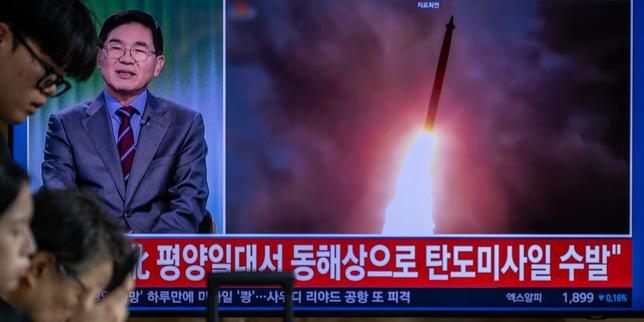
When Pyongyang announces tests of submarine-launched strategic cruise missiles, most headlines treat it like a routine replay of North Korean saber-rattling. Honestly, that misses the point.
A cruise missile flying low over the water doesn't look as dramatic on radar as a high-arcing ballistic missile. Yet in the hands of a submarine crew operating in the East Sea (Sea of Japan), those low-profile weapons complicate regional missile defense in ways that land-based launchers simply can't match. In October 2026, state media reported that North Korea test-fired two types of submarine-launched strategic cruise missiles off its east coast, pointing to an effort to test underwater combat readiness and refine strategic strike skills.
Look closer at what happens when you pair a stealthier flight path with a mobile underwater platform. Radar horizons limit how early coastal or shipboard sensors spot a terrain-hugging or sea-skimming missile. Even when Pyongyang's claims need cautious verification, the strategic logic behind these launches is clear enough: make retaliatory options harder to track, harder to intercept before launch, and harder to ignore.
Why Submarine Cruise Missile Tests Matter Beyond Headlines
Standard news recaps usually stop at the official statement from the Korean Central News Agency (KCNA) and a brief note on regional tensions. That leaves out the operational trade-offs that defense analysts actually argue over.
First, there's a big difference between launching a cruise missile from a fixed coastal site, a surface ship, or a submarine. Land launchers can be watched by satellites and targeted early in a crisis. Surface vessels face heavy air and naval surveillance. A submarine, by contrast, buys time and ambiguity—even if North Korea's diesel-electric fleet faces real acoustic, endurance, and anti-submarine hurdles compared with top-tier naval powers.
Second, "strategic" in Pyongyang's vocabulary signals potential nuclear delivery rather than just conventional punch. Analysts who track North Korean systems—such as the Pulhwasal-3-31 family tested in 2024 and earlier Hwasal-series cruise missiles—have long noted how cruise missiles fit into a broader theater and regional strike toolkit alongside ballistic missiles. Depending on the specific variant and flight profile, ranges discussed by analysts for North Korean strategic cruise missiles generally span roughly 1,500 to 2,000 kilometers, a band that puts targets across South Korea and key bases in Japan within theoretical reach.
Let's be real, though. A test announcement doesn't automatically equal a battle-ready, mass-produced underwater force. Observers frequently distinguish between a successful test firing, a "mobilized posture" drill, and sustained wartime operations under active anti-submarine pressure.
How Cruise Missiles Differ From Ballistic Missiles at Sea
People often lump all missile launches together, which creates unnecessary confusion when reading defense updates. Ballistic missiles arc high into space or the upper atmosphere before diving back down at high speed. Early-warning radars and space sensors are built to spot that bright signature and trace its trajectory fast.
Cruise missiles work more like small, unmanned aircraft flying a programmed route. Because they fly low to evade radar detection and can follow winding paths rather than a straight line, defenders may get less warning time and a trickier interception geometry. On the flip side, cruise missiles are typically subsonic rather than hypersonic-fast, meaning air defenses that do detect them early have a clear target profile to engage.
Putting that kind of weapon on a submarine adds another layer of complexity. Submarines have tight space constraints, complex launch and fire-control procedures, and strict safety rules around underwater operations. Getting two different cruise missile types to work reliably from a submarine platform is an engineering challenge, not a minor software patch.
What Analysts Watch When Pyongyang Claims Two Missile Types
Whenever state media highlights "two types" or "two kinds" of submarine-launched strategic cruise missiles in a single report, defense watchers look for a few concrete clues rather than taking every adjective at face value:
- Platform clues in released imagery: Analysts inspect photographs and video stills for hull markings, fairings, or deck details to see whether a converted submarine—such as the boat widely discussed in reporting around the Hero Kim Kun Ok—was involved.
- Flight duration and routing: Past cruise missile reports have sometimes cited flight times exceeding two hours over looping or elongated paths, which helps estimate endurance and guidance stability even when exact coordinates aren't published.
- Corroboration from neighboring militaries: South Korean, Japanese, and U.S. monitoring often provides independent context on launch detection, splashdown zones, or whether the test matched earlier patterns.
- Timing alongside broader drills or political signals: Launches rarely happen in a vacuum; they frequently line up with defense inspections, military anniversaries, weapons exhibitions, or diplomatic friction.
Common Misconceptions About North Korea's Underwater Force
One common mistake is assuming that any submarine missile test means North Korea has a stealth fleet roaming the Pacific undetected. In reality, North Korea's submarine fleet is largely composed of older and smaller diesel-electric boats, and analysts note that noisy propulsion, limited submerged endurance, and intense allied anti-submarine patrols in East Asian waters remain major constraints.
Another misconception is that cruise missiles are an "easy" shortcut compared to ballistic missiles. While cruise missiles don't require intercontinental re-entry heat shields, building reliable low-altitude guidance, terrain/sea-skimming navigation, and underwater launch canisters still takes years of trial and error. If a system were effortless, you wouldn't see repeated test cycles aimed at checking reliability and crew proficiency.
At the same time, underestimating the threat is just as risky as hyping it. Even a small number of submarine-launched strategic cruise missiles complicates defense planning in Seoul, Tokyo, and Washington. Defenders can't focus solely on high-altitude ballistic interceptors when low-flying threats could arrive from multiple directions.
Where Credible Information Comes From
If you want to follow developments around tests of submarine-launched strategic cruise missiles without getting lost in rumor mills, stick to primary and specialized sources. Official state dispatches from KCNA show how Pyongyang frames the mission and which officials or units it spotlights, while specialized trackers like NK News and policy institutes such as the Sejong Institute break down imagery, past launch histories, and strategic implications.
Broad international outlets like Al Jazeera and regional dailies such as the Korea JoongAng Daily help place a single launch inside the wider diplomatic and military calendar.
When a new report drops, check three things before sharing or reacting: what is confirmed versus claimed, which launch platform is actually indicated, and whether neighboring militaries reported matching detection details. That simple habit keeps you grounded when headlines get loud.