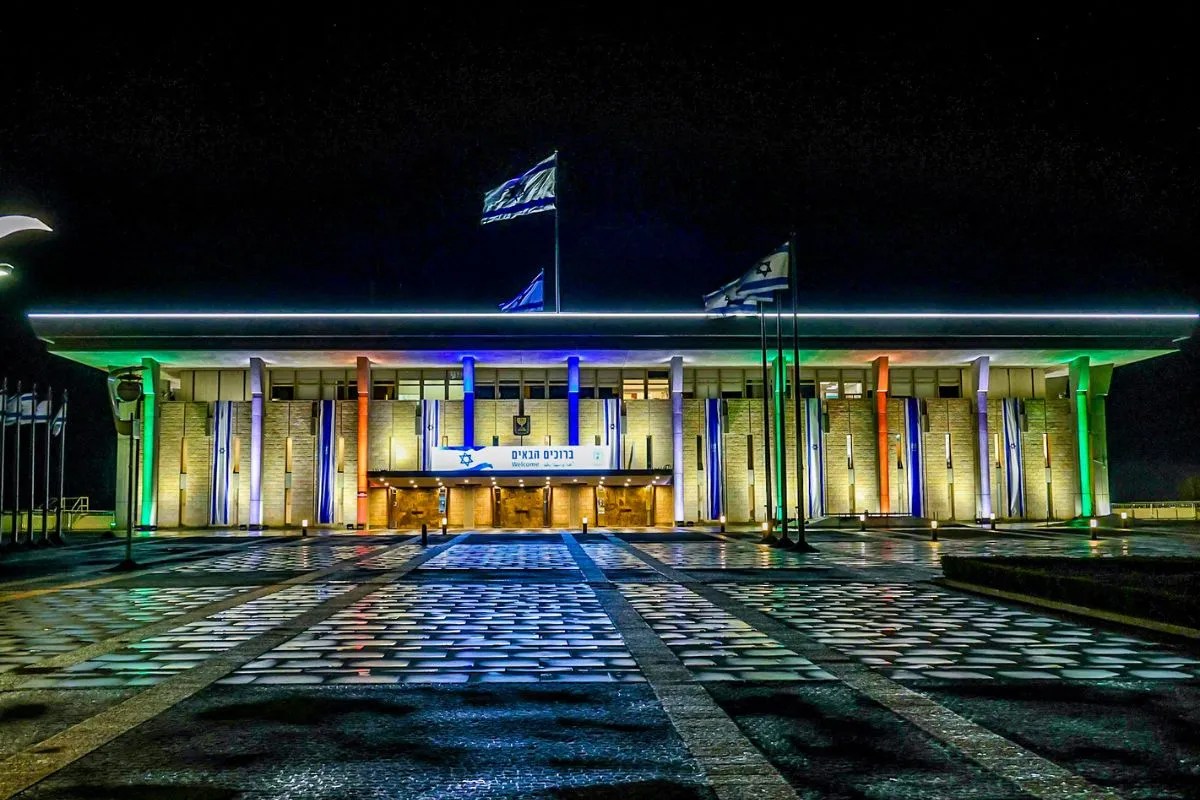
The air inside the Knesset doesn't smell like history. It smells like stale coffee and the electric hum of air conditioning units struggling against the Jerusalem sun. But on the day the vote came down, the atmosphere felt heavy, as if the oxygen itself had been replaced by the weight of a thousand years of grief. Lawmakers sat in their leather chairs, some leaning forward with teeth bared in conviction, others slumped with the look of people who knew exactly what kind of door they were about to kick open.
When the tally was finalized, the room didn't erupt in cheers. It vibrated with a grim, jagged energy. Israel had just moved a step closer to reviving the death penalty for Palestinians convicted of "nationalistically motivated" fatal attacks.
To understand why this matters, you have to look past the ink on the parchment and into the eyes of a mother in Hebron or a father in Tel Aviv. For decades, the death penalty in Israel has been a ghost. It existed on the books, a relic used only once for a monster named Adolf Eichmann in 1962. Now, that ghost has been summoned back to the dinner table. It is no longer a theoretical deterrent. It is a legal reality that threatens to change the molecular structure of the conflict.
The Weight of a Vote
Consider a hypothetical young man named Elias. He grows up in a landscape where every checkpoint is a reminder of his lack of agency. He sees the world through a lens of resistance, shaped by stories of ancestors and the immediate reality of occupation. On the other side, consider a woman named Sarah, who takes the bus to work every morning, her thumb hovering over an emergency app on her phone because the fear of a knife or a bomb isn't a political talking point—it’s her daily commute.
The new law targets the actions that bridge these two lives in the most violent way possible. It dictates that those who kill Israeli citizens with the intent to harm the state will no longer face a life behind bars. They will face the end of their breath.
Proponents of the law, led by figures like Itamar Ben-Gvir, argue that the current system is a "revolving door." They speak of "luxury" prisons where militants earn degrees and wait for the next prisoner exchange to walk free as heroes. To them, the noose is a matter of basic justice. They believe that if you take a life in the name of a cause, you forfeit your right to see the sun rise. It is an argument built on the bedrock of "eye for an eye," a logic as old as the hills surrounding the Holy City.
But justice is rarely a straight line. Often, it is a circle that traps everyone inside it.
The Martyrdom Paradox
The problem with the death penalty in a theater of religious and nationalistic fervor is that it often achieves the exact opposite of its intended goal. Security experts—men who have spent their lives in the dark corners of intelligence gathering—have voiced a terrifying concern.
When you execute a prisoner in a standard criminal case, the story usually ends. When you execute a militant in this conflict, the story is just beginning.
Execution creates a permanent icon. A prisoner in a cell is a man who can age, who can grow old and perhaps even change his mind. A man who dies at the hands of the state becomes a name that is shouted in the streets of Ramallah and Nablus, a martyr whose face is plastered on every wall.
The deterrence argument collapses when your enemy doesn't value their life as much as their legacy. In a world where martyrdom is prized, the noose is not a threat. It is a promotion.
This isn't just theory. Look at history. It is a long, bloody map of how the state’s violence often breeds a new generation of resentment that can't be quenched. The death penalty, instead of ending a cycle, feeds it.
The Fragile Legality of an Unending Conflict
The law, while passed in its preliminary stages, is far from being a simple decree. It is a legal landmine. For decades, the Israeli Supreme Court has been the gatekeeper of a delicate balance between security and the rule of law. This new legislation is designed to bypass that balance, to push through a political agenda in the name of safety.
International law is even more unforgiving. There are rules for how a country can treat those it occupies, even those who commit the most heinous crimes. The death penalty for Palestinians in Israel has long been an taboo, precisely because it opens a Pandora’s box of legal and ethical questions that no one is truly ready to answer.
What happens when a soldier is captured by the other side? If Israel executes Palestinian prisoners, what will happen to the next Israeli captive? The unspoken "rules" of this brutal game have always relied on a certain level of restraint. When that restraint is gone, what remains is a war without end and a justice system that looks more like a battlefield than a courtroom.
The Silent Gaps in the Room
When the news of the law broke, the reactions were predictable. The far-right celebrated a victory for "national pride." The left cried out in despair. But the most important voices are the ones that aren't shouting.
They are the families of the victims. For some, the death penalty is the only way to feel that the life taken from them was truly valued. For others, it is a hollow victory that won't bring their children back and will only ensure that more children—on both sides—will follow them into the ground.
There is a quiet, haunting truth in this conflict: every act of state-sanctioned violence is a stone thrown into a pond. The ripples go on forever.
The law is more than a piece of legislation. It is a signal. It is Israel telling the world—and itself—that the time for nuance is over. It is a declaration that the only language left to speak is the language of finality.
But finality is a dangerous word in a land that has seen empires rise and fall, and where every "final" solution has only led to more questions.
The noose is not a solution. It is a mirror. It reflects a society that is so exhausted by loss that it is willing to sacrifice its own legal soul for a moment of perceived strength.
As the sun sets over Jerusalem, the light hits the stone walls of the Knesset, turning them a deep, blood-orange. The lawmakers have gone home. The protesters have cleared the streets. But the law remains, a silent, growing shadow that stretches across the landscape, waiting for the first neck to feel the rope.
The silence that follows isn't peace. It's the sound of a breath being held.
Would you like me to create an image of the Knesset at sunset or perhaps a conceptual diagram of the legal pathways this law must navigate to become final?