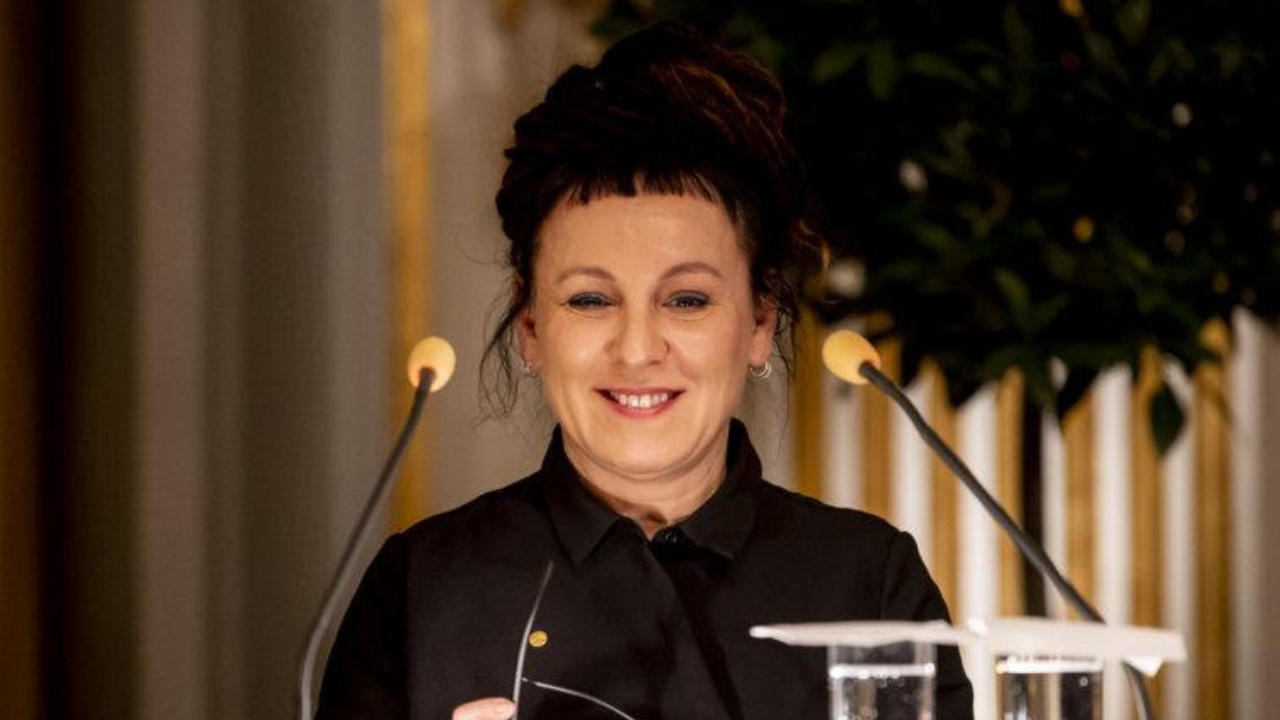
Olga Tokarczuk, the Polish Nobel laureate often celebrated for her intricate, mythological prose, recently sparked a firestorm by admitting she uses large language models to brainstorm and structure her literary work. The backlash was immediate. Purists accused her of outsourcing the soul of literature, while critics questioned the legitimacy of a Nobel win if the mind behind the words relies on a silicon crutch. But the outrage misses the point. Tokarczuk isn’t a lone outlier; she is the first person at her level of prestige to admit that the "solitary genius" is an obsolete myth.
The controversy began when Tokarczuk detailed her process of using AI to generate prompts, explore narrative pathways, and overcome the friction of the blank page. For a writer whose work, like The Books of Jacob, deals with the massive weight of history and the interconnectedness of human experience, the move to digital assistance feels like a betrayal to some. They want the sweat. They want the agony of the isolated creator. Instead, they got a technician.
The Industrialization of the Imagination
For decades, the publishing industry has clung to the image of the writer in a drafty room, fueled by nothing but coffee and conviction. This image sells books. It builds the brand of the "Great Author." However, the modern reality of high-volume, high-complexity intellectual production has been moving toward a collaborative model for years. Research assistants, ghostwriters, and sensitivity readers have long been part of the hidden machinery of the bestseller list.
Tokarczuk’s admission simply moves the collaboration from humans to software.
The friction here isn't about the quality of the output—few can argue that Tokarczuk’s prose has suffered—but about the source of the spark. If an algorithm suggests a metaphor that triggers a chapter, who owns the emotional resonance of that chapter? Critics argue that by using these tools, authors are training the very systems that will eventually replace them. They see it as a form of intellectual strip-mining.
The Polish Backlash and the Weight of Prestige
In Poland, Tokarczuk is more than a writer; she is a cultural lighthouse. Her Nobel win in 2018 was a moment of national validation. When she speaks, the weight of the Polish literary tradition—one forged through censorship, revolution, and deep philosophical inquiry—sits on her shoulders. This makes her pivot to AI feel like a cheapening of a hard-won legacy.
Local commentators have been particularly biting. There is a sense that the Nobel Prize carries an unspoken contract: we give you immortality, and in return, you provide us with something purely human. By breaking that contract, Tokarczuk has forced a confrontation with a reality that most people aren't ready to face. The reality is that the boundary between human thought and machine output is no longer a line. It’s a smudge.
Efficiency versus Artistry
The technical argument for AI in literature is one of efficiency. A writer can cycle through ten different plot directions in an afternoon, a process that might have previously taken weeks of journaling and dead ends. Tokarczuk frames this as an expansion of her toolkit. She views the AI as a mirror, reflecting her own ideas back to her in rearranged forms that she can then polish or discard.
But art has never been about efficiency.
Art is defined by its limitations. The struggle to find the right word, the "mot juste," is what gives a sentence its tension. When that struggle is bypassed, the resulting text often takes on a smooth, frictionless quality that can feel hollow. Even if Tokarczuk’s final drafts are hers alone, the DNA of the machine is present in the architecture of the story.
The Hidden Cost of the Algorithmic Prompt
When an author uses a model to "develop ideas," they are interacting with a statistical average of all the writing that came before. AI does not innovate; it predicts. It looks at the vast corpus of human literature and says, "Based on what exists, this is the most likely next step."
For a Nobel winner, whose job is ostensibly to push the boundaries of what is possible in language, relying on a system built on probability is a paradox. It risks creating a feedback loop where literature becomes increasingly derivative, echoing the structures that the AI has been fed. We are moving toward a world of "mid-century modern" fiction—perfectly shaped, aesthetically pleasing, but fundamentally safe.
The Ghost in the Machine is a Mirror
Tokarczuk’s defenders argue that the tool is no different than a dictionary, a thesaurus, or a search engine. They claim that the "moral panic" surrounding her process is rooted in a misunderstanding of how creativity works. No idea is truly original; we are all products of our influences.
If a writer reads a hundred books to get an idea for one, we call it "research." If a writer uses a machine that has read a billion books to get an idea, we call it "cheating."
The distinction is increasingly difficult to defend on purely logical grounds. However, the emotional distinction remains. Readers want to feel a connection to another human consciousness. They want to know that the person on the other end of the book suffered, doubted, and eventually triumphed. The moment you introduce an algorithm into that equation, the connection thins. The reader begins to wonder if they are being manipulated by an optimized emotional trigger rather than being moved by a genuine insight.
A New Class of Literary Technicians
We are seeing the birth of a new tier of creators. These are not writers in the traditional sense, nor are they mere "prompters." They are curators of machine-generated possibilities. Tokarczuk is at the vanguard of this shift, using her established reputation to experiment with the tech before it becomes the industry standard.
This shift will inevitably lead to a bifurcation of the market. On one side, we will have "High-AI" literature—hyper-complex, densely layered works produced by elite authors using sophisticated digital suites to manage thousands of narrative threads. On the other, we will see a "Handcrafted" movement—books marketed on the fact that no machine touched the manuscript.
The value of the "Handcrafted" label will skyrocket.
The Institutional Crisis
The Nobel Committee and other major literary bodies are now in a corner. They have no way to verify the "purity" of a text. There is no Turing test for a novel. If a writer submits a masterpiece that was 40% structured by an AI, does it still merit the highest honor in the world?
The Swedish Academy has historically been slow to react to technological shifts. It took them decades to acknowledge non-traditional forms like lyrics or investigative journalism. Now, they face a challenge that strikes at the core of their criteria: "the most outstanding work in an ideal direction." If the "direction" is dictated by an LLM, the "ideal" becomes a calculation.
The Brutal Truth of the New Era
The outrage over Olga Tokarczuk isn't actually about Olga Tokarczuk. It is a projection of our collective fear that the one thing we thought was uniquely ours—the ability to tell a story—is being mechanized. We see our own obsolescence in her workflow.
Tokarczuk is simply being honest about a transition that is happening across the entire creative spectrum. From Hollywood scripts to architectural blueprints, the human "creator" is becoming a supervisor. The backlash is a funeral for the romantic era of art, and Tokarczuk is the one who had the audacity to read the eulogy while the body was still warm.
The literary world now has to decide if it cares more about the process or the product. If the product is a masterpiece, does it matter if a GPU helped map the journey? For the purists, the answer will always be yes. For the next generation of writers, the answer will be a prompt.
The era of the solitary genius is over, and no amount of moral grandstanding will bring it back. The machine is in the library, and it has already started writing the next chapter. Stop looking for the soul in the ink and start looking for it in the choice.