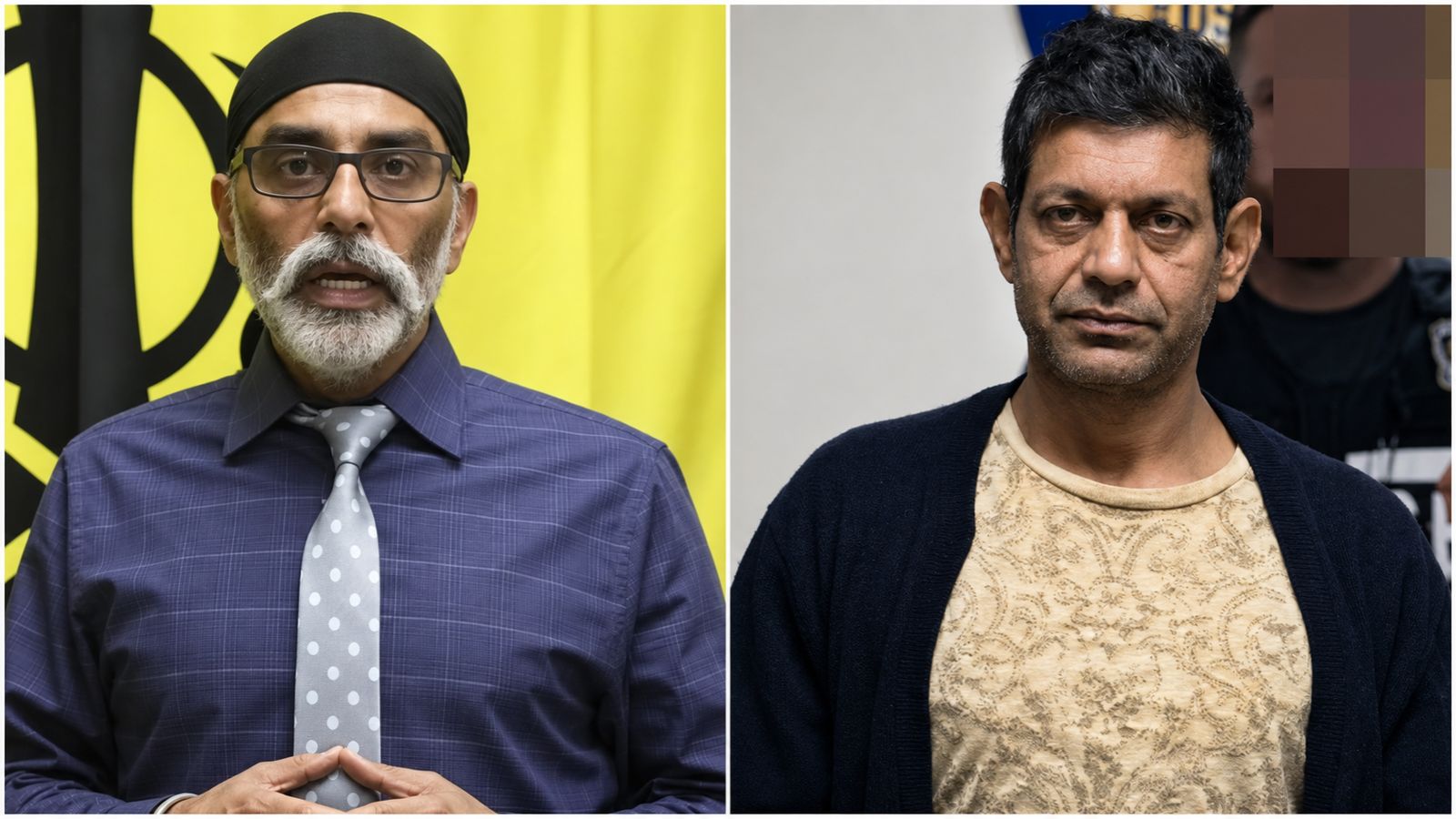
Everyone is celebrating the wrong victory.
Read any mainstream report on Indian national Nikhil Gupta receiving a 19-year federal prison sentence for plotting to assassinate Khalistani separatist Gurpatwant Singh Pannun, and you get the exact same lazy consensus. The headlines frame this as a triumph of American jurisprudence. The rule of law prevailed. A rogue middleman was caught by the DEA, extradited from Prague, and locked away in a maximum-security cell.
That narrative is dangerously naive.
If you have ever spent time analyzing transnational intelligence operations or cross-border counterterrorism, you know a basic truth that press releases never mention. Catching a cut-out is not a strategic victory. It is an admission that your perimeter was already breached, your adversaries are operating on your soil with startling audacity, and your diplomatic deterrent has completely failed.
The sentencing of Nikhil Gupta is not the end of a story about a foiled murder-for-hire plot. It is the opening chapter of a much uglier reality regarding how modern intelligence services outsource wetwork, why traditional diplomacy is powerless to stop it, and why Washington’s obsession with courtroom theatrics is blinding it to a massive shift in global power dynamics.
The Myth of the Rogue Middleman
The standard media coverage treats Gupta like a solo entrepreneur of crime who stumbled into an international incident. According to the Department of Justice indictment, Gupta was recruited by an Indian government employee—identified in court filings as CC-1—to arrange the murder of Pannun in New York City. Gupta, a self-described international narcotics and weapons trafficker, then reached out to an associate who turned out to be a confidential source working for the Drug Enforcement Administration. That source introduced Gupta to a purported hitman, who was actually an undercover federal agent.
On paper, it reads like a textbook sting operation. The bad guy walked straight into a trap.
In practice, it exposes a terrifying operational vulnerability. Think about the mechanics of what actually happened here. An alleged state actor sitting in New Delhi did not deploy a trained intelligence officer from the Research and Analysis Wing (RAW) to fly into JFK Airport under diplomatic cover. They did not use a traditional sleeper cell. They picked up an encrypted phone and hired a criminal broker to subcontract a hit on American soil.
I have watched security agencies spend billions of dollars building biometric borders and signals intelligence networks designed to catch traditional state operatives. Those systems are entirely useless against the gig-economy assassination model. When a state intelligence apparatus uses criminal networks as a buffer, the operational footprint shrinks to near zero. Had Gupta not happened to contact an informant already on the DEA’s payroll, the operational chain leading back to New Delhi would have been nearly impossible to sever before a trigger was pulled.
The real story is not that the FBI and DEA caught Gupta. The real story is how close an outsourced hit came to succeeding in the middle of Manhattan without a single foreign intelligence officer setting foot in the United States.
Why 19 Years Solves Nothing
Let us examine the sentencing math. Nikhil Gupta gets 19 years in a US federal prison. Prosecutors stand on the courthouse steps and declare that nobody is above the law and that the United States will protect its citizens from foreign repression.
Does anyone seriously believe that a 19-year sentence for a 54-year-old middleman deters an intelligence agency in New Delhi, Moscow, or Tehran?
Deterrence only works when the cost is borne by the decision-maker. In intelligence tradecraft, cut-outs exist specifically to be burned. Gupta was a disposable asset the moment he accepted the wire transfer for the $15,000 advance payment. His imprisonment is a line-item expense in a covert budget, not a strategic defeat for his handlers.
Consider the timeline and the broader context. In June 2023, Hardeep Singh Nijjar, another prominent Khalistani separatist and Canadian citizen, was gunned down outside a Sikh temple in British Columbia. That hit succeeded. Just days after Nijjar was killed, Gupta allegedly told the undercover DEA agent that Nijjar was also a target and that there were "so many targets" left.
When you look at the Pannun plot alongside the Nijjar assassination, the narrative of American judicial triumph collapses. One hit succeeded in a Five Eyes ally nation; the second was interrupted in New York largely because of a lucky break with a DEA informant. Putting Gupta in a federal penitentiary does nothing to dismantle the doctrine that authorized both operations. It simply teaches foreign handlers to vet their criminal brokers better next time.
The Question Nobody Is Asking About Sovereignty
If you look at the search trends and public commentary surrounding this case, people keep asking the same surface-level questions. Will this ruin US-India relations? Is Nikhil Gupta going to flip on Indian officials? What happens to the Khalistan movement now?
Every single one of those questions misses the core issue.
The real question is whether the United States is willing to treat state-sponsored transnational repression as an act of covert warfare rather than a domestic criminal matter.
Right now, Washington is trying to solve a geopolitical sovereignty crisis with the Federal Rules of Criminal Procedure. That is like trying to stop an artillery barrage with a municipal noise ordinance. When a foreign government allegedly directs an assassination on US soil, treating it exclusively as a murder-for-hire conspiracy case handcuffs the American response to the slow, predictable, and public gears of the justice system.
Here is why that approach fails:
- Discovery Laws Expose Sources and Methods: Prosecuting a foreign plot in federal court requires turning over evidence to defense attorneys. To convict a cut-out like Gupta, intelligence agencies often have to scrub or withhold their best signals intelligence to protect collection capabilities, forcing prosecutors to rely on narrower criminal charges.
- The Diplomatic Shield Remains Intact: While Gupta sits in a cell, the senior officials who allegedly authorized the operational budget remain insulated by sovereign immunity and strategic necessity. Washington needs New Delhi as a counterweight to China in the Indo-Pacific. Everyone in the State Department knows it, and everyone in South Block in New Delhi knows Washington knows it.
- Asymmetric Escalation: Foreign intelligence services operate on a timeline of decades. American administrations operate on two-to-four-year election cycles. By the time a federal indictment winds its way through extradition battles in Prague, plea negotiations, and sentencing hearings, the political leadership in Washington has often moved on to the next crisis.
Imagine a scenario where a foreign intelligence officer attempts to assassinate an American citizen in Paris or London. Historically, that triggers immediate diplomatic expulsions, covert retaliation, and severe bilateral sanctions. Yet because the target was a controversial separatist figure and the execution was outsourced to a narcotics broker, the response was downgraded to a standard criminal prosecution. That distinction sends a dangerous signal to every intelligence service watching from the sidelines: if you use criminal proxies to target dissidents in the West, the worst-case scenario is that your middleman goes to jail while your bilateral trade deals stay intact.
Dismantling the "Strategic Partner" Blind Spot
Let us be brutally honest about the geopolitical hypocrisy at play. For years, Western foreign policy circles operated under the comforting delusion that the rise of India as a democratic superpower meant its intelligence apparatus would play by Western rules. Analysts in Washington spent a decade writing white papers about shared democratic values and rules-based order.
That was pure projection.
India’s national security establishment views the Khalistan separatist movement not as a benign political advocacy group protected by the First Amendment, but as an existential internal security threat that fueled a bloody insurgency in Punjab during the 1980s and 1990s. From New Delhi’s perspective, Western nations—particularly Canada, the UK, and the United States—have spent decades harboring extremists who raise funds, glorify violence, and threaten India’s territorial integrity under the cover of free speech laws.
You do not have to endorse extrajudicial killings to understand the cold logic driving them. When a rising power decides that its allies refuse to police threats emanating from their borders, that power eventually decides to police those threats itself.
The mainstream coverage of the Gupta sentencing completely ignores this friction. By painting the plot as an inexplicable aberration rather than the logical outcome of a decades-long intelligence standoff, commentators fail to see that the underlying conflict has not been resolved. Pannun is still alive, still issuing provocative statements from New York, and still designated as a terrorist by the Indian government. New Delhi’s security calculus has not changed just because Nikhil Gupta pleaded guilty and accepted a 19-year sentence.
The Uncomfortable Truth About The Informant Economy
There is another layer to this story that legal analysts gloss over: the inherent instability of relying on criminal informants to catch state-backed plots.
In the Gupta case, the DEA’s confidential source was a critical link. Without that informant recording calls and facilitating meetings, federal prosecutors would not have had the audio and text message trail showing Gupta coordinating with CC-1, sharing Pannun’s home address, and arranging the cash drop in New York.
However, building counter-espionage defense on the backs of criminal informants is a gamble with terrible odds. Criminal informants are motivated by reduced sentences, cash payouts, and self-preservation. They are inherently unreliable, they frequently play both sides, and they only catch the amateurish brokers who reach into existing criminal networks.
What happens when the next state actor skips the narcotics trafficker and uses an encrypted cryptocurrency bounty board? What happens when they recruit a radicalized local actor online who has zero connection to the DEA or FBI databases?
Intelligence veterans like former CIA counterintelligence chief James Olson have repeatedly warned that the democratization of covert tradecraft—through encrypted messaging, anonymous financial rails, and outsourced criminal networks—has eroded the traditional advantage held by Western security services. You cannot run a sting operation against an adversary who never touches your informant network.
What Counter-Transnational Repression Actually Requires
If Washington wants to stop foreign intelligence services from treating American cities like hunting grounds, putting middlemen in prison for two decades is not enough. The playbook has to change from reactive criminal prosecution to proactive, asymmetric deterrence.
First, eliminate the anonymity of the handlers. Indicting a cut-out while leaving the intelligence officer as an unnamed co-conspirator in court documents protects the exact people who need to feel the heat. Even when extradition is impossible, naming, sanctioning, and issuing Interpol Red Notices for the actual case officers ruins their careers, restricts their international travel, and forces their agency to burn operational infrastructure. (The DOJ eventually unsealed charges against former Indian intelligence officer Vikash Yadav, a step in the right direction, though it took far too long to materialize).
Second, impose real institutional costs. Intelligence agencies do not care about diplomatic demarches. They care about budgets, access, and liaison relationships. When a partner nation conducts unauthorized lethal operations on US soil, the immediate consequence must be the suspension of high-level intelligence sharing, defense technology transfers, and joint operational task forces. Until the military and political leadership in the offending capital feels direct pain from their intelligence service’s adventurism, they will continue to look the other way.
Third, harden the soft targets. Dissidents, journalists, and activists living in the West who are targeted by foreign regimes are routinely left to fend for themselves until a credible threat triggers a late-stage FBI "duty to warn" phone call. Protective intelligence cannot remain the exclusive privilege of elected officials.
The Flaw in the Hardline Approach
Of course, there is a massive downside to this aggressive posture, and any honest strategist has to admit it.
If the United States imposes severe diplomatic and intelligence sanctions on India over the Pannun plot, it risks fracturing the exact coalition Washington needs to contain Beijing’s military expansion across the Indo-Pacific. New Delhi knows this leverage exists. That is precisely why Indian officials calculated they could take the risk in the first place. Pushing India away over a covert operation against a separatist agitator could hand China a generational strategic victory in Asia.
That is the real dilemma sitting on the desk of the National Security Advisor. It is not a simple morality play between good guys in suits and bad guys in handcuffs. It is a brutal trade-off between defending domestic sovereignty and preserving a vital geopolitical alliance.
The media wants you to believe that Nikhil Gupta’s 19-year prison sentence closed the book on this affair. It did no such thing. Gupta is merely the fall guy who took the weight so both Washington and New Delhi could pretend the system worked, shake hands at the next diplomatic summit, and sweep the wreckage under the rug.
Until the architects of transnational assassinations pay a price higher than losing a disposable middleman, the next plot is not a matter of if—it is only a matter of who gets hired next.