The air changes first. It loses its summer lightness, thickening into something heavy and metallic that sticks to the back of your throat. Out on the East China Sea, the water turns from a familiar blue to an unsettling, bruised purple.
When a typhoon bears down on the coast, the statistics hit the news tickers before the rain hits the pavement. We see the numbers scroll across the bottom of our screens: Typhoon Bavi, packing winds of over one hundred and fifty kilometers per hour, churning through the waves, threatening the dense, industrious hubs of eastern China. But a number like two million—the number of people ordered to pack what they could carry and leave—is too vast for the human brain to truly hold. It sounds like an abstraction. It sounds like a data point.
It is not a data point. It is the sound of two million front doors clicking shut at the same exact time.
Imagine standing in a small kitchen in Zhejiang province. Let us call the woman standing there Lin. She is not a statistic; she is a grandmother whose hands still smell of the scallions she was chopping for dinner before the emergency sirens cut through the evening air. Her television set is casting a blue glow across the linoleum, broadcasting the path of the storm. The red arrow on the map points directly at her life.
She has thirty minutes to decide what matters. The family photo albums? The deed to the small shop down the street? The winter coats?
This is the invisible reality of a mass evacuation. It is a sudden, enforced inventory of a human existence. When the government issues a directive that empties entire coastal cities, it sets off a quiet, chaotic choreography. Two million people do not move like water; they move like a fragile, frightened web of humanity, each thread pulling a lifetime of memories behind it.
The Anatomy of the Escalation
Typhoon Bavi did not arrive without warning, but modern meteorology can only soften the blow; it cannot stop the sky from falling. As the storm intensified over the warm waters of the Pacific, the barometric pressure dropped with terrifying speed. In weather stations across Beijing and Shanghai, meteorologists watched the satellite imagery capture a perfectly defined, malevolent eye.
The threat was clear. Eastern China is the economic engine of the nation, a dense network of high-tech factories, ancient farming villages, and massive shipping ports. A direct hit from a storm of this magnitude does not just knock out power lines; it threatens to rewrite the geography of the coastline. Coastal defenses, built to withstand ordinary seasons, face an existential test when a storm surge arrives at high tide.
But the real problem lies elsewhere, far from the high-tech operations centers. It rests in the logistics of the exodus.
Moving a population the size of a small European country requires an immediate, total mobilization of human resources. Railway schedules are rewritten in minutes. Fishing fleets—thousands of wooden and steel vessels bobbing in the harbors—must be anchored, tied down, or dragged inland. Construction sites, usually humming with the sound of cranes and jackhammers, fall completely silent as workers are bussed to inland shelters.
Consider what happens next to someone like Lin. She steps out into the rain, holding her grandson’s hand. The wind is already beginning to howl through the narrow alleys, a high-pitched whistle that vibrates in the teeth. The streets are a river of red taillights. Buses, chartered by local municipalities, line up at neighborhood squares. Volunteers in bright orange vests shout over the rising gale, directing the elderly, the children, and the infirm into temporary transport.
There is no dignity in a mass evacuation, only survival.
The Weight of the Water
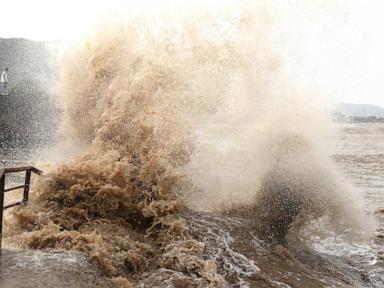
We often measure storms by their wind speed, but it is the water that breaks a community's spirit. Typhoon Bavi brought a deluge that turned small streams into raging torrents within hours. The ground, already saturated by a wet summer, could simply hold no more.
When the rain falls that hard, the world loses its boundaries. The sky and the earth blur into a single, gray sheet. For those waiting in the makeshift shelters—transformed gymnasiums, school auditoriums, and local government buildings—the sound of that rain against the corrugated metal roofs becomes a psychological assault. It is a relentless, drumming reminder of everything they left behind.
In the shelters, the air grows warm and crowded. Thousands of strangers sit shoulder to shoulder on green cot mats. The atmosphere is a strange mix of anxiety and forced camaraderie. People share thermoses of hot tea and instant noodles. Strangers watch each other's children.
Yet, beneath the quiet chatter, the same question haunts everyone in the room: What will be left when the water recedes?
For a farmer along the coastal plains, a storm like Bavi can erase a year's income in an afternoon. The saltwater surge poisons the soil; the fierce winds snap the stalks of rice and wash away the topsoil. For the small business owner, the water ruins inventory, warps floors, and destroys machinery that took a decade to pay off. The economic toll is measured in billions of yuan, but the human toll is paid in sleepless nights and grey hair.
The Aftermath and the Return
The transition from crisis to recovery is never clean. A typhoon does not simply disappear; it weakens, breaks apart, and leaves behind a wet, splintered silence.
When the evacuation orders are finally lifted, the journey home is marked by apprehension. The buses roll back through streets littered with uprooted trees, shattered glass, and the tangled remnants of aluminum signs. The water has left a thick coat of brown mud over everything it touched.
Lin returns to her kitchen. The water rose to the second step of her stoop but did not breach the doorway. She is one of the lucky ones. Others down the street find their roofs peeled back like tin cans, their living rooms filled with river silt.
The news reports will soon move on to the next headline, concluding their coverage with a summary of the structural damage and the efficiency of the response. They will praise the fact that, despite the fury of Typhoon Bavi, the loss of life was kept to an absolute minimum because of the massive, preemptive evacuation.
That efficiency is a triumph of organization, certainly. But the true story of Typhoon Bavi is found in the resilience of those two million individuals who walked away from their homes in the dark, carrying only what they loved, and then walked back to rebuild what they lost.