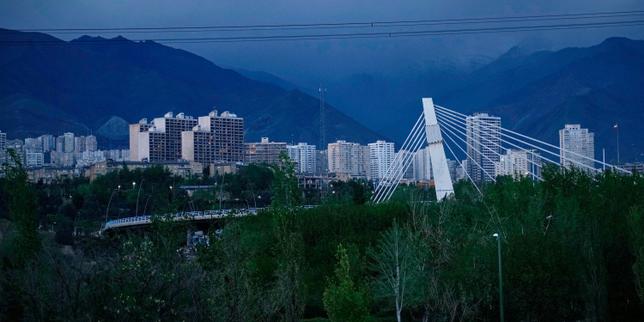
The hum of a refrigerator is a comforting sound until the rest of the world goes silent. In the early hours of a Friday in Tehran, that hum was the only thing keeping Farrah company. She sat in her kitchen, the tiles cold beneath her feet, clutching a glass of water that she hadn't actually sipped in twenty minutes. Outside, the sky was a bruised purple, the kind of color that usually promises a quiet dawn. But the air felt heavy, charged with the static electricity of a city holding its breath.
Then came the sound. It wasn't the roar of a jet or the whistle of a falling shell. It was a rhythmic, mechanical thrumming—the sound of drones.
News reports would later describe the scene with clinical detachment. They would use phrases like "air defense activation" and "situation normal." They would report that drones were intercepted near Isfahan and that Tehran remained "calm." But calm is a relative term when you are staring at a ceiling, wondering if the glass in your windows is about to become a thousand jagged needles.
The Illusion of the Ordinary
By 7:00 AM, the official narrative had solidified. The state media broadcasted images of flowing traffic. Reporters stood on street corners, gesturing to the mundane sight of people buying bread and taxis honking at intersections. "Everything is normal," they insisted.
To the outside observer, it was a victory of resilience. To those living inside the circle, it was a surreal performance.
Imagine a stage where the actors are told the theater is on fire, but they must continue performing a comedy. That is the psychological weight of a "normal" day in a tinderbox. The facts are straightforward: air defenses were triggered, several small drones were downed, and no major damage was reported. Yet, the human reality is a fractured mosaic. The "normalcy" reported by news agencies is a thin veneer stretched over a deep, collective exhaustion.
When the government announces that the situation is stable, they are talking about infrastructure. They are talking about the fact that the power stayed on and the runways at Imam Khomeini International Airport reopened after a brief, frantic closure. They aren't talking about the mother in Isfahan who spent three hours huddled in a hallway with her children, telling them the loud bangs were just "spring thunder."
The drones—described as small, almost hobbyist-grade quadcopters—were not designed to level buildings. Their purpose was different. They were probes, both physical and psychological. They were questions sent into the night, asking how fast the defenses would react and how much the populace could endure before the "normal" mask slipped.
The Geography of Anxiety
Distance in the Middle East is measured in more than kilometers. It is measured in the reach of a missile and the flight time of a drone. When explosions were reported near a military base in Isfahan, the shockwaves traveled instantly to Tehran, Tabriz, and beyond.
Isfahan is the heart of Iran’s nuclear research and its industrial soul. It is a city of turquoise domes and ancient bridges. To see it become a coordinate on a target map changes the way a citizen looks at their own backyard.
Consider a hypothetical shopkeeper in the Isfahan bazaar, let’s call him Reza. For Reza, the news that "no damage occurred" is good for his inventory, but it does nothing for his peace of mind. He still has to open his doors. He still has to haggle over the price of saffron and silk. But every time a motorbike backfires in the street, his heart skips. The geopolitical chess match between Isfahan, Tehran, and Jerusalem isn't played on a wooden board; it's played across Reza’s nervous system.
The technical experts will tell you that the drones were likely launched from within Iranian borders. They will debate the efficacy of the S-300 surface-to-air missile systems. They will analyze the "tit-for-tat" nature of the strikes following the massive drone and missile barrage launched by Iran against Israel days earlier.
But the real story isn't the hardware. It’s the silence.
The Cost of the Unsaid
There is a specific kind of fatigue that comes from living in a state of permanent "almost."
For decades, the shadow war was fought in the dark. It was cyberattacks on cooling systems, mysterious disappearances of scientists, and "industrial accidents" at remote facilities. Now, the war has stepped into the light. When the sky lights up over a major city, the ambiguity vanishes.
The strategy of "strategic ambiguity" used by governments is a luxury that civilians cannot afford. While diplomats choose their words carefully to avoid escalation, the people on the ground are left to decode the subtext. If the drones were small, does that mean the threat is over, or does it mean the next one will be larger? If the city is "normal," why are the grocery store shelves suddenly a little bit emptier as people quietly stock up on rice and oil?
This isn't just about a single night in April. It’s about the cumulative weight of the unknown.
In the West, we often view these events through the lens of a tactical briefing. We see maps with red arrows. We hear analysts talk about "deterrence signals" and "proportionality." These words are a way of distancing ourselves from the visceral reality. They turn a terrifying night of uncertainty into a logic puzzle.
But for the person sitting in that kitchen in Tehran, proportionality is a meaningless concept. There is no such thing as a "proportional" threat to your home. There is only the presence of fear or the absence of it.
The Persistence of Life
Despite the tension, the city moved.
By mid-morning, the parks in Tehran were filling up. It was a Friday, the weekend in Iran. Families spread carpets for picnics. Men played chess in the shade of plane trees. To a casual tourist, it would look like a postcard of tranquility.
This is the most haunting part of the narrative: how quickly humans adapt to the unthinkable. We are a species that can learn to eat lunch while the horizon glows. We can learn to ignore the sirens if they happen often enough.
But this adaptation comes at a price. It requires a hardening of the heart. It requires a person to stop planning for next year and start planning for next hour. When a society begins to live in the "next hour," the foundations of everything—economy, education, family—start to fray.
The "situation normal" headline is perhaps the greatest lie of modern conflict. It suggests that as long as the buildings are standing, the people are fine. It ignores the invisible scars. It ignores the fact that a generation of children is growing up knowing the difference between the sound of an outgoing interceptor and an incoming strike.
The Empty Sky
As evening returned to Tehran, the state media shifted its focus. The narrative moved to the "failure" of the intruders and the "power" of the state. The drones were dismissed as toys. The tension was laughed off.
But as the sun dipped behind the Alborz mountains, the residents of the city didn't just go back to their lives. They watched the sky. They checked their phones. They looked at their neighbors with a new, unspoken understanding.
The drones were gone, but they had left something behind. They left the realization that the wall between "normal life" and "total war" is as thin as a pane of glass.
Farrah is back in her kitchen. The refrigerator is still humming. She has finally finished her glass of water. She looks at her reflection in the window and wonders if the sky will stay dark tonight, or if it will turn that terrible, artificial bright again.
The city is quiet. The streets are clear. The official report says the situation is normal.
But in the silence of the night, every hum sounds like a heartbeat, and every shadow looks like a wing.



