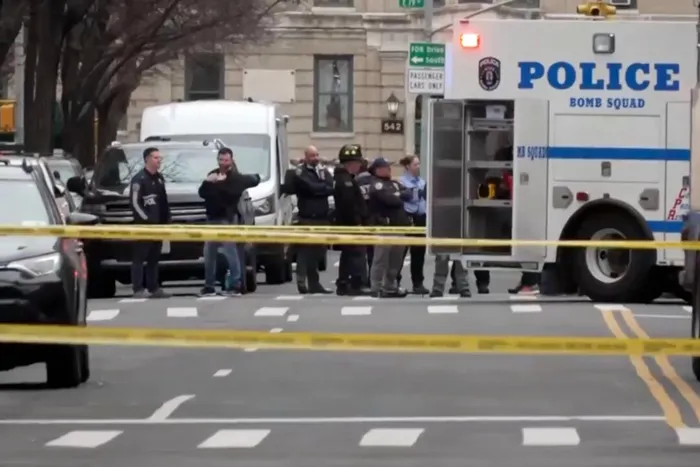
The air in the Upper East Side usually smells of expensive laundry detergent and the faint, metallic tang of the Second Avenue Subway. It is a neighborhood defined by its quietude, a place where the chaos of New York City goes to sleep behind limestone facades and doormen in white gloves. But on a Tuesday night outside the home of Assemblymember Zohran Mamdani, the silence didn’t just break. It disintegrated.
There is a specific sound a city makes when it is on edge. It’s the low hum of a refrigerator in a dark kitchen, the sound of a spring stretched too tight. For weeks, the sidewalk outside the Mayor-elect’s residence had been a stage for the raw, jagged friction of modern American life. Protesters and counter-protesters occupied the same few slabs of concrete, separated by little more than a thin blue line of police tape and a widening chasm of mutual exhaustion.
Then came the flash.
It wasn't a firework. It wasn't the festive pop of a celebratory cracker or the harmless bang of a prankster. When the device landed near the feet of those gathered, it carried the weight of something much darker. The New York Police Department would later use three clinical, terrifying letters to describe it: IED. An Improvised Explosive Device.
The Anatomy of a Threat
To the casual observer, an IED sounds like a relic of a distant battlefield, something encountered in a dusty valley in a different hemisphere. But when the NYPD’s Bomb Squad arrived to sift through the debris on that sidewalk, the reality was much closer to home.
A standard firework is designed to go up. It wants to be light, to be color, to be a momentary distraction in the sky. An IED is designed to go out. It is built with the singular intent of pushing pressure and heat into the space where people stand. By definition, an improvised explosive device uses non-military components—often household items, hardware store scraps, and volatile chemicals—to create a blast that is unpredictable and lethal.
The device thrown near Mamdani’s home wasn't just "big." It was sophisticated enough to be classified as a weapon of terror. It represents a shift from the performative noise of protest to the visceral reality of political violence. When a device is categorized this way by the Arson and Explosion Squad, it means the investigators found a deliberate initiation system—a way to make it blow up exactly when and where the person throwing it intended.
The Invisible Stakes of a Neighborhood
Imagine you are a neighbor three doors down. You are washing dishes or putting a toddler to bed. You hear the blast. For a split second, you think it’s a transformer blowing or a heavy truck hitting a pothole. But then the sirens start. They don't stop for hours.
The stakes of this incident aren't just found in the criminal statutes or the police reports. They are found in the sudden, sharp realization that the "front lines" are no longer somewhere else. They are on your doorstep. For Zohran Mamdani, a man who transitioned from the world of rap and film to the gritted-teeth reality of Albany politics, the threat is a literal invasion of his private sanctuary.
But the ripple effect moves further than the target.
It touches the delivery driver who has to pull over because the street is suddenly a crime scene. It touches the police officer who has to approach a suspicious bag with the knowledge that it might contain a pressure cooker or a pipe bomb. It touches the very idea of what it means to disagree in public.
We have entered an era where the "heckler’s veto" has been replaced by something far more explosive. Protesting is a fundamental American right, a messy, loud, and necessary part of our civic plumbing. But an IED is not a protest. It is a monologue delivered with a detonator. It is an attempt to end the conversation by removing the speakers from the room.
The Mechanics of Fear
Why do we care about the "improvised" nature of the device? Because it reflects a DIY radicalization that is harder to track than any organized cell.
- Accessibility: The ingredients for a low-level IED are sitting in the cleaning aisle of your local supermarket.
- Volatility: Because they are handmade, these devices are notoriously unstable. They are as much a danger to the person carrying them as they are to the target.
- Intent: You don't "accidentally" build an IED. It requires research, assembly, and a conscious decision to cross a line from speech to shrapnel.
The NYPD’s confirmation that this was a functional explosive changes the narrative from a "skirmish between protesters" to a federal-level investigation. The Bureau of Alcohol, Tobacco, Firearms and Explosives (ATF) doesn't get involved for a firecracker. They get involved when the chemistry of a neighborhood is being altered by gunpowder and malice.
The Human Cost of the New Normal
Consider the psychology of the people on that sidewalk. On one side, you have protesters advocating for a shift in city leadership, driven by a belief that the current path is unsustainable. On the other, counter-protesters who see those very actions as a threat to the stability of their city.
In the middle sits the Mayor-elect.
When a bomb is thrown at a politician's home, the intended victim isn't just the individual. It’s the institution. It’s the idea that we can elect someone and then hold them accountable through votes, letters, and peaceful assembly. When the IED enters the equation, the goal is to make the cost of public service too high to pay. It’s a tax on participation, paid in the currency of fear.
The investigation is ongoing, and the footage from the dozens of Ring cameras and NYPD "Argus" units is being scrubbed frame by frame. They are looking for a silhouette, a flick of a wrist, a person in a hoodie who thought that their anger justified a blast radius.
The Last Echo
The yellow tape will eventually be rolled up. The soot on the pavement will be washed away by a morning rain or a sanitation crew. Mamdani will continue his work, and the protesters will likely return, perhaps with more caution or perhaps with more fire in their bellies.
But the neighborhood has changed. You can feel it in the way people walk a little faster past the barricades. You can hear it in the way the conversation shifts when the word "IED" is mentioned—a word that used to belong to war correspondents and history books, now settled firmly into the lexicon of a New York City Tuesday.
The real danger isn't just the blast itself. It's the silence that follows. It's the moment we stop being shocked that someone tried to blow up a piece of the city to make a point. It’s the slow, steady hardening of the heart that happens when we realize the sidewalk isn't just a place to walk anymore. It’s a place to watch your step.
The city continues to hum, but the frequency has shifted. We are all waiting for the next sound, hoping it’s just the wind, yet knowing exactly how easily the silence can be torn apart.