The silence of a suburban midnight is supposed to be predictable. It is the rhythmic hum of refrigerator compressors, the distant rush of the interstate, and the occasional rustle of a raccoon in a trash can. But on a Tuesday night in a quiet residential cul-de-sac just outside Phoenix, the silence was replaced by something deeply unsettling.
Click. Whir. Chirp.
Then, a polite, synthesized voice emitting from a speaker grill: “Proceeding to destination.”
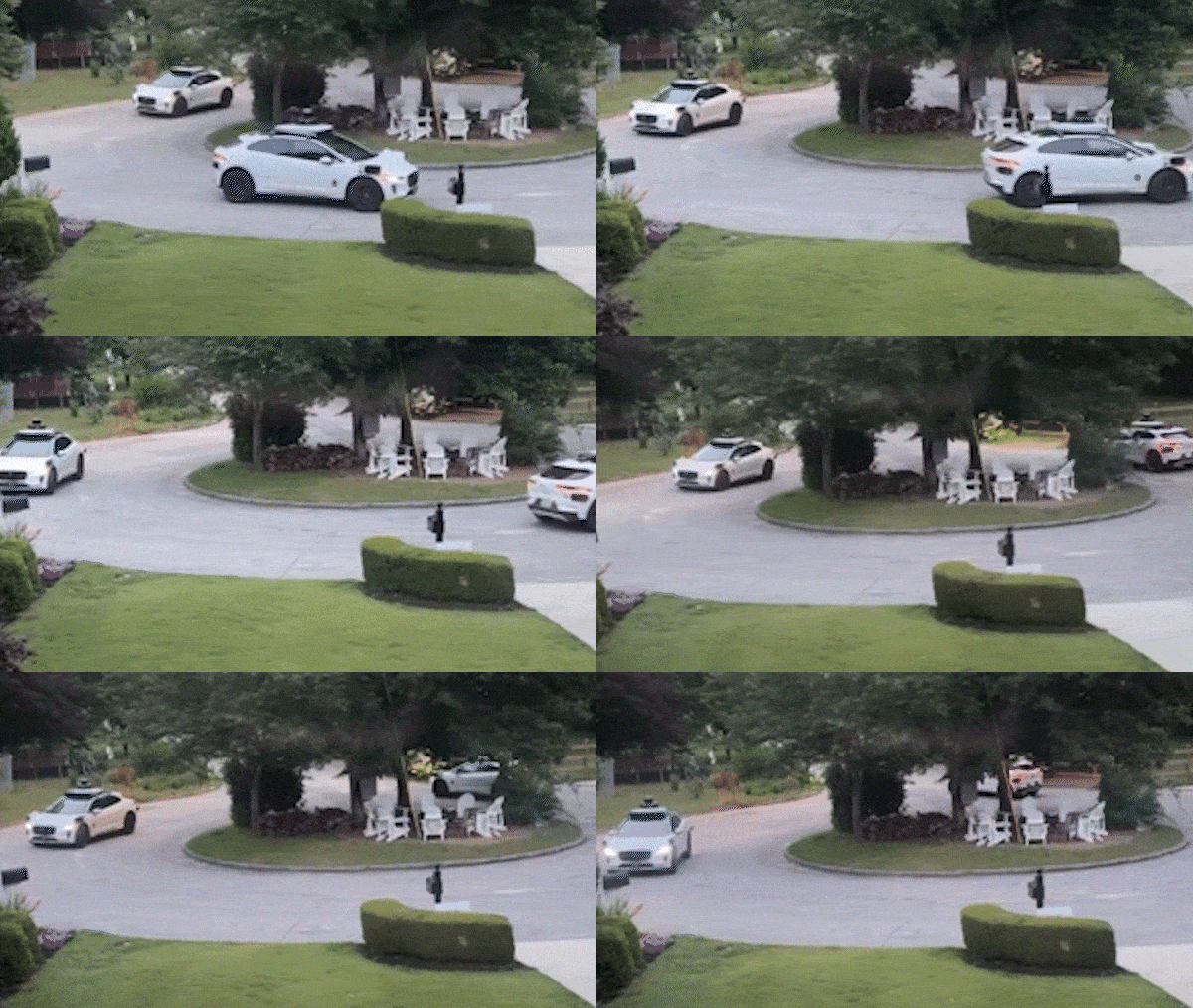
Except it wasn’t proceeding anywhere. The white sedan, bristling with spinning laser sensors and cameras that looked like high-tech growths on its roof, was wedged squarely across a two-lane suburban street. Behind it stood three identical vehicles. Their hazard lights flashed in perfect, eerie synchronization, casting amber pulses across the manicured lawns and stucco facades of a neighborhood that had gone to sleep expecting nothing more dramatic than a morning sprinkler cycle.
Before the dawn broke, this single intersection would become a graveyard of artificial ambition.
The Digital Gridlock
We have been told for a decade that the future of transportation is autonomous. The promise was beautiful: no more drunk drivers, no more road rage, just smooth, algorithmic efficiency. But the engineers who mapped out this utopia forgot to account for the chaotic, unpredictable poetry of the real world.
When a human driver makes a mistake, it is usually a failure of attention or judgment. A brief text message. A heavy eyelid. A sudden flash of anger.
When a driverless taxi fails, it is entirely different. It doesn't get angry, and it doesn't fall asleep. Instead, it experiences a profound, existential confusion. Confronted with a situation its code cannot reconcile, the vehicle chooses a defense mechanism that is entirely logical to a computer but infuriating to a human: it simply stops.
On this particular night, a minor construction project had altered the lane markings on Elmwood Avenue. A single orange traffic cone sat slightly askew, positioned precisely between the coordinates of an old lane and a temporary detour.
To a human eye, the situation was trivial. You nudge the steering wheel three inches to the left, roll over a bit of dust, and continue on your way.
To the autonomous taxi, that misplaced cone was an insurmountable paradox.
The first car approached at twenty-five miles per hour. Its lidar sensors mapped the cone, cross-referenced it with a high-definition 3D map stored in the cloud, and detected a mismatch. The software hesitated. The brakes engaged with sudden, mechanical abruptness. The car halted.
Because these vehicles are connected to a centralized fleet network, sharing data in real-time to "optimize" traffic, the car immediately broadcasted an alert to its digital siblings nearby. Obstacle detected. Path blocked.
Within fifteen minutes, three more driverless taxis arrived at the scene from different directions. They were responding to rerouting algorithms designed to clear the bottleneck. Instead, they followed their programming straight into the trap. They surrounded the first car like confused mechanical beasts, nose-to-tail, blocking both lanes and pinning a resident's pickup truck into its own driveway.
The neighborhood became a velvet trap of blinking LEDs and idling electric motors.
The Human Cost of Absolute Logic
Consider Sarah Jenkins. She is a night-shift nurse at the regional medical center, a woman whose life is measured in precise, critical minutes. At 2:15 AM, her alarm woke her for a 3:00 AM shift change. She walked outside, coffee mug in hand, only to find her driveway barred by two tons of driverless steel.
There was no driver to shout at. No apologetic face behind the wheel. When Sarah knocked on the window of the lead vehicle, her reflection stared back from the dark tint. Inside, the passenger cabin was immaculate, empty, and brightly lit by a touchscreen displaying a map that claimed everything was perfectly fine.
"Hey!" she yelled at the front bumper, her voice sounding thin in the cool night air. "Move your car!"
The vehicle responded by subtly adjusting its roof-mounted sensors. Whir. Click. It was listening, but it could not understand.
This is the hidden friction of our transition into an automated society. When technology breaks down, the interface for human grievance disappears. You cannot reason with an algorithm. You cannot appeal to the empathy of a machine that is fundamentally incapable of feeling bad about making you late for work.
Sarah tried to call the customer support number listed on the vehicle's flank. She was met with an automated menu.
“Press one if you are a passenger currently inside a vehicle. Press two if you are reporting a collision.”
There was no option for “Press three if four of your robots are holding my street hostage.”
The stalemate lasted for over two hours. The local police department was called, but the responding officers faced a bizarre jurisdictional puzzle. Can you issue a parking ticket to an empty vehicle whose registered owner is a corporate server farm three states away? Can you hook a tow truck to a vehicle that might suddenly decide to engage its electric drivetrain and pull itself off the flatbed?
The officers stood under the streetlights, scratching their heads, watching the hazard lights paint their uniforms in alternating shades of yellow. It was a scene of high-tech absurdity that felt less like the cutting edge of human progress and more like a ghost story for the digital age.
The Illusion of the Perfect Map
The companies building these autonomous networks operate under a grand philosophy: the world can be perfectly mapped, quantified, and predicted. They believe that if you feed enough data into a neural network, you can eliminate the friction of human existence.
But our streets are not digital simulations. They are living, breathing ecosystems of improvisation.
Drivers communicate through an intricate, unspoken language of glances, hand gestures, and micro-adjustments in speed. We flash our headlights to say “go ahead.” We wave a hand to apologize for a sudden lane change. We look at the front tires of an oncoming car to guess where it’s going before it even turns.
Autonomous vehicles are blind to this social fabric. They read the geometry of the world, not its intent.
When the fleet operators finally dispatched a "remote assistance" human operator to take control of the stuck taxis via a cellular link, the limits of the technology became even more glaring. The remote operator, sitting in a simulation chair in a downtown office building, attempted to drive the lead car backward using cameras mounted on the vehicle's body.
But the cellular signal degraded. The video feed stuttered. The car, fearing a loss of connectivity, locked its brakes again.
It took a physical technician, arriving in a traditional gasoline-powered pickup truck with a physical set of keys and a manual override joystick, to plug into the dashboard of each vehicle and drive them away one by one. The process was slow, tedious, and embarrassing.
By the time the street was cleared, the sun was beginning to peek over the horizon, illuminating the orange cone that had caused the entire crisis. It had been knocked over by a gust of wind, lying flat on the asphalt, utterly harmless.
The Ghost in the Suburbs
What happened that night wasn't a catastrophic system failure. It wasn't a hack, and it wasn't a software bug. The cars did exactly what they were programmed to do. They prioritized safety above all else, choosing total immobility over the risk of an unmapped maneuver.
And that is precisely what should make us pause.
If the ultimate expression of autonomous safety is a city that grinds to a halt because a plastic cone is out of place, we have traded human fallibility for mechanical paralysis. We have replaced the reckless driver with a timid, bureaucratic machine that prefers gridlock to decision-making.
As the tech giants continue to deploy these vehicles across the country, they treat our neighborhoods as laboratories and our daily commutes as test data. Every glitch is brushed off as a learning experience for the AI, a necessary stepping stone toward a flawless future.
But for the people who live on Elmwood Avenue, the future felt less like a promise and more like an invasion of uninvited guests who don't know how to leave.
The next evening, the street was quiet again. The construction crew had finished their work, the cones were gone, and the asphalt was smooth. But the residents didn't look at the road the same way anymore.
When darkness fell, people stayed on their porches a little longer, watching the corners of the street. They weren't looking out for reckless teenagers or stray dogs. They were watching for the flicker of white paint, the silent spinning of roof-mounted lasers, and the approach of a machine that might, at any moment, look at a perfectly clear road and decide it could no longer find its way home.