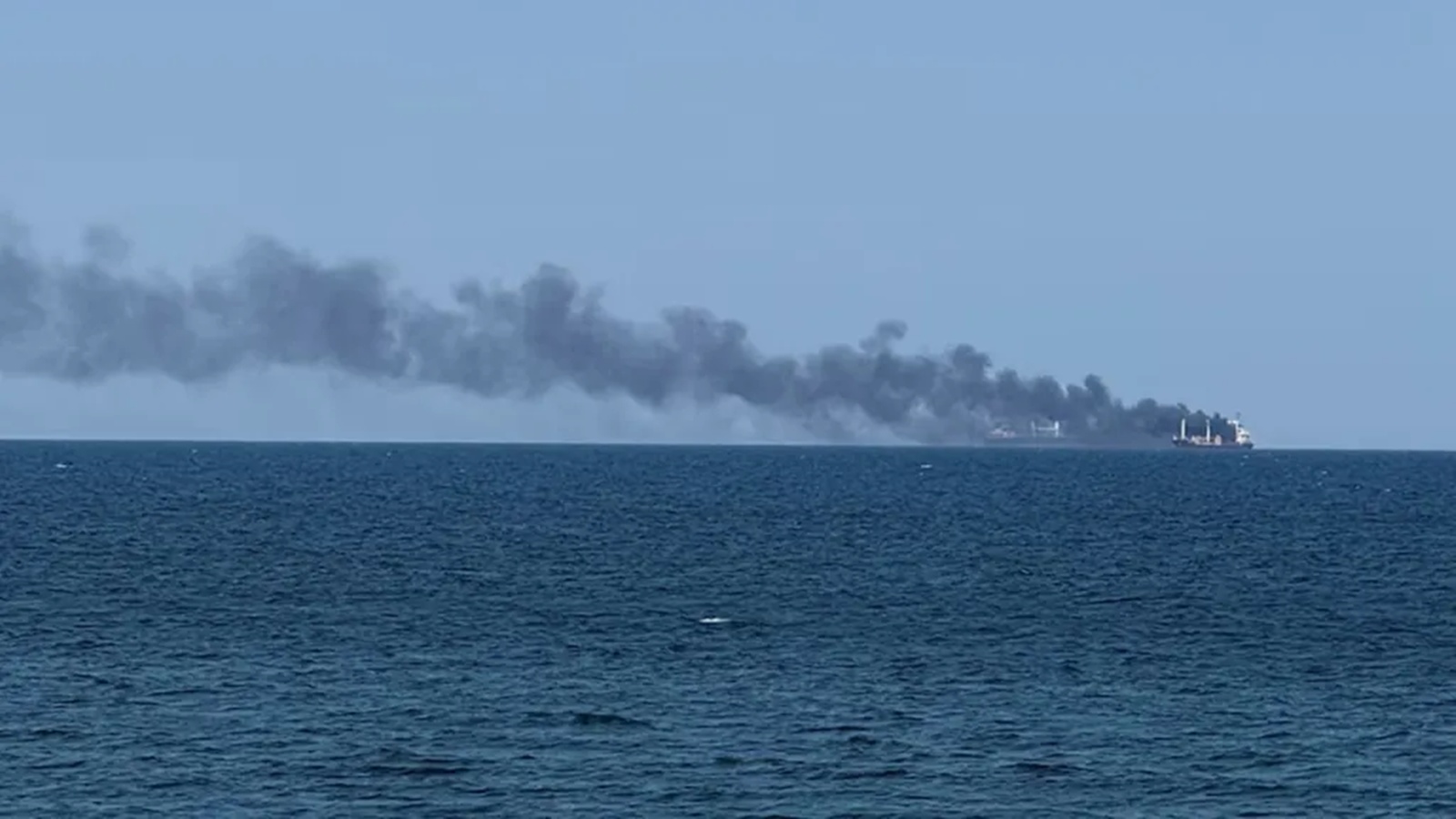
The sea does not care about geopolitics. It cares only about wind, depth, and the weight of what floats upon it. Yet for the fourteen souls aboard the MSV Faize Noore Oliya, the dark waters off the coast of Yemen became an arena of invisible threats, high-stakes survival, and a sudden, violent encounter that changed everything in a fraction of a second.
Picture the scene. It is another grueling shift on a commercial sailing vessel navigating the restless currents of the Red Sea. The air is thick with salt and the low hum of the engine. Sailors know this route by heart—the narrow corridors where global commerce pulses day and night. For the thirteen Indian nationals and one Yemeni crew member working on that deck, the journey was routine. Cargo to move. Distances to cross. Families waiting thousands of miles away in coastal towns across India, expecting a phone call when the port lights finally appeared.
Then came the flash.
There was no negotiation, no warning, no preamble. A projectile cut through the night sky and struck the civilian vessel with devastating precision.
Consider what happens next: the abrupt shriek of tearing metal, the shockwave vibrating through the soles of bare feet, the immediate panic of realization. Water begins to rush into the hold with terrifying speed. A ship that took months to build and years to master surrenders to gravity in minutes. The MSV Faize Noore Oliya began to list, capsize, and sink into the cold abyss roughly thirteen nautical miles south of Hodeidah.
In situations like this, time fractures. Seconds stretch into hours. To visualize the terror, imagine standing on a tilting deck as the horizon tilts violently sideways, the ocean rising to swallow the only safe ground you know. The crew had moments to make life-or-death choices. Abandoning ship into open water means facing the dark, unpredictable expanse of a conflict zone where civilian shipping has increasingly become collateral damage.
Rescue did not come from an abstract alliance or a distant government decree. It came from the Yemeni Coast Guard and joint naval units of the national resistance forces who cut through the dark waves to reach the sinking hull. Plucked from the water and brought safely to the Port of Mokha, the fourteen survivors carried with them the heavy silence of men who had just looked over the edge. Physical injuries were avoided, but the psychological toll of a peaceful livelihood turning into a warzone target is a different kind of wound entirely.
Back in New Delhi, the response was swift and sharp. Union Shipping Minister Sarbananda Sonowal took to public platforms to condemn what he termed an unprovoked attack on a defenseless commercial vessel. The Ministry of External Affairs echoed the outrage, emphasizing that free and unhindered navigation through international waterways remains non-negotiable. Behind the diplomatic statements and the coordination of the Indian Embassy in Riyadh, however, lies a deeper, more unsettling reality.
India supplies hundreds of thousands of active merchant seafarers to the global maritime workforce. These sailors are the unsung circulatory system of international trade, carrying everything from fuel to food across volatile global chokepoints. When a small sailing vessel is blasted beneath the waves near the Bab el-Mandeb strait or the Red Sea, the shockwaves are felt far beyond the hull's final resting place. It rattles every family kitchen table in Gujarat or Kerala where a son, father, or brother is currently out at sea.
The conflict lines in these waters have redrawn themselves with brutal indifference to civilian flags. As regional tensions expand and maritime trade routes transform into flashpoints, the margin for error shrinks to zero.
Out on the water, the surface closes over the wreckage of the Faize Noore Oliya, leaving behind only ripples, floating debris, and the quiet, persistent hum of a world economy that keeps moving regardless of who gets left behind in the dark.


