Power in Washington is rarely measured in volts or watts. It is measured in leverage that goes unseen until the exact moment it vanishes.
Walk through the corridors of the capital late at night, and you can smell the quiet panic of momentum shifting. The marble pillars do not shake when a deal collapses. Instead, the air simply grows heavy. Phones buzz silently against mahogany desks. Coffee goes cold in paper cups bearing congressional seals. Someone always has to blink first. For another look, read: this related article.
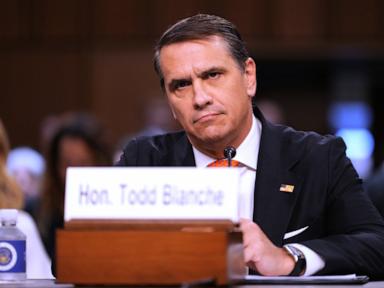
Todd Blanche found himself staring into that exact kind of darkness.
For weeks, the machinery of political alignment had been humming. Allies of Donald Trump were expecting financial backing, a steady stream of resources designed to anchor a high-stakes legislative defense. It was the kind of transactional architecture that Washington has relied on for generations. Money moves, loyalty locks in, and the wheels keep turning. Further coverage on this trend has been provided by NBC News.
Then, the Senate floor turned cold.
GOP senators, individuals whose votes were required to confirm Blanche for the high-profile position of attorney general, drew a hard line in the sand. They did not shout from the rooftops. They simply whispered a warning through the appropriate channels: Proceed with the funding distribution, and your confirmation process hits a wall from which it will never return.
Consider what happens next.
In the calculus of modern ambition, a nomination for attorney general is the ultimate prize. It is the crown jewel of legal power. Everything else—every political PAC, every allied campaign, every ideological war chest—is secondary fuel. When forced to choose between feeding the machine outside or securing the keys to the kingdom inside, the machine loses. Every single time.
Blanche acted swiftly. The funds were rescinded.
The announcement did not arrive with a dramatic press conference or an emotional address to the nation. It came through the quiet rustle of shifting priorities. A memo here, a canceled wire transfer there, and millions of dollars suddenly evaporated from the expected ledger of Trump's congressional allies.
Betrayal is a strong word, but in politics, it is usually just arithmetic.
To understand why this moment matters, you have to look past the headlines and into the psychological underbelly of the Senate. These are individuals who pride themselves on being the ultimate arbiters of executive appointments. They hold the constitutional advice-and-consent power like a loaded weapon. They want deference. They demand respect. And when an incoming legal nominee attempts to grease the wheels of political influence while simultaneously asking for their stamp of approval, those senators see a challenge to their authority.
They decided to make an example of the moment.
Let us be honest about how the system operates. We pretend that ideology drives every legislative fracture. We like to think that senators oppose or support nominees based purely on constitutional purity or strict adherence to the law. Sometimes, that is true. More often, it is a turf war. It is about who holds the leash.
When those senators threatened to block the attorney general bid, they were not just protecting a procedural rule. They were reminding everyone in the room who actually runs the upper chamber. They were saying that no amount of outside money can buy immunity from the legislative veto.
Blanche understood the message immediately.
He found himself caught in the oldest trap in American governance: the friction between the executive branch's desire for loyal enforcers and the legislative branch's insistence on absolute supremacy over confirmations. To secure the office, he had to cut the cord. He had to signal to the senators that his allegiance to their confirmation timeline superseded his obligations to the wider network of political allies.
The fallout was instantaneous.
Phone lines lit up in congressional offices. Operatives who had counted on those funds suddenly found themselves staring at empty spreadsheets, scrambling to plug holes in their upcoming campaigns. Frustration rippled through the outer circles of the movement. How could a key ally fold so quickly? How could the money be pulled back at the very moment it was needed most?
Because survival is the first law of Washington.
Imagine standing on the deck of a ship as the mast begins to splinter. You do not worry about the cargo in the hold. You throw it overboard to keep from capsizing. The rescinded funds were simply cargo. The nomination was the ship.
This is the hidden cost of the confirmation game. Every nominee must shed pieces of themselves, their past alliances, and their immediate commitments to squeeze through the narrow needle's eye of the Senate judiciary committee. By the time they emerge on the other side, gavel in hand, they belong to the institution that vetted them just as much as they belong to the president who appointed them.
The headlines will fade. New battles will replace this one before the week is out. Another fund will be raised, another threat will be issued, and another compromise will be struck in a dim back room where nobody takes notes.
Yet, the imprint remains.
For a brief, illuminating moment, the curtain was pulled back. We saw the raw machinery exposed, gears grinding against gears, money being traded for votes, and ambition consuming loyalty whole.
The office of the attorney general is now one step closer to reality. But the price was paid in the currency of trust, spent quietly in the dark, where the only sound was the click of a wire transfer being canceled just before midnight.