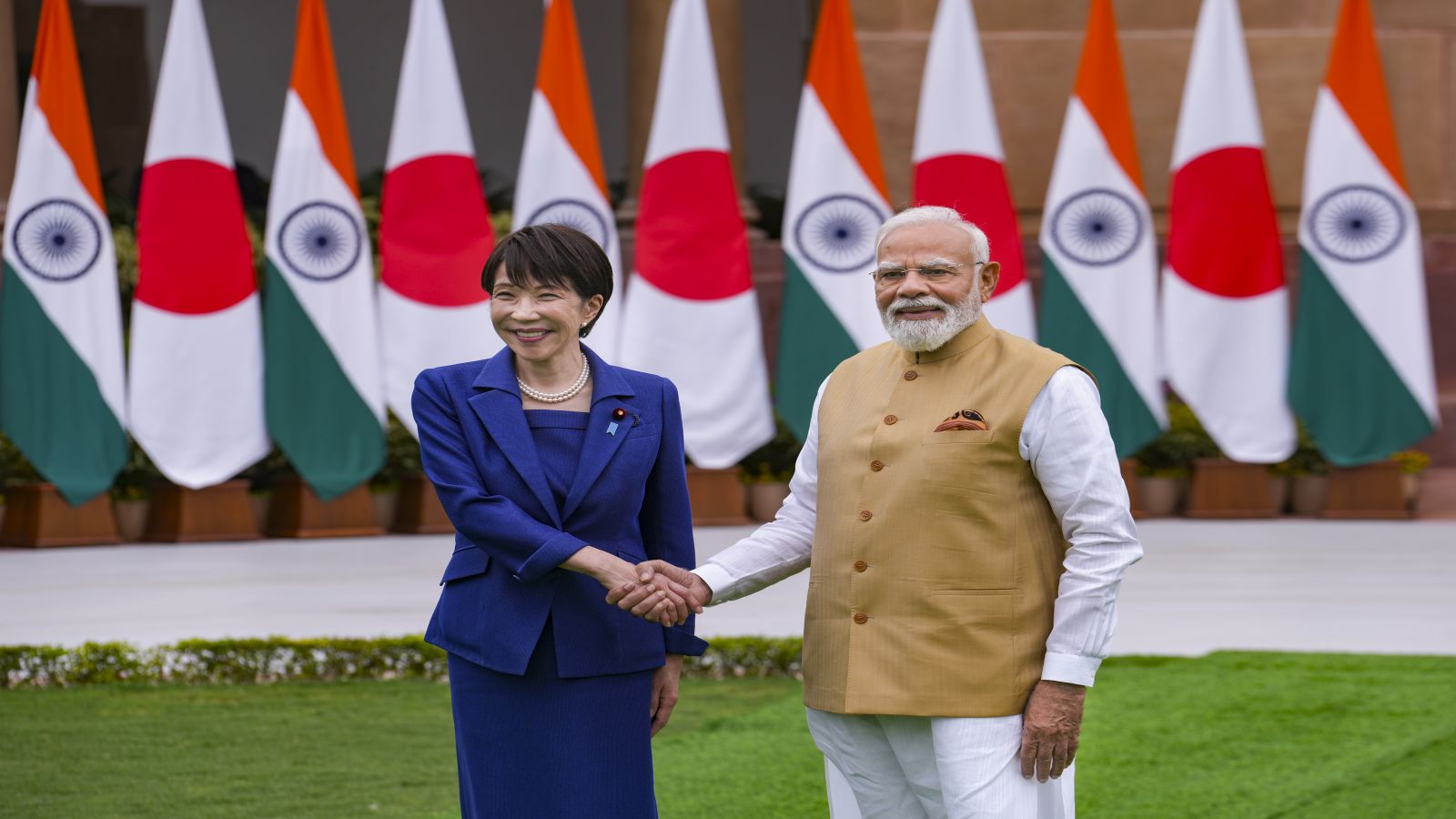
Geopolitics usually moves at the pace of a glacial slide. You get the same old dry communiqués, stiff handshakes, and generic statements about "shared values." But the 16th India-Japan Annual Summit in New Delhi just flipped the script. When Indian Prime Minister Narendra Modi welcomed Japan's first female Prime Minister, Sanae Takaichi, the typical diplomatic playbook went out the window.
Modi openly referred to Takaichi as his "younger sister." Takaichi smiled, leaned into the sentiment, and confirmed they had agreed to run the bilateral relationship as "brother and sister."
If you think this is just empty theatrical bonhomie, you're missing the real story. Behind the family optics lies a massive structural shift in how Asia's two largest democratic economies plan to survive an era of global volatility. They didn't just talk. They signed a first-ever defense co-development deal, committed to a major software-hardware integration for artificial intelligence, and unlocked a multi-billion-dollar investment pipeline.
This isn't just about friendship. It's about economic survival and military deterrence.
The Defense Breakthrough Nobody Saw Coming
For decades, the defense relationship between New Delhi and Tokyo was strictly look-but-don't-touch. Japan's pacifist constitutional history made defense technology transfers a bureaucratic nightmare. India's legacy of buying Russian hardware meant the systems didn't talk to each other anyway.
That era is officially over.
The headline achievement of this summit is a signed agreement for the joint development of the Naval Radio Antenna, known as "Unicorn." This isn't an off-the-shelf purchase. It's the first time India and Japan are putting their engineers in the same room to build military hardware together.
The Unicorn antenna system is critical for maritime security. It integrates multiple communication and radar functionalities into a single, stealthy structure, drastically reducing the radar cross-section of naval vessels. By co-developing this tech, New Delhi and Tokyo are sending a blatant signal to Beijing. They intend to maintain a rules-based order in the Indo-Pacific, and they're willing to share their most sensitive military engineering secrets to do it.
Takaichi didn't hold back on why this matters. She immediately directed officials to schedule the next 2+2 ministerial dialogue before the end of the year. The plans include an upcoming joint naval exercise between a Japanese Maritime Self-Defense Force destroyer and an Indian Navy vessel, alongside expanded maintenance and repair cooperation in the Indian Ocean.
Merging Japanese Hardware with Indian Code
Everyone talks about artificial intelligence, but most bilateral AI pacts are just fluff. This one is different because it addresses a fundamental mismatch in global technology.
Japan builds some of the finest precision hardware, industrial machinery, and robotics on earth. India possesses an unmatched army of software engineers, data scientists, and a sprawling digital public infrastructure. The joint statement on AI signed at the summit formally links these two ecosystems.
Several leading Indian AI institutions signed direct agreements with Japanese corporate and research partners. The goal isn't just to write better algorithms. It's to embed Indian AI software directly into Japanese manufacturing, semiconductor fabrication, and next-generation mobility systems.
Speaking of mobility, the newly unveiled India-Japan Next Generation Mobility Partnership Framework expands their classic automotive alliance. It moves beyond cars into shipbuilding, aviation, and logistics. If you can inject autonomous AI systems into these sectors, you suddenly change the efficiency of global supply chains.
Moving Beyond Simple Infrastructure Loans
Historically, Japan was India's wealthy benefactor, funding massive metro projects and the Mumbai-Ahmedabad bullet train through development loans. That dynamic has evolved into a hard-nosed commercial partnership.
During the summit, Modi revealed that roughly 120 new business agreements had been wrapped up over the past year alone. These deals are set to pump more than $10 billion in fresh Japanese investment into India. The ultimate target is hitting ¥10 trillion in investments while doubling the number of Japanese companies operating on Indian soil.
But where is that money going? It's avoiding real estate or generic retail. Instead, it's flooding into a newly minted Joint Roadmap on economic security. The focus areas are specific:
- Semiconductors: Building out manufacturing plants and secure packaging facilities in India to insulate both nations from a Taiwan crisis.
- Critical Minerals: Securing the supply chains for rare earth elements necessary for electronics and defense systems, reducing reliance on Chinese monopolies.
- Clean Energy: Launching the India-Japan Bio-gas Initiative, which aims to set up 1,000 bio-gas and organic fertilizer plants across rural India.
They also launched a dedicated initiative on energy resilience to protect against global oil shocks, with Japan explicitly backing India’s entry into the International Energy Agency.
How to Leverage the India Japan Corridor
If you're running a business in tech, defense manufacturing, or clean energy, you can't treat this summit as distant political noise. The policy alignment means government money and fast-tracked regulatory approvals are coming.
First, look at the AI and software integration. Indian tech firms should actively seek partnerships with Japanese industrial firms looking to automate their legacy hardware. The hardware-software convergence is where the grants will be.
Second, pay attention to the shift in manufacturing. With Japan pushing to diversify its manufacturing base away from East Asia, the "Make in India" initiative is getting a heavy Japanese upgrade. Supply chain logistics, semiconductor component manufacturing, and green energy infrastructure are the clear winners here.
Forget the sentimental "brother and sister" headlines. The real takeaway is that India and Japan are locking arms to build a fortress of technology and defense infrastructure that will reshape Asia for decades.