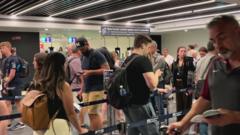
If you planned a quick European getaway this summer, you might want to pack a lot more patience. The European Union's Entry/Exit System, known as EES, went live across the Schengen Area on April 10. Since then, it's done exactly what aviation experts and airport operators feared. It's turned routine passport control into a massive bottleneck.
Travelers are facing lines that stretch for hours. Airport executives are pointing out massive design flaws. Airlines like Ryanair, easyJet, and Jet2 are warning passengers about missed flights and schedule chaos. The reality on the ground contradicts any promises of automated efficiency. For non-EU citizens, including British holidaymakers, crossing the border has become a test of endurance. For a different view, consider: this related article.
The Tripling of Border Times Is Already Here
The numbers coming out of European hubs are alarming. Airport bosses across the continent are reporting that passport processing times have easily tripled since the April rollout. During peak weekend traffic, what used to take forty-five seconds per passenger now takes several minutes.
Alexander Zinell, the chief executive of Fraport Greece, which manages fourteen regional airports, openly criticized the system for having fundamental flaws. He isn't the only one sounding the alarm. Airlines Council International Europe confirmed that wait times of three and a half hours have already hit multiple airports during busy periods. Related insight regarding this has been published by AFAR.
The situation could get even worse. The International Air Transport Association projects that peak summer travel crowds could push border queues to six hours. Think about standing in a hot, crowded terminal for six hours just to get your face scanned and fingerprints registered. That's the stark reality facing families right now.
In Milan, more than a hundred passengers recently missed a single flight to Manchester because they were stuck in passport queues. This isn't an isolated incident. Budget carriers are dealing with delayed departures every day because passengers are trapped behind border booths.
What the Entry/Exit System Actually Demands from You
The system replaces the old practice of manually stamping passports. The EU wants a digital record of every non-EU traveler entering and leaving the Schengen zone. They want to track the strict ninety-day stay limit within any 180-day window automatically.
Your first trip to Europe under these rules requires you to create a digital profile. You have to step up to a dedicated kiosk. You must scan your passport, let a camera capture your facial image, and place your fingers on a scanner to provide four fingerprints.
The registration process itself takes about two minutes per person if the machinery works correctly. It doesn't sound like much. But multiply two minutes by a plane load of three hundred passengers arriving simultaneously. If an airport only has a few functioning kiosks, the math breaks down instantly.
Once your data is in the system, it stays valid for three years or until your passport expires. On subsequent visits, you theoretically only need a quick scan to verify your identity. The problem is the initial enrollment surge. Millions of travelers are hitting the border for the first time this summer, creating a perfect storm of bureaucratic delays.
A System Riddled with Flaws and Redundancy
Aviation groups and transport ministers are frustrated because the rollout happened before the technology was fully ready. Reports indicate that some border crossings are experiencing technical bugs where travelers are forced to submit the same biometric scans multiple times because the database fails to register the first attempt.
The UK travel association ABTA has been tracking the rollout closely. Mark Tanzer, the chief executive of ABTA, noted that more than half of surveyed travelers had heard little to nothing about these new rules before arriving at the terminal. People show up completely unprepared, which slows down the lines even more as officers explain the steps to confused families.
Nine EU countries, including heavyweight travel destinations like France, Germany, Greece, Italy, and Spain, recently signed a joint letter to the European Commission. They're asking for an extension of the emergency safeguards that allow border guards to temporarily suspend biometric checks when queues become dangerously long.
Right now, a temporary amnesty allows border agents to wave travelers through to ease congestion. That flexibility is scheduled to end on September 6. If the European Commission refuses to extend this deadline, the autumn travel window could see even worse gridlock. The transport sector views the September date as a major cliff-edge.
The Massive Economic Toll of Border Gridlock
This isn't just an inconvenience for holidaymakers. It's a massive threat to the European tourism economy. The World Travel & Tourism Council published data showing that routine delays of three hours or more could cause a loss of up to 41 million visitor arrivals.
The WTTC surveyed thousands of international travelers from the UK, the US, Canada, and Australia to see how they would respond to these delays. The results should terrify resort owners. Nearly 39% of British travelers said they would be much less likely to visit the Schengen Area if multi-hour lines become the norm. One-third of American and Canadian tourists said the same thing.
If these travelers stay home or choose destinations with easier entry rules, the financial hit will be immense. The WTTC estimates that up to $45.4 billion in travel spending could vanish from the European economy.
The Unique Chaos at Juxtaposed Borders
While air travel is suffering, the situation at the UK-France border is uniquely complicated due to juxtaposed controls. At the Port of Dover, the Folkestone Eurotunnel, and London St Pancras International, French border police conduct their checks on British soil before you ever board the ferry or train.
The British government scrambled to inject £20 million into the Port of Dover to build extra passport check booths and expand processing lanes. They also brokered a deal with French authorities to increase the number of French border guards stationed at British terminals during the peak summer weeks.
Heidi Alexander, the British transport minister, raised these concerns directly with the EU transport commissioner to ensure both sides cooperate. The physical space at Dover and St Pancras is incredibly limited. You can't easily expand a historic train station or a tight ferry port to accommodate hundreds of self-service biometric kiosks.
A single broken kiosk or a shortage of French staff on a Friday morning can trigger miles of traffic backups on the roads leading to Dover. The local infrastructure simply wasn't built to handle this level of processing depth.
How to Survive the Chaos on Your Next Trip
You can't change the border rules, but you can change how you prepare for them. If you're heading to Europe over the coming months, you need to alter your usual travel habits.
Don't cut your arrival times close. Airlines are actively changing their guidance. For short-haul flights that usually require a two-hour arrival window, push it to three hours. If you're using the ferry or the Eurostar, give yourself significantly more buffer time than the operators recommend.
Keep your physical documents organized. Have your accommodation address, return tickets, and travel insurance easily accessible. Border officials are asking more follow-up questions to input into the digital profiles. If you're hunting through your phone for a booking confirmation email while standing at the desk, you're delaying everyone behind you.
Check if your destination country offers a pre-registration mobile app. A few EU nations are testing optional apps that let you input your passport details up to 72 hours before you travel. While it doesn't bypass the facial scan at the border, it cuts out the manual typing time at the kiosk.
Go straight to passport control when returning or departing. Many travelers make the mistake of lingering in the duty-free shops or restaurants after clearing security, forgetting that the EES exit check happens right before the boarding gates. Clear the border first, then relax.
Pack essential supplies in your hand luggage. Bring extra water, snacks, and any necessary medications into the queue with you. If you get stuck in a three-hour line in a corridor that lacks air conditioning or restroom access, you'll be glad you prepared.
The Entry/Exit System is here to stay, and it serves as the foundation for the upcoming ETIAS travel authorization fee launching later this year. The digital border transition is going to be incredibly painful for the next year or two until the systems stabilize and repeat travelers are fully registered. Until then, the best defense is absolute preparation and realistic expectations about how long it takes to get to your destination.


