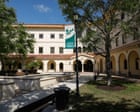
The media consensus on New College of Florida is lazy, predictable, and fundamentally misunderstands the economics of modern higher education. Read any mainstream coverage of the Sarasota school since Governor Ron DeSantis overhauled its board of trustees and you will find the same hand-wringing narrative. They call it an ideological vanity project. They call it a cautionary tale of political overreach. They look at the plan to triple enrollment from roughly 700 students to several thousand and declare it an operational impossibility that will destroy the institution’s academic soul.
They are completely wrong. Also making headlines in this space: Why Trump Vowing Zero Financial Relief to Iran Will Achieve Absolutely Nothing.
What is happening at New College is not a tragedy; it is a masterclass in institutional arbitrage. The legacy media is blinded by culture war optics, missing the cold, hard business reality underneath. Higher education is a failing industry. Small, niche, private-style liberal arts colleges are dying by the dozen across New England and the Midwest because their business models are broken. They rely on massive tuition fees, tiny student bodies, and bloated administrative overhead.
New College was on that exact same trajectory. It was an underfunded, under-enrolled state school with crumbling infrastructure, masquerading as an elite private boutique. It was a luxury product with no market share. Additional insights into this topic are detailed by USA Today.
The state-backed intervention did not kill New College. It threw a drowning institution a multi-million-dollar lifeline and gave it a radical new customer acquisition strategy. If you strip away the partisan screaming matches, the math behind tripling the student body makes perfect sense.
The Broken Math of the Niche Liberal Arts College
To understand why the expansion plan is necessary, you have to understand the existential crisis facing small-enrollment institutions. I have spent years analyzing the financial structures of universities, and the data is grim. A college with fewer than 1,000 students is a financial nightmare.
The fixed costs of running a university do not scale down linearly. You still need a president, a provost, a financial aid office, a registrar, IT infrastructure, facility maintenance, and compliance officers to satisfy federal regulators. When you divide those fixed costs across 700 students, your cost per student is astronomical.
For decades, New College survived as an anomaly: a tiny, public honors college heavily subsidized by Florida taxpayers. But the subsidies were not keeping pace with reality. The campus needed tens of millions of dollars in deferred maintenance. Student retention was slipping. Enrollment was stagnant because the school’s hyper-specific, unstructured academic model only appealed to a microscopic slice of the population.
Consider the baseline operational math of higher education:
- Fixed Overhead: Administrative costs remain largely stagnant whether a campus has 800 students or 2,400 students.
- Variable Revenue: Tuition and state funding allocations scale directly with headcount.
- The Inflection Point: For a physical campus of New College's size, the breakeven point to achieve self-sustaining operational efficiency is roughly 2,000 to 2,500 students.
Tripling the size of the student body is not a reckless gamble; it is the only way to dilute the school’s fixed overhead and achieve economies of scale. It turns a fragile, subsidized boutique into a resilient, self-sustaining institution.
Sports and Ideology Are Just Customer Acquisition Channels
The loudest criticism of the New College transformation centers on two things: the introduction of a massive intercollegiate athletics program and the explicit shift toward a traditional, civic-minded curriculum. Critics mock the idea of a quirky liberal arts school suddenly recruiting baseball players, scholarship golfers, and basketball recruits. They claim it degrades the intellectual environment.
This is a fundamental misunderstanding of customer acquisition.
In the business world, if your product is failing to attract buyers, you change the marketing, you change the features, or you find a new target demographic. New College’s old demographic—students seeking a highly eccentric, narrative-grade, self-directed liberal arts experience—was exhausted. The pool was too small to sustain the school.
Old Strategy:
[Niche, Unstructured Curriculum] ➔ [Microscopic Target Market] ➔ [Chronic Under-enrollment]

New Strategy:
[Athletics + Classical Curriculum] ➔ [Massive, Under-served Market] ➔ [Rapid Scale]
By introducing NAIA sports, the administration tapped into a massive, highly motivated market of prospective students. Student-athletes possess high retention rates, strong discipline, and they bring their families’ wallets to campus. Look at small private colleges across America like Wayland Baptist or Cumberlands; they survived the enrollment cliff by turning 30% to 50% of their student body into athletes.
The "anti-woke" branding operates exactly the same way. It is a brilliant, low-cost marketing play. While every other liberal arts college in America competes for the exact same pool of progressive, urban high school graduates, New College carved out an uncontested market space. By positioning itself as a bastion of traditional western canon and civic virtue, it became a beacon for thousands of families seeking an alternative to mainstream campus culture.
The school did not have to spend millions on national advertising campaigns. The media’s outrage machine generated hundreds of millions of dollars in free publicity. Every negative article in a national newspaper served as a direct advertisement to a massive, under-served demographic of conservative and moderate parents who suddenly realized there was a public honors college tailored explicitly to their values.
Dismantling the "Loss of Academic Prestige" Myth
Commentators frequently lament that New College is losing its elite status, pointing to the departure of legacy faculty members and changes in historical ranking metrics.
Let’s be brutally honest about academic prestige: it does not pay the electric bill.
The traditional definition of academic prestige is a luxury good reserved for institutions with multi-billion-dollar endowments, like Harvard, Yale, or Williams. A small public school in Florida cannot afford to prioritize the esoteric preferences of a handful of tenured professors over institutional survival.
Furthermore, the idea that a rapid influx of students inherently lowers quality is a myth perpetuated by legacy institutions to maintain an artificial scarcity cartel. Look at Arizona State University under Michael Crow. ASU scaled enrollment massively, embraced non-traditional students, and simultaneously boosted its research output and corporate partnerships.
The new leadership at New College, including President Richard Corcoran, recognized that the value of a degree is tied to institutional survival, not ideological purity. By replacing departing faculty with scholars aligned with the new mission, the college is building a cohesive brand. In the modern educational marketplace, a distinct, highly defined brand is infinitely more valuable than a generic, fading reputation for being "quirky."
The Actual Risk Nobody Is Talking About
My perspective is not without skepticism. The strategy is sound, but the execution carries real operational risk. The danger at New College is not the ideology or the athletics; it is the physical infrastructure gap.
Scaling an organization by 300% in a short window creates massive logistical bottlenecks. I have watched companies collapse under the weight of their own rapid growth because their back-end systems could not handle the volume. For New College, the friction points are hyper-physical:
- Housing Deficits: Turning old dorms around and leasing local hotels is a messy, expensive stopgap. If permanent, high-quality housing does not keep pace with enrollment, student retention will plummet after year one.
- Administrative Strain: The financial aid, advising, and registrar offices must upgrade from small-scale operations to enterprise-level systems without dropping the ball on compliance.
- Accreditation Scrutiny: Rapid shifts in faculty composition and curriculum attract intense focus from regional accreditors like SACSCOC. Managing that bureaucratic relationship requires flawless execution.
If the school fails, it will not be because they abandoned their old identity. It will be because they failed to manage the raw mechanics of hyper-growth.
Stop Romanticizing the Past
The critics demanding that New College return to its roots are advocating for institutional suicide. The status quo was completely unsustainable.
Higher education is undergoing a massive structural correction. The institutions that survive the next decade will be those that abandon the ivory tower illusion and operate like agile, market-responsive organizations. New College of Florida recognized its structural vulnerability, capitalized on state political willpower to clear its debts, and re-engineered its entire value proposition to capture a massive, untapped market.
The old New College is dead because it could not afford to live. The new New College is expanding because it cracked the code on modern student acquisition. Stop reading the cultural commentary and look at the ledger. This is a turnaround play, and the numbers are winning.