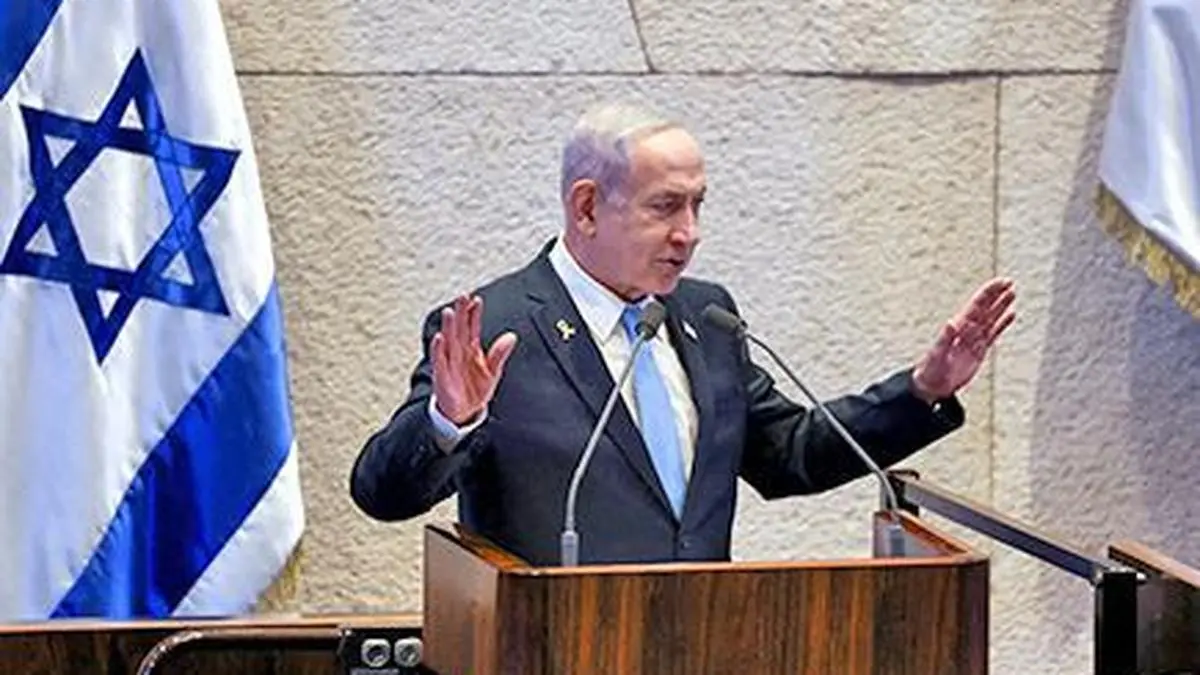
Benjamin Netanyahu has once again pinned the Middle East to a razor’s edge by declaring that Israel’s military objectives will be met through either a negotiated agreement or a swift return to high-intensity combat. Behind the "finger on the trigger" rhetoric aimed at Tehran lies a calculated gamble intended to preserve his political coalition while daring the Iranian regime to miscalculate. This is not merely a tactical update from a war room; it is a masterclass in brinkmanship designed to signal to both domestic critics and international adversaries that Israel refuses to accept a "frozen" status quo.
The prime minister’s latest stance centers on the survival of the Israeli state under the shadow of a nuclear-capable Iran and its regional proxies. By framing the current pause as a temporary breather rather than a permanent ceasefire, Netanyahu is signaling that the war’s primary objectives—the dismantling of Hamas and the restoration of security on the northern border—remain non-negotiable. To understand the gravity of this moment, one must look past the televised warnings and examine the structural pressures squeezing the Israeli leadership from within. You might also find this connected article useful: The Wings That Cannot Carry You Home.
The Dual Track of Deception and Deterrence
Military strategy often relies on the illusion of choice. Netanyahu’s public insistence that Israel is prepared to resume fighting "at any moment" serves as a pressure valve for a government facing intense scrutiny. On one side, the families of hostages demand an immediate deal at almost any cost. On the other, the hard-right elements of his cabinet view any permanent cessation of hostilities without total victory as a historic betrayal.
This "agreement or fighting" binary is a defensive posture. It allows the Prime Minister to navigate the diplomatic demands of the United States while maintaining the credible threat of force. If an agreement is reached, he claims victory through diplomacy. If the talks fail, he blames the intransigence of his enemies and moves back into a kinetic phase with the justification that every peaceful avenue was exhausted. It is a win-win for his political longevity, though it keeps the entire region in a state of chronic anxiety. As reported in recent reports by The Guardian, the implications are notable.
The Iranian Shadow Over the Levant
While the immediate conflict focuses on Gaza and the Lebanese border, the real target of Netanyahu’s "finger on the trigger" warning is the Islamic Revolutionary Guard Corps (IRGC). Israel is currently engaged in a multi-front struggle where the geography is local but the funding and orders are regional.
Tehran has long utilized a strategy of strategic patience, hoping to bleed the Israeli economy and military through a war of attrition. Netanyahu’s rhetoric is an attempt to disrupt this patience. By suggesting that Israel is ready to escalate directly against Iranian interests, he is trying to shift the cost-benefit analysis for the Supreme Leader. The message is blunt: do not mistake a pause in Gaza for a lack of resolve regarding your nuclear program or your shipments of precision-guided munitions to Hezbollah.
The Logistics of Resuming a High-Intensity Conflict
Resuming a war is significantly harder than continuing one. When units are pulled back, when reservists are sent home to restart a flagging economy, and when the international community begins to breathe a sigh of relief, the political and logistical friction of restarting the engine is immense.
Israel’s military apparatus is currently balancing the need for recuperation with the necessity of readiness. To "resume fighting" effectively, the Israel Defense Forces (IDF) must maintain a massive logistical tail.
- Ammunition Stockpiles: Dependence on U.S. resupply remains the ultimate bottleneck.
- Intelligence Continuity: The "eyes" over Gaza and Southern Lebanon cannot be blinked for a second, or the targets move and the maps become obsolete.
- Economic Strain: Every day a reservist stays in uniform is a day they are not contributing to Israel's tech-heavy GDP.
The "trigger" is not just a metaphor. It is a billion-dollar-a-day infrastructure that is currently idling at a very high RPM. Netanyahu knows that this state of readiness cannot be maintained indefinitely. Therefore, the window for an "agreement" is much smaller than the public rhetoric suggests.
The Red Line of Negotiated Failure
What defines a "bad agreement" in the eyes of the Israeli security establishment? For Netanyahu, any deal that leaves Hamas with a functional governing capacity or Hezbollah with its Radwan forces south of the Litani River is a failure.
The investigative reality suggests that the gaps between the parties remain tectonic. Hamas seeks a permanent end to the war and a full withdrawal; Israel seeks a temporary lull to retrieve hostages followed by the right to resume operations. These two positions are fundamentally irreconcilable. When Netanyahu says he will achieve his goals "by agreement," he is essentially asking for a surrender that is dressed up as a treaty. When that surrender is not forthcoming, the "trigger" becomes the only remaining policy tool.
The Washington Factor and the Limits of Sovereignty
No discussion of Israeli military intent is complete without acknowledging the role of the White House. The Biden administration—and any subsequent U.S. leadership—views a regional conflagration involving Iran as a worst-case scenario. Netanyahu’s warnings are often as much for the ears in Washington as they are for those in Tehran.
Israel is asserting its right to unilateral action. By publicly stating that the "finger is on the trigger," Netanyahu is telling his primary benefactor that Israel will not be restrained by American electoral cycles or diplomatic timelines if it perceives an existential threat. This creates a friction point: the U.S. wants to "de-escalate" and "integrate," while the current Israeli leadership believes that only "deterrence through overwhelming force" can ensure long-term survival.
The tension here is palpable. If Israel moves back into a high-intensity phase without explicit U.S. backing, it risks diplomatic isolation. However, if it waits for a consensus that never comes, it risks a devastating first strike from its neighbors. Netanyahu has clearly decided that the risk of the former is preferable to the risk of the latter.
The Internal Collapse of the Status Quo
Domestically, the "agreement or fighting" stance is a thin veneer over a fractured society. The Israeli public is exhausted. The "start-up nation" is seeing its credit ratings slashed and its social fabric torn.
Netanyahu’s rhetoric serves as a unifying force, reminding the citizenry of the external threat to keep internal dissent at bay. But this strategy has a shelf life. An "agreement" that doesn't feel like a victory will trigger protests from the right; a "resumption of fighting" that leads to more casualties without a clear exit strategy will trigger protests from the center and left.
The Prime Minister is walking a tightrope over a canyon of his own making. He has tied his political fate to the outcome of this conflict, meaning he cannot afford a quiet, inconclusive end to the violence. He needs a definitive moment—a "clear-cut goal achieved"—to justify the immense cost of the last several months.
Why the Iran Warning is Different This Time
In previous years, Netanyahu’s warnings to Iran were often seen as theatrical, involving diagrams at the UN or high-profile speeches. Now, the theatre has been replaced by the roar of F-35s. The shadow war is no longer in the shadows.
The April exchange of fire between Israel and Iran changed the calculus forever. The "trigger" is no longer a hypothetical concept; it is a battle-tested mechanism. Israel has shown it can reach into the heart of Isfahan, and Iran has shown it can launch hundreds of drones and missiles directly from its soil. This proximity to total war means that Netanyahu’s words carry a weight they lacked in 2012 or 2015.
The danger of a "resumption of fighting" in Gaza or Lebanon is that it could easily serve as the spark for that larger, final confrontation. If Hezbollah feels it is being pushed to the brink of destruction, it will call on Tehran. If Tehran feels its "ring of fire" around Israel is being dismantled, it may feel compelled to act directly. Netanyahu is betting that his warning will make Iran back down. History suggests that in this region, such bets often lead to the very escalation they were meant to prevent.
The Mechanics of the End State
The "goals" Netanyahu refers to are becoming increasingly difficult to define in military terms. You can kill a commander, you can blow up a tunnel, and you can seize a border crossing. You cannot, however, shoot an ideology out of the air.
If the "agreement" route is taken, it will likely be a messy, fragmented series of local deals rather than a grand peace treaty. If the "fighting" route is taken, it will involve a grinding, urban occupation that could last years. Neither option leads to the "total victory" promised on campaign posters.
The real reason this crisis persists is that the exit ramps all lead to places the current Israeli government is unwilling to go: Palestinian statehood, a compromise on Jerusalem, or a long-term diplomatic thaw with a hostile Iranian regime. Without a political vision to match the military "trigger," the fighting is not a means to an end, but a cycle that feeds itself.
Netanyahu has positioned himself as the only man capable of navigating this maze. By keeping his finger on the trigger, he ensures that he remains at the center of the world's attention, even as the ground beneath his feet continues to shift. The tragedy of this posture is that it leaves no room for the "agreement" to actually take root, as the threat of "resuming fighting" is always used as the primary negotiating tool. This is the brutal truth of the current Israeli strategy: it is a plan for survival, not for peace.
The trigger is held tight because the moment it is released, the political and security vacuum it leaves behind may be more dangerous to the Prime Minister than the war itself.