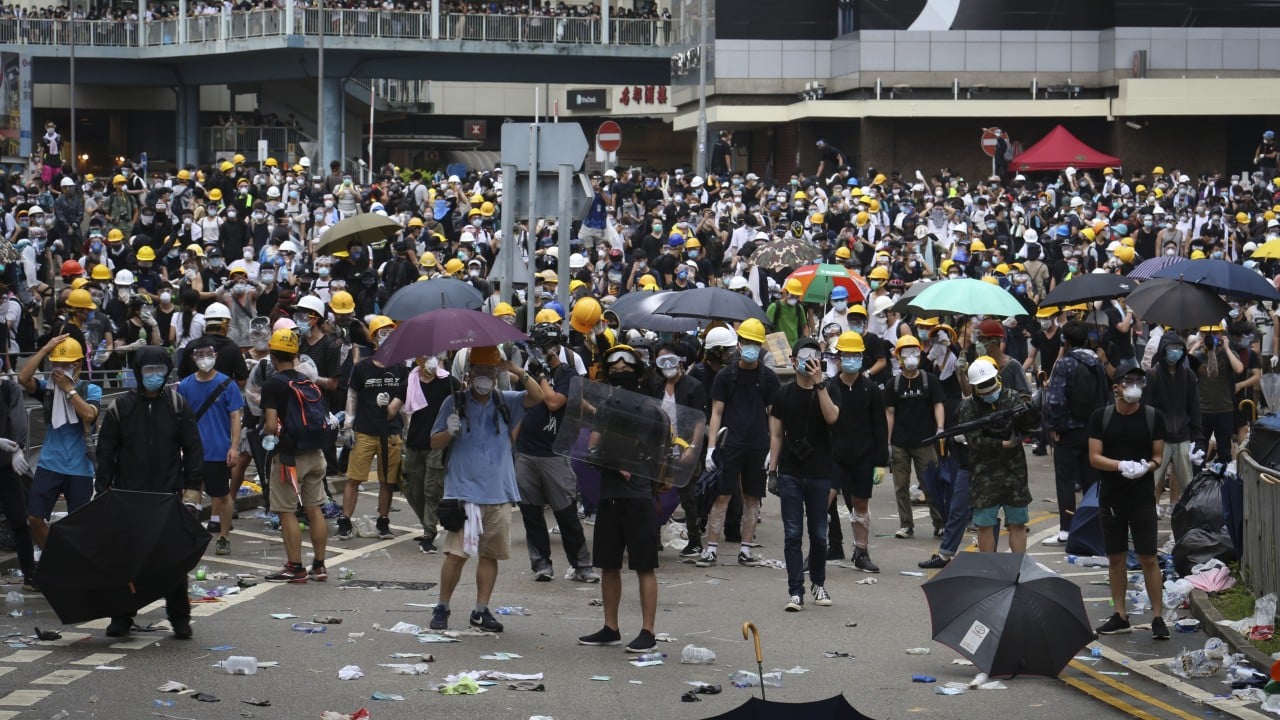
The rain in Hong Kong does not just fall; it claims the city. It slickens the steep, narrow alleys of Soho and turns the reflection of thousands of vertical neon signs into bleeding pools of red and electric blue on the asphalt. For years, that damp air carried a different kind of electricity. It was the scent of tear gas, the sharp tang of burnt plastic, and the collective, deafening roar of millions of voices echoing between skyscrapers.
If you stood on Hennessy Road in the blistering summer of 2019, the noise was a physical wall.
Today, if you stand in that exact same spot, the sound you hear is entirely different. It is the hum of double-decker buses shifting gears. It is the rhythmic clacking of high heels on subway tiles as commuters rush toward the MTR. It is the clatter of dim sum baskets hitting round wooden tables in crowded teahouses.
To the casual observer, normalcy has returned. The physical scars on the pavement have been paved over. The broken brick barriers are gone. But a city is not just its infrastructure. It is a shared psychological space. For Hong Kong to truly move past the trauma of the 2019-2020 protests, it cannot merely clean its streets. It has to heal its mind.
The Weight of the Unsaid
Let us ground this in a reality that tens of thousands of locals live every single day. Consider a hypothetical, yet deeply representative, family sitting down for Sunday dinner in a small apartment in Mong Kok.
We will call the father Mr. Chan. He is a fifty-year-old accountant who spent his life believing that stability, hard work, and predictability were the supreme virtues required to survive in this hyper-competitive territory. Across the table sits his twenty-four-year-old daughter, Yan. In 2019, she was on the front lines, wearing a black mask, convinced she was fighting for the very soul of her home.
For three years, they barely spoke. The dinner table, once a place of laughter and shared plates of roasted goose, became a minefield.
Their estrangement was a microcosm of Hong Kong itself. The social fabric did not just tear; it shredded along generational, political, and socio-economic lines. Friends blocked each other on WhatsApp. Long-standing family businesses closed because they were labeled "blue" or "yellow" by online factions. The city became a panopticon of mutual suspicion.
The introduction of the National Security Law in 2020 and the subsequent Article 23 legislation in 2024 fundamentally altered the rules of the game. The overt political turbulence stopped. The protests vanished from the streets. Order, from a legal and administrative standpoint, was restored.
But order is not reconciliation.
Mr. Chan looks at Yan now, and there is a fragile truce between them. They talk about the weather. They talk about the rising cost of groceries. They avoid the past because looking it directly in the eye feels too dangerous. This silence is what Hong Kong is currently navigating. It is a heavy, collective breath held in the chest, waiting to see if it is finally safe to exhale.
The Price of Permanent Anxiety
When a community undergoes prolonged collective trauma, the economic indicators are often the first to flash red, but the human indicators are the ones that linger.
Data from local universities over the last few years revealed a stark uptick in anxiety and depressive symptoms across all demographics in Hong Kong. It was not just the young activists who suffered; business owners who watched their life savings evaporate during the dual crises of the protests and the pandemic felt a profound sense of helplessness.
The city’s greatest asset has always been its relentless, vibrant energy. It is a place that traditionally never sleeps, driven by an unshakeable belief that tomorrow will be more prosperous than today. When that optimism is replaced by hyper-vigilance, the collective psyche erodes.
People began to leave. The exodus of middle-class professionals, teachers, and young families to the United Kingdom, Canada, and Australia was not just a statistic in a government immigration ledger. It was a loss of institutional memory. It meant schools suddenly had empty desks, and offices lost mid-level managers who held decades of specialized knowledge.
For those who stayed, a question hung in the air like the heavy humidity before a typhoon: What is our identity now?
If Hong Kong is no longer the hyper-politicized battleground of East and West, what is it? The answer cannot simply be "a financial hub." Human beings do not risk their lives, or their futures, merely to optimize a stock exchange. They need a story to believe in.
Recalibrating the compass
To draw a definitive line under that tumultuous era, the city requires a massive, deliberate pivot toward civic empathy. This is not about forgetting. Forgetting is impossible. It is about integration—taking the jagged, painful pieces of recent history and fitting them into a broader narrative of resilience.
The government’s initial response was understandably focused on security. But a society cannot be governed by deterrence alone. True stability requires a foundation of trust.
Consider how a broken bone heals. It does not mend by being ignored; it mends when it is aligned correctly and given the space, nutrition, and time to knit back together. For Hong Kong, that alignment means creating spaces where people feel heard without fear. It means shifting the public discourse from a binary of "loyalty versus betrayal" to a more nuanced understanding of shared destiny.
There are quiet, grassroots signs that this is happening. In small indie coffee shops in Sham Shui Po, young artists are channeling their complex emotions into poetry, music, and digital art that explores themes of belonging and memory. They are not looking to start a revolution; they are looking to understand their own hearts.
Meanwhile, older generations are beginning to realize that the youth were not driven by a desire to destroy the city, but by a distorted, passionate love for it. The methods were deeply polarizing, but the underlying anxiety—the fear of becoming irrelevant, the soaring cost of housing, the lack of upward mobility—was entirely real.
Address the material anxieties, and you drain the swamp of political radicalism.
Hong Kong remains one of the safest cities on Earth. Its infrastructure is immaculate. Its courts, particularly in commercial matters, still command global respect. Its tax system is a marvel of efficiency. These are the structural pillars. But the emotional pillars require urgent maintenance.
The New Narrative of the Fragrant Harbor
The name "Hong Kong" translates to Fragrant Harbor. It earned that moniker centuries ago as a trading port for incense. Incense only releases its sweetness when it is subjected to fire.
The fire of 2019 changed the city permanently. The old Hong Kong—the laissez-faire, politically apathetic colony-turned-enclave—is dead. It is not coming back, and no amount of nostalgia will resurrect it.
But what is emerging in its place has the potential to be tougher, more mature, and uniquely self-aware.
The city is rediscovering its position as a cultural bridge. As mainland China continues to project its economic influence globally, Hong Kong remains the one place where that massive continental power meets the fluid, maritime traditions of the international community. It is a bilingual, bicultural laboratory.
Look at West Kowloon Cultural District. On any given weekend, thousands of people lie on the grass outside the M+ Museum, watching the sun set behind the skyline of Hong Kong Island. Inside the museum, avant-garde art coexists with historical retrospectives. Out on the lawn, teenagers practice dance routines, families walk their dogs, and elderly couples sit on folding chairs.
They are all there together, sharing the same air, looking at the same horizon.
Yan and her father eventually stopped avoiding the topic of the past. It happened over a simple bowl of wonton noodles. There were no grand apologies, no tearful recantations of political beliefs. Instead, Mr. Chan reached across the table and placed a piece of gai lan into his daughter’s bowl.
"Eat," he said softly. "You look thin."
It was a tiny gesture. Undramatic. Insignificant to anyone else. But in that small corner of Kowloon, it was a seismic shift. It was an acknowledgment that despite the ideological gulf that had threatened to tear them apart, the bond of blood and shared survival was stronger.
Hong Kong will move forward not because a decree was signed or a new law was passed. It will move forward because its seven million residents will eventually tire of carrying the weight of old grievances. They will look at the neon lights reflecting in the puddles, they will listen to the relentless pulse of the city, and they will choose to build something new from the wreckage of what was lost.
The city has always been a survivor. It survived world wars, epidemics, economic collapses, and sovereignty shifts. Every single time, the global obituaries were written prematurely. The secret to its endurance is not that it never breaks, but that it knows exactly how to put itself back together, leaving the scars visible as a testament to its strength.