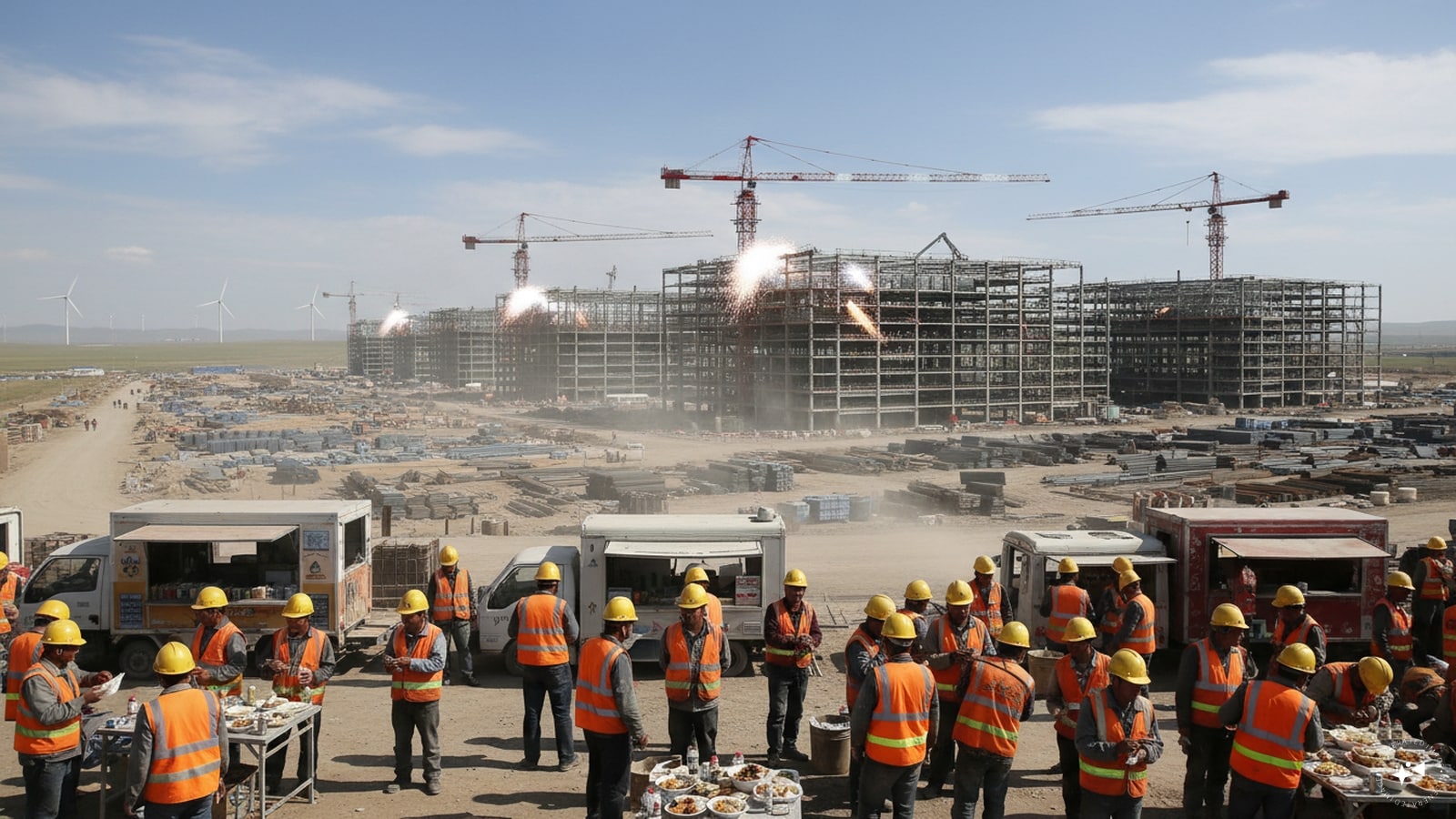
The hum begins four hundred miles west of Beijing before you ever see a concrete wall or a flashing server rack. It is a low, vibrational thrum that rattles the loose gravel on empty roads and sets the dry grass trembling. If you stand too long near the fence line of these remote valleys, your teeth feel it.
Silicon is hungry. Recently making waves in this space: Where the Edge of the World Meets the Sky.
We forget this because our interaction with artificial intelligence usually happens on a five-inch piece of glass we carry in our pockets. We tap a screen, we ask a question, and an answer appears. It feels weightless. It feels like magic. But magic requires a furnace, and the furnace is moving.
Consider a man named Chen. He is fictional, but he represents a hundred real engineers who traded the smog and neon of Shenzhen for the biting winter winds of Inner Mongolia. Chen wears a thermal parka inside a warehouse that stretches longer than three football fields. His breath mists in the air, not because the room is cold—though it has to be—but because the sheer density of computational heat demands an environment so frigid it feels like an industrial freezer. Additional details into this topic are covered by Engadget.
Chen looks at a row of blinking green lights. Each light represents a rack of high-performance graphics processing units chewing through mathematical models designed to train the next generation of large language models. These machines do not sleep. They do not pause to catch their breath. They pull megawatts of electricity straight out of high-voltage transmission lines that were originally strung across these desolate steppes to power old coal towns that have long since hollowed out.
This is the great migration.
For years, the story of modern technology was concentration. Companies built their data centers near major metropolitan hubs—Shanghai, Guangzhou, Beijing—close to the venture capital, the fiber-optic trunks, and the young college graduates who code until dawn. But artificial intelligence broke that map. It broke the math. A single training run for an advanced neural network can consume as much electricity as a small city does in a year.
You cannot put that kind of load next to a residential apartment complex in Shanghai without turning out the lights for millions of people. The grid would buckle. The transformers would melt.
So the servers are fleeing to the periphery. They are heading deep into the Gobi Desert, into the freezing northern provinces, and onto the high plateaus of Guizhou, where ancient rivers carve through limestone and hydroelectric dams churn out cheap, relentless watts.
China is racing to build these far-flung fortresses not out of some abstract desire for geographical expansion, but out of sheer, survivalist necessity. Power is the ultimate bottleneck of the intelligence age. Whoever holds the electrons holds the mind.
To understand the scale of this shift, you have to look at the energy equation. Traditional computing is efficient, like a bicycle. Artificial intelligence training is a freight train barreling down a mountain with the throttle stuck. The GPUs must run continuously for weeks or months at a time. If the power flickers for even a fraction of a second, an entire month of expensive computation can evaporate, corrupting checkpoints and forcing engineers to start the training run from scratch.
That is why these remote locations matter. They offer two things the coastal megacities cannot: dirt-cheap electricity, often subsidized by local governments desperate for economic relevance, and ambient weather that helps cool the processors naturally. In places like Ulanqab, the winter lasts for half the year. The wind outside is a frozen scalpel. Engineers simply open the louvers, letting the sub-zero air rush in to cool the humming racks, saving millions of dollars in mechanical air conditioning costs.
We are watching a strange, historic inversion. The physical infrastructure of the most ethereal, digital technology in human history is anchoring itself to the harshest, most elemental landscapes on earth. Deserts, frozen tundras, and deep mountain gorges are becoming the new capitals of intellectual power.
Chen pulls his parka tighter around his neck and checks a diagnostic monitor. A warning light flickers amber on rack 412. A cooling pump is losing pressure. He grabs his heavy wrench, his boots crunching against the frost on the concrete floor, and walks down the long aisle toward the hum. Outside, the stars wheel over an empty horizon, indifferent to the algorithms training beneath them, spinning the future out of cheap electricity and cold mountain air.