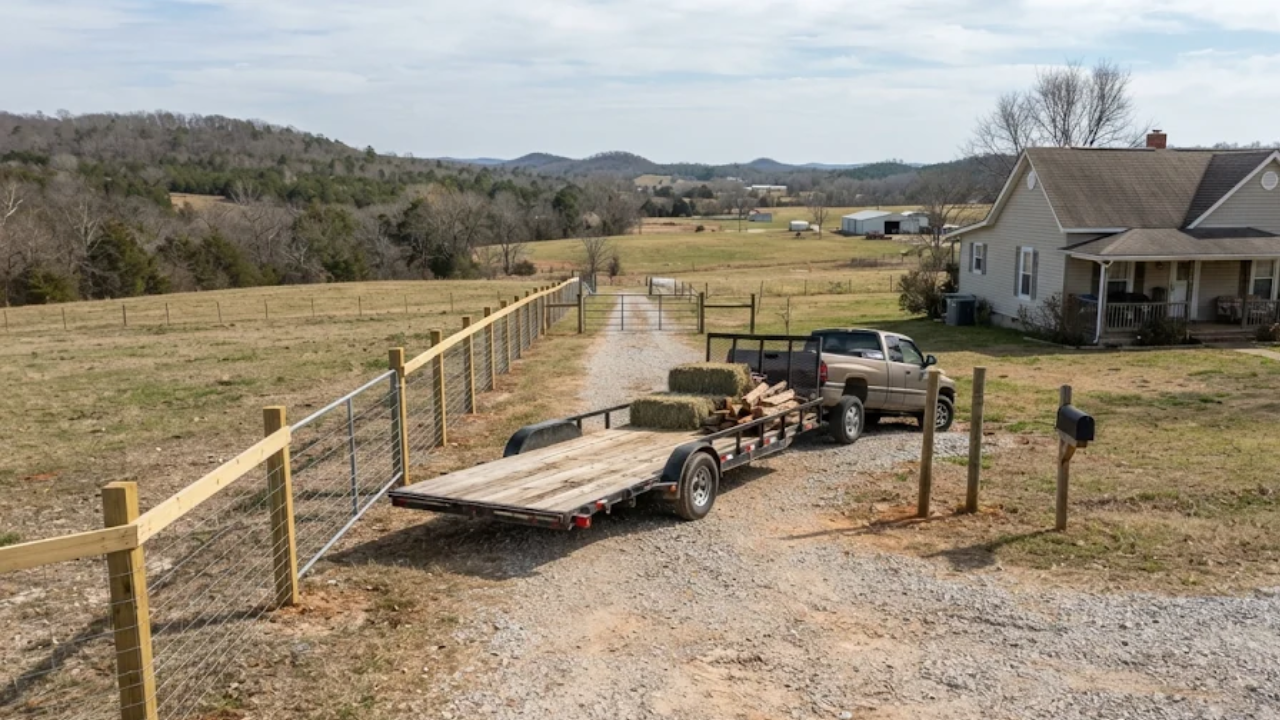
An Arkansas appellate court ruling overturning a property dispute where a neighbor’s fence narrowed a homeowner’s trailer access from twenty feet down to eight highlights a critical principle of real estate law. Prescriptive easements and implied easements protect long-standing access routes even when a property deed lacks explicit written language. When an adjacent landowner erects a physical barrier that functionally destroys a neighbor's ability to maneuver vehicles or trailers onto their own lot, trial courts frequently misapply strict boundary-line logic, forcing appellate judges to step in and restore practical access rights.
Property line disputes rarely start with bulldozers and court summonses. They usually start with a tape measure, a freshly poured concrete post hole, and an assumption that owning the dirt gives you absolute authority over how your neighbor uses the edge of it.
I have spent decades covering municipal zoning boards, county circuit courts, and appellate dockets. Few legal battles burn hotter or drain bank accounts faster than two neighbors fighting over twelve feet of gravel. On paper, the conflict looks absurdly simple. One homeowner needs twenty feet of clearance to back a utility trailer or boat into their side yard or rear garage. The neighbor checks a plat map, decides the boundary line sits closer than previously assumed, and puts up a privacy fence that leaves an eight-foot gap.
You cannot back a standard trailer through an eight-foot chute without tearing off a fender or ripping down the fence panels. Yet in trial courts across Arkansas and the broader American South, judges routinely side with the fence builder on the first pass. They look at the recorded deed, see no formal written easement, and declare that a property owner has every right to fence their own land.
That surface-level reading of property law is exactly why appellate courts exist.
The Mechanics of Access vs Ownership
To understand why an appellate court reverses a trial judge over twelve feet of driveway clearance, you have to separate two distinct legal concepts that homeowners—and occasionally lower courts—confuse. Fee simple ownership governs who holds title to the soil. An easement governs who has the legal right to cross or use a specific portion of that soil for a defined purpose.
When a homeowner buys a rural or suburban lot in Arkansas, the existing driveway or access path often predates both current owners by decades. Previous neighbors likely shared a wide turning radius without ever hiring a real estate attorney to draft a formal express easement and record it at the county courthouse. Everything works smoothly until one parcel sells.
The new neighbor hires a surveyor. The surveyor plants iron pins along the true legal boundary. Suddenly, the new owner realizes that ten or twelve feet of the gravel apron their neighbor uses to swing a trailer into the backyard actually sits on their side of the pins.
Building a fence right on that surveyed line feels like an obvious exercise of property rights. Legally, however, erecting that fence often triggers a collision with three well-established doctrines of property law.
Prescriptive Easements and the Clock
Under Arkansas law, an easement by prescription operates much like adverse possession, except it grants a right of use rather than outright ownership of the land. If a homeowner and their predecessors have openly, visibly, and continuously used a twenty-foot path to access their property for at least seven years—the statutory period in Arkansas—without formal permission, the law recognizes that a prescriptive right has matured.
Trial courts often stumble on the requirement of "adversity" or "hostility." In everyday English, hostility sounds like shouting matches over the hedge. In property law, it simply means using the land as if you have a right to do so, rather than asking the neighbor for a favor every time you hitch up a trailer. When a lower court mistakenly treats decades of unchallenged trailer access as mere neighborly permission, the appellate court steps in to correct the legal standard.
Implied Easements and Prior Use
Even if the seven-year clock is disputed, easements implied by prior use frequently govern subdivisions and split lots. Imagine a single owner once held both parcels, built a house with a rear shop, and laid down a twenty-foot gravel drive to reach it. Later, that owner splits the land and sells the two halves separately.
If the twenty-foot width was obvious, continuous, and reasonably necessary for the enjoyment of the lot with the shop, the law implies that the right to use that full width transferred with the deed. Cutting that width down to eight feet does not merely inconvenience the homeowner. It destroys the functional utility of the property as it existed when the parcels were divided.
Boundary by Acquiescence
A third doctrine that frequently surfaces in Arkansas appellate reversals is boundary by acquiescence. When adjacent landowners mutually recognize a fence line, a row of trees, or the edge of a gravel driveway as the dividing line between their properties for a long period, that accepted line can supersede a modern survey. A neighbor cannot suddenly dig up a thirty-year-old status quo just because a new transit laser says the line sits twelve feet to the left.
Why Eight Feet Fails the Real-World Engineering Test
Lower courts sometimes fall into the trap of thinking a compromise solves the problem. A judge looks at a survey, notes that the homeowner still has eight feet of clearance between their house and the new fence, and concludes that access has not been completely cut off.
Anyone who has ever hitched a tandem-axle trailer to a half-ton pickup truck knows that conclusion ignores basic physics.
A standard utility trailer or bass boat trailer measures between seven and eight feet wide from fender to fender. A full-size pickup truck mirrors the same width. Leaving an eight-foot corridor between a permanent structure and a wooden or chain-link fence gives the driver zero margin for error. More importantly, it eliminates the turning radius required to pivot a trailer from a street or narrow drive into a side yard.
| Access Width | Vehicle Clearance | Trailer Maneuverability | Practical Legal Impact |
|---|---|---|---|
| 20 Feet | Full clearance for trucks, RVs, and wide trailers with mirrors extended | Allows natural swing radius for backing tandem-axle trailers safely | Preserves historical utility and full market value of the parcel |
| 12 to 14 Feet | Tight passage for standard passenger vehicles; minimal room for wide rigs | Requires multiple multi-point turns; high risk of scraping fences or siding | Substantial interference with established access rights |
| 8 Feet | Barely accommodates a single vehicle mirror-to-mirror in a straight line | Functionally impossible to pivot or back a standard trailer into position | Constitutes constructive obstruction of an established easement |
Appellate judges look at the purpose of the historical use. If the established use was simply walking a lawnmower from the front yard to the back, eight feet is plenty. If the established use was hauling trailers, boats, or equipment to a rear storage area, reducing a twenty-foot corridor to eight feet is legally indistinguishable from padlocking a gate across the driveway. Under established easement principles, the owner of the servient estate—the land burdened by the access path—cannot erect barriers that unreasonably interfere with the dominant estate's established use.
The Hidden Financial Trap of Neighbor Fence Wars
Litigating a fence dispute all the way to a state court of appeals is a brutal financial exercise. Most homeowners assume their title insurance policy will step in and pay the legal bills when a neighbor blocks their driveway.
They are almost always wrong.
Standard owner’s title insurance policies explicitly exclude boundary disputes, unrecorded easements, and matters that an accurate survey would have disclosed at the time of closing. Unless the homeowner paid extra for an extended survey endorsement when they bought the house, the title insurer will issue a denial letter within ten days of receiving the claim.
That leaves both neighbors paying hourly litigation rates out of pocket. A contested easement trial in circuit court easily costs between fifteen thousand and thirty thousand dollars in attorney fees, surveyor depositions, and expert testimony. Taking that loss up to the Arkansas Court of Appeals adds another ten thousand to twenty thousand dollars for appellate briefing and transcript preparation.
The irony is staggering. Two neighbors will routinely spend a combined seventy-five thousand dollars fighting over a twelve-foot strip of gravel worth less than three thousand dollars in raw land value.
How Trial Courts Get Tripped Up
When an appellate court reverses a trial judge in a property access case, the reversal rarely stems from a disagreement over who testified more convincingly. Appellate courts give immense deference to a trial judge's assessment of witness credibility. Instead, reversals happen because the trial court applied the wrong legal framework to undisputed physical facts.
Consider a hypothetical scenario that mirrors dozens of real appellate dockets. A homeowner buys a house in 2015. Since at least 1998, owners of that house have used a twenty-foot-wide gravel lane along the southern edge of the lot to pull campers and flatbeds into a backyard pole barn. In 2023, a developer buys the adjacent lot, runs a survey, and discovers that twelve feet of that gravel lane lies across the property line. The developer builds a cedar fence eight feet from the homeowner's garage wall.
At trial, the developer's lawyer argues that because the homeowner cannot produce a written document signed in 1998 granting an easement, the developer owns the land free and clear. The trial judge agrees, ruling that the homeowner still has eight feet of grass on their own side of the line and can simply drive across that.
On appeal, that ruling collapses. The appellate court points out three fatal errors in the trial court's logic:
- Ignoring continuous historical use. The twenty-foot width was used openly for twenty-five years—more than triple the seven-year statutory threshold required to establish a prescriptive right.
- Misinterpreting necessity vs. prescription. While an easement by necessity requires proving a parcel is completely landlocked, a prescriptive easement does not. A homeowner does not have to prove they are trapped on their property to keep an access width they have legally earned through decades of continuous use.
- Allowing unreasonable interference. Even when a property owner holds title to the underlying soil, once an easement attaches to that strip of land, the owner cannot narrow it to a point that destroys its historical function.
The Gray Areas Where Homeowners Still Lose
Winning on appeal is never guaranteed, and property owners who assume they can park trailers on a neighbor's lot indefinitely often get a rude awakening. Appellate courts draw a sharp line between established historical use and unilateral expansion.
If a homeowner spent twenty years driving a compact sedan down a ten-foot path, they cannot suddenly buy a thirty-five-foot fifth-wheel camper and demand that the neighbor tear down a fence to give them twenty feet of swinging room. The scope of a prescriptive or implied easement is strictly frozen at the level of use that existed during the statutory period.
Permissive use is the other trap that sinks homeowners in court. If the neighbor can produce an old text message, an email, or credible testimony showing that the previous owner explicitly said, "Sure, you can swing your trailer over my grass until I decide to put up a fence," the prescriptive clock never starts ticking. Permission is the absolute antidote to prescription. You cannot acquire a hostile legal right over land you were invited to use as a temporary favor.
Protecting Your Access Before the Post Hole Digger Arrives
Waiting until a neighbor pours concrete for fence posts is the most expensive way to handle a boundary vulnerability. By the time the posts are set, pride has hardened into stubbornness, and every conversation happens through lawyers.
Homeowners who rely on wide side-yard access, shared driveways, or tight turning radii to move trailers, RVs, or work trucks should audit their property lines long before a dispute brews. Start by pulling the actual recorded deed and the most recent ALTA/NSPS land title survey or county plat map. Do not rely on where the grass stops being mowed or where an old hedge sits.
If your daily or seasonal vehicle access crosses onto an adjacent parcel by even three or four feet, address it while relations with the neighbor are cordial. A real estate attorney can draft a simple, recorded driveway easement agreement or a boundary line adjustment for a fraction of what a single day in circuit court costs. Once recorded in the county land records, that document binds future buyers of both properties and stops fence disputes before a surveyor ever sets foot on the grass.
When a neighbor does unexpectedly erect a barrier that chokes off established access, immediate documentation determines the outcome of the case. Photograph the exact measurements with a tape measure visible in the frame, capture tire tracks or gravel wear showing the historical twenty-foot path, and gather statements from prior owners or long-time neighbors who watched trailers use that exact footprint for years. Courts do not protect theoretical convenience—they protect proven, physical history etched into the ground.