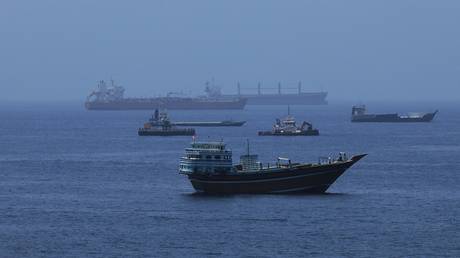
Salt crusts on the window of a tanker wheelhouse before the sun even clears the jagged peaks of the Persian Gulf. Captain Tariq wipes the glass with a calloused thumb, his eyes fixed on the horizon where twenty-one miles of blue water separate two worlds. To his right lies the arid coast of Oman; to his left, the steep, iron-colored cliffs of Iran. Between them runs a shipping lane barely two miles wide for heavy traffic, a compressed bottleneck carrying a fifth of the petroleum that keeps global engines turning.
For thirty years, Tariq has guided supertankers through the Strait of Hormuz. He knows the personality of the tide here, the way the currents pull a quarter-million-ton hull toward hidden shallows if the rudder slips even a fraction of a degree. But lately, the physical hazards of wind and water have been eclipsed by something far less tangible. A frequency on the radio. A quiet shift in the invisible lines of authority drawn across the sea.
When international agreements fracture and diplomatic channels go cold, the map of the world does not change on paper. It changes on the water. Recent strategic realignments and bilateral understandings are quietly rewriting who holds the keys to this maritime gate, giving Tehran a firmer hand on the choke point through which global commerce must pass.
To understand what this means, you have to stand on the bridge of a vessel carrying two million barrels of crude oil when the VHF radio crackles to life.
Revolutionary Guard patrol boats do not need to board a ship to assert dominance. Their presence alone alters the calculus of every captain, every shipping insurer, and every corporate board room from Tokyo to Houston. A few years ago, passing through Hormuz meant acknowledging international maritime law and the right of innocent passage through a global commons. Today, it increasingly means checking off a mental inventory of who holds de facto veto power over your cargo.
Consider a hypothetical grain shipment headed for the Persian Gulf, or a liquefied natural gas carrier bound for European terminals. Under the evolving framework of regional accommodations, Iranian maritime forces are cementing an operational reality: if you want to pass, you acknowledge our gaze. You answer our hails promptly. You heed our vector adjustments.
This is not a sudden military invasion. It is something much more durable. It is administrative gravity.
Geography is destiny, and Iran sits squarely on the northern lip of the most important energy corridor on Earth. When distant capitals negotiate deals that concede regional hegemony or lift enforcement pressures, the local power vacuum fills immediately. Water flows downhill, and authority flows to the strongest resident actor. By expanding cooperative security agreements with neighboring states and securing bilateral maritime protocols, Tehran is institutionalizing its oversight.
The market feels this long before the consumer pays an extra cent at the pump.
Marine insurance underwriters in London do not panic easily, but they do calculate risk with cold precision. When a single nation gains enhanced tactical control over a critical strait, the risk premium on every hull traversing that water ticks upward. Premiums compound. Shipping lines adjust routes or demand higher spot rates. The cost of a barrel of oil is not just the price extracted from the earth in the Ghawar field or the Permian Basin; it is the accumulated tax of anxiety paid every time a steel behemoth slips past the Greater and Lesser Tunb islands.
We forget how fragile the modern nervous system of global trade really is. We live surrounded by manufactured abundance, assuming that goods arrive by magic, that oil simply appears in storage tanks, that the global supply chain is an indestructible highway. It is not a highway. It is a tightrope. And the Strait of Hormuz is the narrowest part of that rope.
Tariq remembers when the strait felt international. Navies from half a dozen nations patrolled the blue expanse, maintaining a fragile balance that kept the commercial lanes open and neutral. Today, those external guarantees are receding. Regional powers are carving out spheres of influence, and international maritime conventions are bending to the weight of local muscle.
When control over a shipping lane shifts, the consequences ripple outward in concentric circles.
First, the immediate neighbors adjust their posture. Nations that rely entirely on the export of their hydrocarbons find themselves accommodating the new sheriff in the corridor. Diplomacy becomes a series of quiet concessions. You do not invite confrontation when the key to your economic survival hangs by a thread held by your neighbor across the gulf.
Second, global logistics firms begin recalculating margins. Alternative pipelines exist, yes—routes across Saudi Arabia to the Red Sea, or overland corridors through the United Arab Emirates. But they cannot carry the sheer volume of a daily armada of supertankers. The math remains stubborn. Hormuz is irreplaceable.
Third, and most invisibly, the psychological climate of the region hardens. A captain approaching the strait no longer looks out at a neutral sea. Every radar blip is scrutinized with heightened anxiety. Every radio transmission carries the weight of potential detention, seizure, or diplomatic escalation. The margin for error shrinks to zero.
History is filled with narrow waters that decided the fate of empires. The Bosporus. The Malacca Strait. The Panama Canal. Whenever a single entity secures dominant leverage over one of these economic jugulars, the global balance of power undergoes a quiet tectonic shift. No shots need to be fired. No formal declarations of war need to be published. The reality is established on the water, enforced by patrol craft, and accepted by a world too exhausted to contest every nautical mile.
The sun dips below the horizon, painting the oil-slicked harbor of Bandar Abbas in bruised shades of violet and orange. Captain Tariq turns away from the window, pulling his cap lower against the evening chill, and reaches for the engine telegraph to check his speed. Out in the darkness, the lane is waiting. The water is the same as it has always been, ancient, deep, and indifferent. But the hand on the rudder is changing, and the world has not yet realized how much heavier the passage has become.