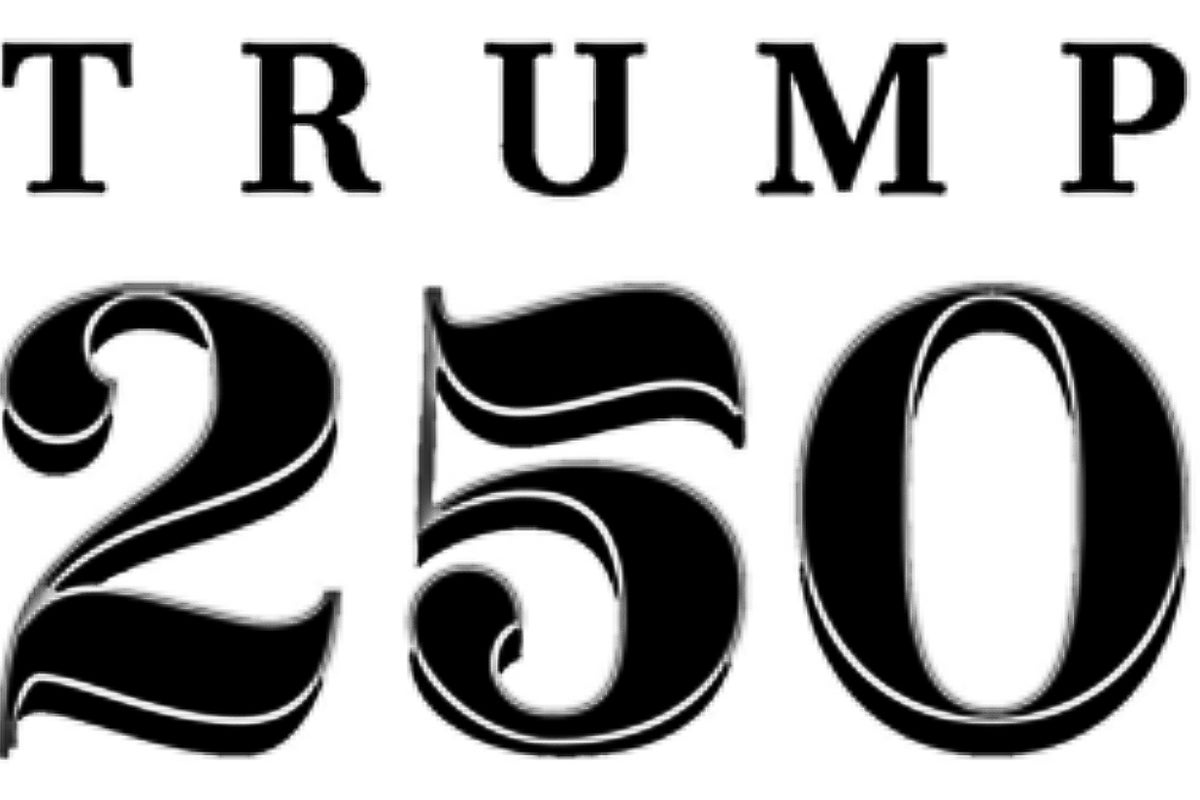
The ink on a trademark application is usually cold. It is the language of clerks and cubicles, a dry recitation of international classes and filing codes. But when the Trump Organization filed for the rights to the phrase "Trump Semi-Quincentennial," the paper didn’t just represent a business move. It represented a collision between the personal brand of one man and the 250th anniversary of the United States.
Imagine a small-town parade in the summer of 2026. Flags are snapping in the breeze. The air smells of charcoal and asphalt. Now, imagine that the very name of the celebration—the milestone of a quarter-millennium of American history—is owned. Not by the public, not by the Library of Congress, but by a private family office in a gold-trimmed tower in Manhattan.
The filings, submitted to the U.S. Patent and Trademark Office, reveal an ambition that goes far beyond typical political merchandising. The Trump Organization is seeking to lock down the "Trump 250" and "Trump Semi-Quincentennial" monikers across a staggering array of products. We aren't just talking about hats. We are talking about glassware, decorative magnets, luggage, and even Christmas tree ornaments.
It is a play for the soul of a celebration.
The Business of Being a Founder
Trademarking a name isn't a new strategy for the former president. The name "Trump" has been slapped onto everything from steaks to high-rises for decades. However, tying that name to a specific, unrepeatable moment in national history creates a different kind of friction.
Usually, national anniversaries are a free-for-all for the public imagination. In 1976, during the Bicentennial, you could buy a red-white-and-blue toaster from just about anyone. No single entity claimed the right to own the "Bicentennial" itself. But the 250th birthday—the Semi-Quincentennial—is being approached through the lens of modern brand warfare.
Consider the hypothetical shop owner in a swing state. Let’s call him Elias. Elias wants to sell commemorative mugs that celebrate both the 2024 election victor and the 250th anniversary of the Declaration of Independence. If these trademarks are granted, the legal perimeter around that combination of words becomes a minefield. Elias might find himself receiving a cease-and-desist letter not from a government agency, but from a private legal team protecting a corporate asset.
This is the invisible stake: the privatization of a public milestone. It turns a moment of national reflection into a proprietary product line.
A History of Claiming the Map
The Trump Organization’s move follows a long-standing pattern of "defensive" and "offensive" filing. They aren't just looking to sell shirts; they are looking to prevent anyone else from doing so. By securing these terms early, they ensure that the "official" merchandise of the 250th anniversary—at least for a specific segment of the population—is funneled through a single family’s ledger.
The math of it is simple. The 250th anniversary will be a multibillion-dollar cultural event. Every city, every school, and every brand will want a piece of the nostalgia. By anchoring the Trump name to the year 2026, the organization is effectively attempting to brand the calendar itself.
But there is a technical hurdle that most people miss. To win a trademark, you have to prove that the name identifies the source of the goods. You have to prove that when people see "Trump 250," they think of a specific business entity, not just a historical event. The Patent Office often looks askance at attempts to trademark phrases that are "merely descriptive" or "geographically descriptive."
Yet, Donald Trump has a unique advantage here. He is the brand. His legal team will likely argue that his involvement in the 250th anniversary—perhaps as a returning president or a leading political figure—makes the phrase synonymous with his personal venture.
The Emotional Toll of the Trademark
There is a certain exhaustion that comes with the branding of everything. We live in an era where stadiums are named after insurance companies and parks are sponsored by soft drinks. We are used to it. But the 250th anniversary of a country is supposed to be the one thing that belongs to everyone and no one.
When a private organization moves to claim the language of that anniversary, it creates a sense of exclusion. It tells a portion of the country that this birthday has a gatekeeper.
Take a moment to think about the word "Semi-Quincentennial." It is a mouthful. It is clunky, Latinate, and hard to spell. Most people won’t even use it; they’ll just say "the 250th." But in the world of law, that clunky word is a valuable piece of intellectual property. By claiming it, the Trump Organization is planting a flag in the linguistic soil of the future.
The Legal Gauntlet
The process won't be a cakewalk. The U.S. Patent and Trademark Office is notoriously finicky about political figures. There are rules against registering trademarks that consist of or comprise the name, portrait, or signature of a living individual without their written consent. Since Donald Trump obviously consents to his own organization using his name, that's not the issue.
The real issue is "dilution" and "confusion." Will the public believe that the U.S. government is endorsing these products? Will they think the "Trump 250" mug is the official mug of the United States of America?
If the government decides that the trademark creates a false suggestion of a connection with a national symbol or institution, the application could be rejected. But the Trump legal team is experienced. They know how to navigate the gray areas. They will argue that this is simply a commercial extension of a well-established brand, no different than "Trump Golf" or "Trump Winery."
The Ghost of 1776
The irony is thick. The men who gathered in Philadelphia in 1776 were, in many ways, rebels against the idea of royal monopolies. They were fighting against the notion that a single family or a single crown could own the rights to a tea trade or a territory.
Now, 250 years later, the tools of the very democracy they built are being used to create a new kind of monopoly—a monopoly on the memory of their rebellion.
It isn't just about money. It never is with trademarks of this scale. It is about the legacy. It is about making sure that when the history books are written about the year 2026, the name "Trump" is inextricably linked to the celebration. It is an attempt at immortality through the United States Patent and Trademark Office.
The Customer at the Counter
Consider the grandmother looking for a souvenir for her grandson. She sees two ornaments. One is a generic bell with "1776–2026" on it. The other is a "Trump 250" ornament, shimmering in gold, marketed as a limited-edition piece of history.
Which one does she choose?
The trademark ensures that if she chooses the gold one, the profits flow back to a private estate. It ensures that the competition—the smaller vendors, the independent artists—cannot use that specific combination of words to catch her eye. It thins the herd of available ideas.
We often think of trademarks as shields, protecting businesses from copycats. But in this case, the trademark is a sword. It is being used to clear a path through the crowded marketplace of the American identity, carving out a space where only one brand is allowed to stand.
The Weight of the Future
As 2026 approaches, the tension between public history and private branding will only grow. We will see more of these filings. We will see more attempts to capture the lightning of the American spirit and bottle it for retail.
The Trump Organization is simply the first to move with such audacity. They have recognized that in the modern world, he who owns the name owns the narrative.
Whether the Trademark Office allows it or not, the message has been sent. The 250th anniversary isn't just a date on the calendar anymore. It is a product. It is a campaign. It is a brand.
And for the man whose name is on the tower, it is the ultimate acquisition.
The sun will set on July 4, 2026, regardless of who owns the rights to the words we use to describe it. The fireworks will still burst in the same patterns of red and white. But for those watching, there will be a nagging question in the back of the mind: who owns the birthday of the free?