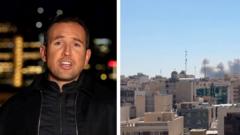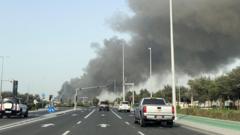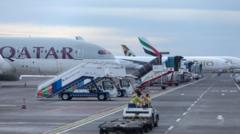
The headlines follow a predictable, weary script. War clouds gather in the Middle East, and suddenly, the British government "mounts an operation" to save its citizens. We see photos of RAF Voyagers on the tarmac and hear soaring rhetoric about "standing ready." It’s presented as a triumph of logistics and a testament to the state’s reach.
It is actually a confession of systemic incompetence.
Governments treat mass evacuations like a heroic insurance policy. In reality, they are the final, desperate symptom of a foreign policy that has lost its grip on ground truth. We are obsessed with the mechanics of the "get out" while ignoring the rot that makes the "stay" impossible.
The standard narrative suggests that thousands of Britons are victims of sudden, unpredictable shifts in regional stability. This is a lie. Stability doesn’t vanish overnight; it erodes over months of ignored warnings and failed diplomacy. When the Foreign, Commonwealth & Development Office (FCDO) starts chartering planes, it isn't "supporting" its citizens. It is scrambling to fix a mess it failed to prevent, using your tax money to subsidize the risk of those who ignored the "Do Not Travel" warnings for years.
The Logistics of Performance Art
Most people assume an evacuation is a precise, military-grade extraction. I have seen how these operations actually function from the inside. They are chaotic, reactive, and largely performative.
The UK government currently talks about pre-positioning troops in Cyprus and preparing the Red Ensign group for maritime extraction. It sounds "robust." It isn't. An evacuation of 10,000+ people from a congested urban environment like Beirut or a collapsing infrastructure in the Levant is a nightmare that no amount of RAF transport can solve.
- The Bottleneck Fallacy: You can have fifty planes on the runway in Akrotiri, but if the road to the airport is controlled by a local militia or blocked by two million terrified locals, your planes are expensive lawn ornaments.
- The Intelligence Gap: The FCDO relies on voluntary registration. At any given time, they have no idea exactly how many dual nationals are actually on the ground. They are planning for a number they’ve essentially guessed.
- The Financial Moral Hazard: We have created a culture where the state acts as a free concierge for the adventurous. If you choose to maintain a business or a lifestyle in a known "High Risk" zone against explicit government advice, why is the public purse responsible for your business-class exit when the inevitable happens?
We need to stop calling these "rescue missions." They are expensive clean-up crews for those who gambled on stability and lost.
The Cost of the "Safety" Illusion
The UK spends millions on these surges. That is money diverted from long-term regional intelligence and diplomatic presence—the very things that might actually prevent the need for a surge in the first place.
Consider the mathematics of a standard evacuation. To move 1,000 people via military airlift in a non-permissive environment, the cost per head can exceed £15,000 when you factor in fuel, security, staffing, and the opportunity cost of diverting military assets from actual defense duties.
By the time the government tells you to leave, the market has already told you. Commercial flights disappear not because the planes aren't there, but because the insurance premiums for the airlines have spiked. The government isn't providing a service; it's providing an insurance bailout.
Why the "Consular Assistance" Promise is a Trap
The British public has been conditioned to believe that a blue passport is a magical shield. This "Consular entitlement" is a dangerous myth.
The FCDO’s own small print admits they have no legal obligation to evacuate you. They do it because it looks good on the evening news. This creates a "Consensus of Safety" where individuals stay in danger zones longer than they should because they believe the "Operation" will always be there to catch them.
Imagine a scenario where the UK government spent that same "Operation" budget on permanent, localized crisis infrastructure instead of last-minute hardware. Or, more controversially, what if the government mandated "Crisis Insurance" for any citizen traveling to or living in a Level 4 risk zone?
If you want to live in a tinderbox, you should pay for the fire engine.
The Diplomacy of Cowardice
The most offensive part of the "mount an operation" rhetoric is that it masks a total lack of leverage. When we see the UK moving ships into the Eastern Med, it isn't to project power; it's to signal to the domestic electorate that "we are doing something."
Real power would be the ability to influence the actors on the ground to maintain a corridor of safety. Since we’ve largely outsourced our Middle Eastern policy to Washington or neutralized our influence through inconsistent regional engagement, we are left with the only tool we have: the bus.
We are no longer a player in the region; we are the cleanup crew.
The Brutal Reality of the Extraction List
When the crunch comes, the "Operation" becomes an exercise in cold, bureaucratic triage.
- Tier 1: Diplomatic staff and their families (The "Essentials").
- Tier 2: British passport holders with no other residency.
- Tier 3: Dual nationals.
- Tier 4: Dependents and local staff.
In every major evacuation of the last twenty years—from Kabul to Khartoum—this hierarchy has led to heartbreak and abandoned allies. The "operation" isn't for everyone. It’s for the people who make the government look the worst if they get captured or killed.
If you are a dual national living in a village outside the capital, the "UK mounting an operation" means nothing to you. You are on your own. The government just won’t say that until the last plane has already cleared the airspace.
Stop Asking if the Government is Ready
People always ask: "Is the UK ready to evacuate its citizens?"
It’s the wrong question. The real question is: "Why are there still 10,000 citizens there who think the government can save them?"
The move to deploy 700 troops to Cyprus isn't a sign of strength. It is a sign that the UK has accepted that the region is going to burn and we have zero ways to stop it. We have retreated from the role of the architect and accepted the role of the ambulance driver.
We need to dismantle the expectation of the "Rescue." If you are in a conflict zone, the responsibility for your life belongs to you, not a taxpayer in Manchester who has never left the county.
The government’s "Operation" is a sedative for the public. It’s a way to pretend we still have a "Global Britain" footprint when all we really have are a few aging transport planes and a lot of hope.
The next time you see a headline about the UK "mounting an operation" in the Middle East, don't feel proud. Feel embarrassed. It means we’ve already lost the plot.
If the planes are warming up, the diplomacy has already died. Get out on your own terms, on your own dime, or accept that you are a pawn in a logistical photo-op that will likely leave you standing at a closed gate while the last C-17 disappears into the clouds.
The state is not your bodyguard. It’s just the guy who files the paperwork after you’re gone.