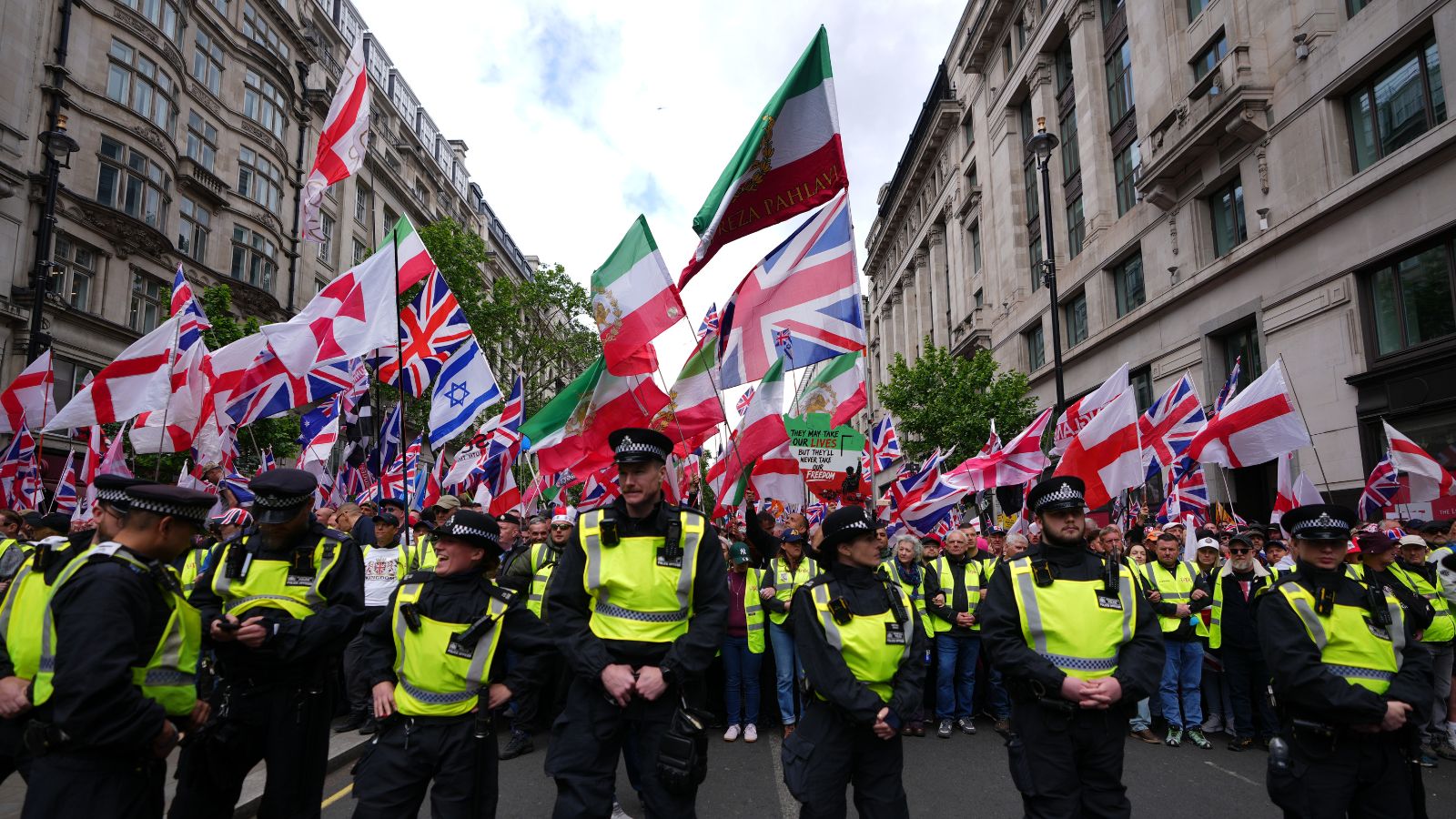
The modern political protest is dead. What we have instead is a fractured, multi-headed bazaar of grievances, and the mainstream media is utterly terrified of it.
Look at the recent headlines coming out of London. Thousands gathered. Demands flew from every corner—some shouting for the removal of Prime Minister Keir Starmer, others demanding the release of hostages in the Middle East, and still more waving banners for localized economic relief. The establishment press looked at this sprawling, chaotic assembly and instantly panicked. They slapped on a label: "agitators." They painted a picture of a coordinated, dangerous mob united by a singular, sinister intent to disrupt civil society. Recently making news recently: The Moscow Air Defense Bottleneck: Quantifying Third-Party Attrition in Deep Strike Operations.
It is a lazy, outdated narrative. It is also entirely wrong.
The media’s insistence on viewing large public gatherings through a 20th-century lens—where every march must have a singular manifesto and a clear, undisputed leader—is a coping mechanism. It is easier to dismiss a crowd of twenty thousand people as erratic "agitators" than it is to confront a much more uncomfortable reality: our political systems are failing to aggregate public opinion, and the streets have become the clearinghouse for a bankrupt political discourse. Further details on this are covered by TIME.
The Fallacy of the Single-Issue Movement
For decades, political scientists and media executives operated on a simple premise. A protest meant a group of people marched for Point A to achieve Outcome B. Think of the anti-war protests of 2003 or the miners' strikes of the 1980s. There was a clear target, a clear demand, and a clear group of representatives.
Those days are gone. Welcome to the era of the intersectional omni-protest.
When you see a crowd in London simultaneously protesting British foreign policy, domestic austerity, and the leadership of the Labour party, you are not witnessing a coordinated uprising. You are witnessing a collision of desperate demographics. The assumption that the guy holding a "Starmer Out" sign agrees on every geopolitical nuance with the person demanding international hostage releases is a fundamental misunderstanding of modern public assembly.
The Aggregation Problem
In economic theory, the Market Failure Theory dictates that when a market cannot efficiently allocate goods and services, an external correction occurs. We are seeing a political failure of the same magnitude.
The standard democratic process—voting once every few years for a pre-packaged party platform—no longer filters the specific anxieties of the electorate. When the official opposition behaves like the ruling party, and the ruling party behaves like a technocratic board of directors, citizens lose their standard channels of grievance.
The street becomes the open-source platform.
Imagine a scenario where an online forum has no moderators and no specific topic threads. Everyone posts their biggest emergency simultaneously. That is what happened in central London. It is not an organized threat to democracy; it is the natural consequence of a political system that has closed its ears to nuance. Calling these people "agitators" is like blaming the thermometer for the fever.
Why the Establishment Craves "Agitators"
The word "agitator" is a weaponized piece of linguistic laziness. It implies that the thousands of people who spent their Saturday marching through the rain were manipulated by hidden puppet masters. It strips the participants of their agency.
Why does the media do this? Because nuance doesn’t generate clicks, and structural failure doesn't fit into a two-minute broadcast segment.
| Media Narrative | The Empirical Reality |
|---|---|
| A coordinated mob with a unified, disruptive agenda. | A decentralized collection of distinct groups sharing physical space. |
| Dangerous radicals rejecting democratic norms. | Frustrated citizens utilizing the only visible platform left to them. |
| Led by fringe political operators. | Spontaneous, algorithmic organization with no central command structure. |
I have spent years analyzing political movements and organizational structures. I have watched legacy media organizations melt down in real-time trying to cover decentralization. When the Occupy Wall Street movement refused to appoint a single leader in 2011, the press corps didn't know how to book them for interviews. The same thing is happening now. The institutional mind cannot comprehend a crowd that speaks in twenty different voices at once.
By branding a multi-faceted crowd as a singular mass of "agitators," the state and the media achieve a dual purpose:
- They excuse themselves from addressing any specific, legitimate grievance.
- They justify an increasingly authoritarian policing response.
If a protest is a chaotic mess of contradictory demands, a government doesn't have to fix the NHS, rewrite foreign policy, or address the cost-of-living crisis. They can just label the whole thing a public nuisance and move on.
Dismantling the "People Also Ask" Delusions
When events like the London protests occur, the internet searches for answers based on fundamentally flawed premises. Let's dismantle the most common assumptions guiding public perception right now.
"Are these protests making London unsafe?"
This is the classic suburban panic question. The short answer is no. The long answer requires looking at crime statistics versus political disruption.
The vast majority of large-scale demonstrations in Western capitals involve zero significant violence. Property damage is rare; physical assaults are rarer still. The discomfort people feel is not a threat to their safety; it is a threat to their convenience. Traffic is diverted. Trains are crowded. The illusion of a placid, perfectly compliant metropolis is temporarily shattered.
To mistake architectural friction for physical danger is a luxury of the insulated. A city that cannot tolerate a clogged thoroughfare for an afternoon is a city that doesn't understand the mechanisms of its own liberty.
"Why can't protesters just focus on one issue?"
This question assumes that human lives are lived in neat, isolated silos.
If you are a working-class resident in East London, your anger about skyrocketing rents is intimately tied to your anger about utility bills, which is tied to your anger about a government that seems to find endless resources for foreign entanglements while cutting local council budgets.
The demand for a "clean," single-issue protest is a demand for a polite, easily ignorable protest. It asks the vulnerable to compartmentalize their hardship so that onlookers don't have to think too hard.
The Dark Side of Decentralized Dissent
Lest this be mistaken for a romantic defense of every person on the street, let’s be brutal about the downside of this new reality.
While the media’s panic over "agitators" is absurd, the complete lack of cohesion within these movements presents a massive structural flaw. When a protest represents everything, it ultimately represents nothing.
A movement with a thousand different slogans cannot negotiate. It cannot send a delegation into 10 Downing Street to hammer out a deal, because no single person in that crowd has the mandate to speak for the rest. The crowd that gathered to protest Starmer and demand hostage releases simultaneously has no mechanism for accountability.
This is the tragedy of modern activism. The same decentralization that makes a movement impossible for the state to crush also makes it impossible for the movement to win. It becomes a form of political performance art—loud, cathartic, visually striking, but functionally impotent.
The Reality Check
Stop looking at aerial footage of crowds and searching for a cohesive plot. There is no plot. There is no mastermind behind the curtain orchestrating a synchronized assault on British values.
What you are seeing is the fragmentation of the public square. The traditional institutions that once managed public discontent—trade unions, local political chapters, community churches—have been systematically hollowed out. In their absence, the street corner and the algorithmic feed are all that remain.
The thousands of people who marched in London weren't a unified army of agitators. They were a vivid, messy portrait of a society that has forgotten how to talk to itself. They are the symptoms of a political system that treats citizens like consumers, wondering why the consumers are suddenly trying to break down the storefront doors.
The media will keep screaming about chaos and coordination because it keeps the eyeballs glued to the screen. But the real story isn't the threat of a mob uprising. It's the profound, terrifying silence of a government that has nothing left to say to its people.