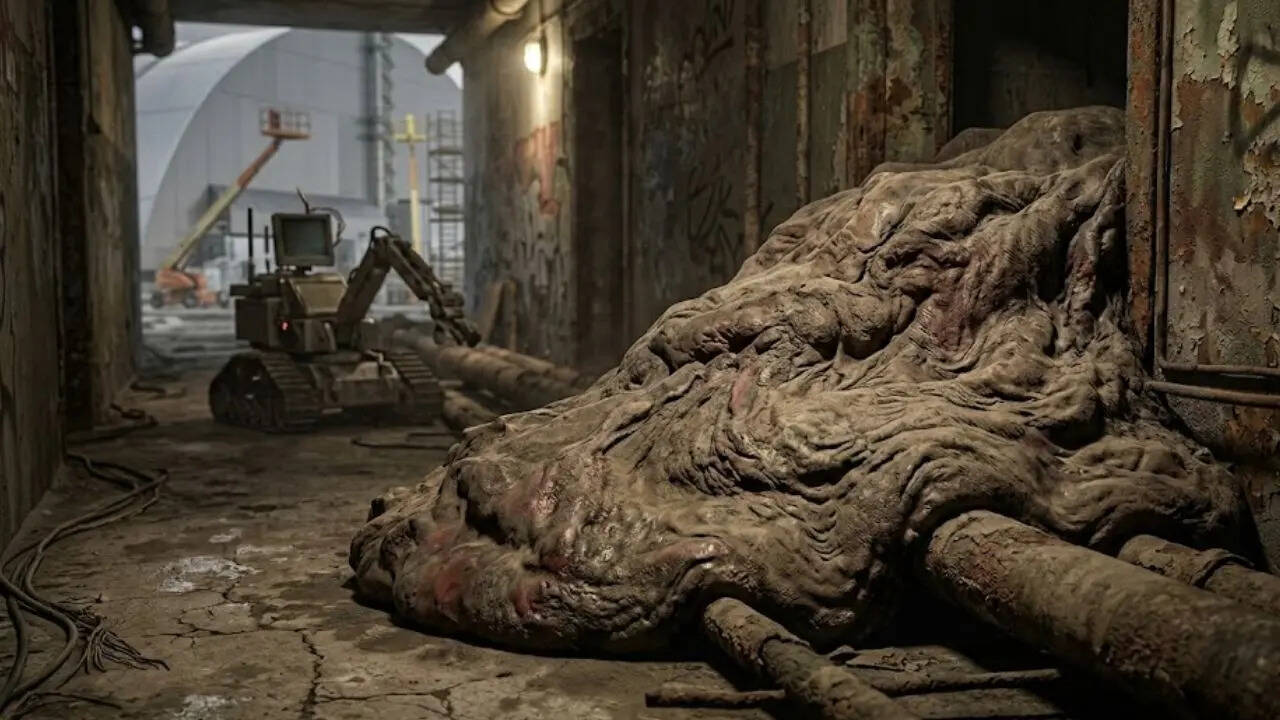
Deep beneath the shattered ruins of Chornobyl Reactor Number 4, tucked away in a dimly lit corridor, sits a mass of hardened volcanic material known to the world as the Elephant’s Foot. It is arguably the most famous toxic artifact on the planet. For decades, popular media has cast this object as an immortal, ever-burning, indestructible monster. The narrative suggests that it remains a singular, static threat that defies science and time.
The truth is far more nuanced. The Elephant’s Foot is not an indestructible monolith. It is a corium formation, a ceramic lava created in 1986 from molten nuclear fuel, sand, zirconium, and concrete. It is not currently "burning" in a traditional sense, nor is it an impenetrable barrier to human ingenuity. The reality is that the Elephant’s Foot is slowly self-destructing, turning into dust under the weight of its own radioactive decay.
The Physics of Decay
The common perception of the Elephant’s Foot ignores the fundamental reality of atomic instability. The mass is effectively a glass matrix—a silicate ceramic—trapping uranium and fission products. Because it is highly radioactive, the interior of this material is constantly bombarded by its own emissions.
This is a process called self-irradiation. Over time, alpha particles and other forms of radiation tear through the atomic structure of the ceramic glass, breaking chemical bonds and causing the material to lose its physical integrity. The surface of the foot has visibly changed over the decades. What was once a smooth, glass-like substance when first photographed in the late 1980s has transformed into a brittle, cracked, and increasingly porous mass.
It is not failing to be destroyed by human effort; it is being destroyed by the laws of physics. The foot is literally crumbling into rubble.
Why Removal Remains Delayed
If the material is disintegrating, the logical question is why we have not already vacuumed it up and buried it in a deep geologic repository. The obstacle is not a lack of technology, but a matter of risk-benefit calculation and logistical nightmare.
Radiation exposure remains the primary barrier. While the intensity of the Foot has dropped significantly since the disaster—thanks to the decay of short-lived isotopes like cesium and strontium—it remains lethal. Proximity to the mass for even a short duration can cause severe radiation sickness. For years, the priority was not to dismantle the Foot, but to contain the entire ruins of Reactor 4.
The New Safe Confinement (NSC), a gargantuan steel arch completed in 2016, was the necessary first step. It stabilized the site, preventing further collapse of the damaged structure and shielding the area from the elements. Dismantling the interior of the reactor, including the various corium masses, is a process that requires specialized robotics capable of operating in high-radiation environments for extended periods. The industry currently lacks an incentive to rush this extraction. The material is contained, it is monitored, and it is not leaking into the groundwater. In the world of nuclear decommissioning, leaving it to stabilize—and continue its natural decay—is the safest path forward.
Challenging the Radioactive Narrative
The reputation of the Elephant’s Foot as the "most radioactive object in history" is a historical exaggeration that has outlived its usefulness. While it was undeniably lethal in the immediate aftermath of 1986, it is no longer the sole, or even the primary, threat within the exclusion zone.
Spent fuel rods in other locations can produce radiation fields orders of magnitude higher than those of the Foot. There are other, less famous corium formations in the basement of the plant that carry their own risks. The focus on the Elephant’s Foot often serves as a distraction from the broader, more complex challenge of the entire site: thousands of tons of radioactive debris, contaminated water, and the structural instability of the original, failing sarcophagus.
The Future of the Corium
The fate of the Elephant’s Foot is settled by the march of time. Eventually, the radiation levels will drop to a point where robotic intervention becomes far easier. At that stage, the mass will be broken down, collected, and treated as high-level nuclear waste.
There is no magical, insurmountable mystery behind why it still exists. It exists because the cost of premature removal outweighs the risk of letting it remain in a secure, shielded facility. We are currently in the waiting phase. Every day, the radioactivity declines, and the structural integrity of the ceramic continues to wane.
The danger is not that it will remain forever. The danger is the impatience of observers who expect an overnight solution to a problem that requires decades of methodical, incremental work. The Elephant’s Foot is not an apex monster. It is a piece of industrial waste, a testament to a catastrophic engineering failure, and a problem currently being solved by the slow, inevitable process of radioactive half-life. We are not waiting for a miracle. We are waiting for the physics to catch up to our capability.