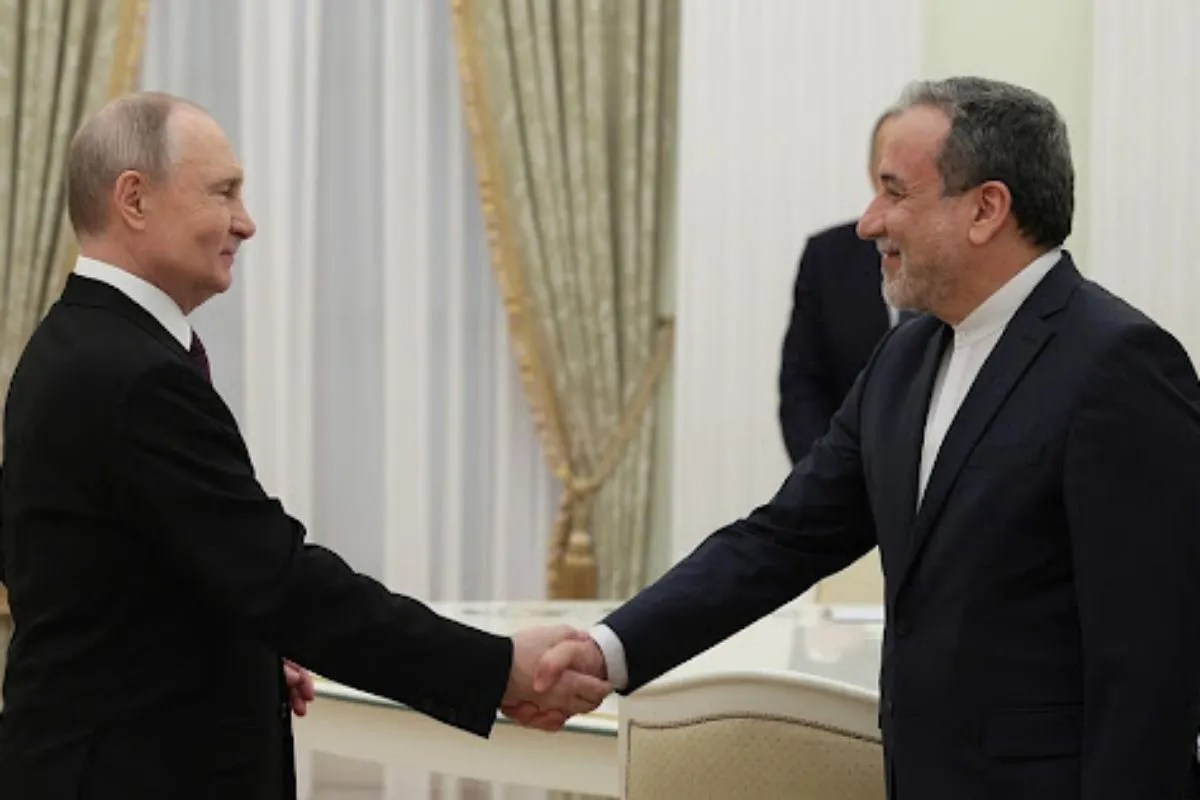
The air in Moscow during a diplomatic summit doesn't just feel cold; it feels heavy. It is a specific type of atmospheric pressure that exists when the world’s most sanctioned capitals decide to redraw the lines of the global map. When Iranian Foreign Minister Abbas Araghchi stepped onto the tarmac for his high-stakes visit, he wasn't just carrying a briefcase. He was carrying the collective breath of a region on the brink.
Diplomacy is often portrayed as a series of handshakes and staged photos. The reality is far more visceral. It is the sound of a pen scratching against paper in a room where the heaters are humming too loudly. It is the sight of two men, Araghchi and his Russian counterparts, looking at a globe and seeing not countries, but vulnerabilities.
The Weight of the Atomic Ghost
For years, the Joint Comprehensive Plan of Action (JCPOA) has been a ghost. It haunts every corridor of the Iranian Foreign Ministry. Araghchi knows this ghost better than anyone. He was one of its original architects, a man who spent months in Viennese hotels trying to trade centrifuges for a chance at a normal economy. Now, in the halls of the Kremlin, the stakes have shifted from theoretical physics to immediate survival.
Consider a family in Isfahan. They do not care about the technicalities of uranium enrichment percentages. They care about the price of medicine and whether the lights will stay on through the winter. For them, Araghchi’s flight to Russia is a desperate reach for air. If Russia can act as a bridge back to a nuclear consensus—or at least a shield against further isolation—that family might see the inflation curve flatten.
Russia occupies a strange position here. It is no longer just a mediator; it is a partner in a very exclusive club of nations that the West has attempted to shut out. This creates a unique brand of chemistry. When Araghchi sits across from Russian officials, they aren't speaking through the filter of Western expectations. They are speaking the language of the besieged.
The Geometry of a Ceasefire
The headlines shout about "game-changers," but the truth is found in the quiet geometry of the battlefield. The conflict in the Middle East has become a tangled web of proxies, precision strikes, and ancient grievances. Araghchi’s visit isn't just about Tehran and Moscow; it’s about Beirut, Gaza, and the shipping lanes of the Red Sea.
Russia has spent decades cultivating a role as the "honest broker" in the Middle East, maintaining ties with Israel, Iran, Saudi Arabia, and the Emirates. But that balancing act is wobbling. Iran needs Russia to use its leverage to cool the temperature. A ceasefire isn't just a humanitarian necessity; it is a strategic requirement for a regime that cannot afford a full-scale regional conflagration while its economy is tied to a ventilator.
Imagine the map spread out on a mahogany table. One finger points to the borders of Lebanon; another traces the path of drones over the desert. The conversation isn't about peace in the poetic sense. It is about "de-escalation management." It is about finding the exact point where everyone can stop shooting without looking like they’ve lost.
The Invisible Currency of Survival
We often talk about trade deals in terms of billions of dollars. In the context of the Iran-Russia axis, the currency is different. It is hardware. It is intelligence. It is the "North-South Transport Corridor." This isn't just a collection of railway tracks and ports; it is a bypass surgery for the global heart.
By connecting Russian forests to the Persian Gulf, these two nations are trying to build a world where the US dollar doesn't hold the keys to the kingdom. Araghchi’s mission is to ensure that this corridor is more than just a blueprint. For a merchant in Tehran, this could mean Russian grain arriving without the interference of maritime sanctions. For a technician in Kazan, it could mean Iranian software or drone technology keeping a factory line moving.
The irony is thick. Two of the world's most historic empires are leaning on each other to avoid a future where they are footnotes in a Western-led century.
The Person at the Center of the Storm
Abbas Araghchi is not a firebrand. He is a career diplomat, a man who understands that in the world of power, a whisper often carries further than a scream. His presence in Moscow is a signal to the incoming administrations in the West. It says: We have options.
But options come with costs. Aligning too closely with Moscow during the ongoing crisis in Ukraine tethers Iran’s fate to a conflict it didn't start. It is a gamble of breathtaking proportions. If Russia succeeds in stabilizing its own front, Iran gains a powerful, permanent patron. If the Russian experiment falters, Iran finds itself doubled down on a losing hand.
There is a certain loneliness in this kind of diplomacy. Araghchi is operating in a space where trust is a luxury no one can afford. Every smile for the cameras is a calculation. Every shared statement is a compromise.
Beyond the Brink
The world watches these meetings with a mix of fatigue and dread. We have seen "historic" visits before. We have heard the promises of new eras. Yet, there is something different about this specific moment in 2026. The old guard of global politics is fraying. The institutions that used to govern these disputes—the UN, the IAEA—are often reduced to spectators.
In this vacuum, the bilateral meeting becomes the supreme authority. Araghchi and his hosts are aware that the world they are building might be fractured, but it will be theirs. They are moving away from the "tapestry" of international cooperation toward a jagged, functional reality of necessity.
As the sun sets over the Moskva River, the motorcades hum back toward the airport. The documents signed today won't change the world tomorrow morning. They won't instantly lower the price of bread in Tehran or stop the drones from flying. But they move the needle. They shift the gravity.
The true impact of Araghchi’s journey won't be found in the official communiqué. It will be found in the silence of a missile battery that doesn't fire, or the sudden, unexpected resumption of a bank transfer that was previously blocked. It is the slow, grinding work of staying alive in a world that has decided you shouldn't exist.
The map has been redrawn. The ink is still wet. Araghchi is flying home, leaving behind a Moscow that is no longer just a destination, but an anchor.