The paper cup was warm against Sarah’s palm at 7:14 AM. Steam curled upward into the grey morning air, carrying the sharp, comforting scent of dark roast. She took a sip, checked her watch, and hurried toward the train station. By 7:35 AM, that exact cup would be empty, tossed casually into a public wire basket alongside a hundred others.
To Sarah, the cup had served its purpose. To the rest of the world, it had just begun an absurdly long afterlife. Expanding on this idea, you can find more in: The Ghost Behind the Podium And Why Universities Are Demanding More.
We live in a culture built on the cult of the disposable. Every single morning, millions of us perform a quiet ritual: we extract liquid energy from beans, pour it into a vessel engineered to survive a nuclear winter, and then discard it without a second thought. We are creatures of convenience, trading permanence for a twenty-minute caffeine fix. But garbage does not simply vanish when the sanitation truck rumbles down the street. It accumulates. It waits.
Consider the sheer scale of the habit. Billions of single-use coffee cups manufactured every year, lined with microscopic polyethylene plastic to prevent leaks, rendering them virtually immune to traditional paper recycling facilities. They stack up in landfills. They drift across ocean currents. They break down into stubborn microplastics that eventually find their way back into the food chain, resting quietly in the bloodstream of the very people who drank the morning brew. Analysts at Glamour have shared their thoughts on this situation.
For decades, the response to this crisis has been an exhausted shrug. Municipalities threw their hands in the air, citing prohibitive sorting costs and logistical nightmares. Environmentalists shouted into the void, waving statistics that washed over the public like white noise. People felt guilty, bought reusable thermoses, forgot them on the kitchen counter, and returned to the familiar convenience of the cardboard-and-plastic cylinder.
Change rarely arrives through massive, society-wide epiphanies. More often, it slips in through the back door, disguised as a mundane municipal public works project.
In 2023, somewhere down under on the suburban asphalt of Australia, a quiet revolution took place beneath the tires of everyday commuters. Engineers did not invent a miraculous new chemical compound. They did not launch a multi-billion-dollar global initiative. Instead, they looked at a pile of trash and saw a foundation.
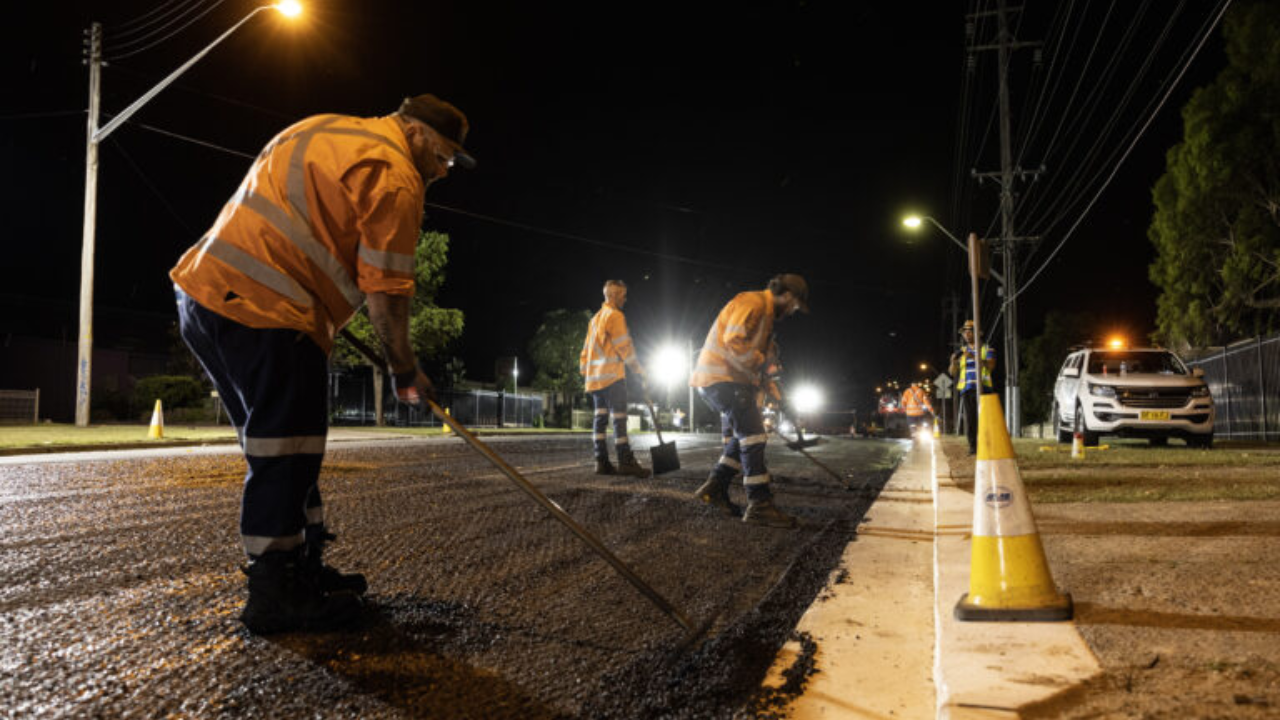
Picture a standard road crew in a quiet suburb. The air smells of dust, sweat, and diesel fuel. Heavy machinery growls against the tarmac. But look closer at the raw materials spilling out of the dump trucks. Mixed into the traditional bitumen and rock aggregate are crushed remnants of everyday life. One hundred thirty-five thousand items, to be precise.
This is a hypothetical scenario grounded in verified municipal data, but imagine the sorting facility weeks prior. Thousands of crushed glass bottles, stripped of their labels and pulverized into sand-like consistency. Mountains of discarded takeaway coffee cups, collected from office buildings and corner cafes, shredded into confetti. Glass provides the rigid structural strength, the unyielding skeleton that bears the weight of speeding sedans and heavy delivery trucks. The paper and plastic lining from the cups act as a binding agent, a polymer reinforcement that gives the mixture flexibility and resilience against thermal cracking.
When this unusual recipe was laid out across two suburban streets, the standard metrics of road construction shifted.
We are conditioned to think of carbon footprints as abstract figures relevant only to corporate boardrooms and international climate summits. But a carbon footprint has weight. It has physical volume. By replacing a significant portion of traditional virgin energy-intensive materials with upcycled post-consumer waste, the engineers achieved something remarkable. They slashed the asphalt’s carbon footprint by twenty-four percent.
Stop for a moment and let that number settle. Twenty-four percent. Not through a compromise in quality, not by forcing drivers to abandon their vehicles, but simply by changing the chemistry of the ground we drive on.
Roads are the silent arteries of modern civilization. They connect us to our workplaces, our families, our grocery stores, and our escapes. We rarely look down at them, except to curse a pothole or watch the wipers smear away the rain. Yet we traverse them daily, trusting our safety to crushed stone and petroleum residue.
When those suburban roads were paved with morning coffee, the relationship between human habit and municipal infrastructure subtly re-aligned. The cup Sarah threw away at the train station is no longer an isolated tragedy of waste. Statistically speaking, a fragment of it might well be supporting the bus tire rolling past her window right now.
Skepticism, of course, is entirely natural. Whenever a novel environmental solution emerges, the cynical mind immediately searches for the hidden catch. Is it too expensive? Does it break down after a single harsh winter? Will it leach toxic chemicals into the local groundwater when the summer heat beats down on the pavement?
The early data offers a reassuring counter-narrative. Upcycled asphalt roads often outperform traditional mixes. The glass aggregate resists moisture damage better than standard sand, and the polymers from the shredded cups increase elasticity, preventing the brittle fracturing that plagues aging infrastructure in fluctuating climates. It is durability born out of debris.
Yet the true triumph of this initiative is psychological rather than structural.
For too long, sustainability has been framed as a burden of subtraction. We are told to use less, drive less, buy less, and live less comfortably. We are handed a list of restrictions designed to induce guilt rather than inspiration. But transforming morning waste into the very streets we walk on represents a philosophy of addition. It acknowledges human behavior as it actually exists—messy, rushed, and addicted to convenience—and works with it instead of fighting against it.
People are going to keep drinking coffee on their morning commutes. Cafes are not going to vanish. The machinery of modern life moves too fast for overnight abstinence.
The secret, then, is not convincing humanity to stop producing waste, but redefining what waste actually is. Waste is merely a resource in the wrong place, waiting for imagination to catch up with consumption.
Think about the next time you hold a paper cup. Feel the heat of the liquid. Notice the slight flex of the cardboard against your fingers. When you drop it into the bin, you are no longer just ending a routine. You are participating in an invisible, ongoing cycle. That cup is heading toward a second life. It is waiting to become part of the journey home.