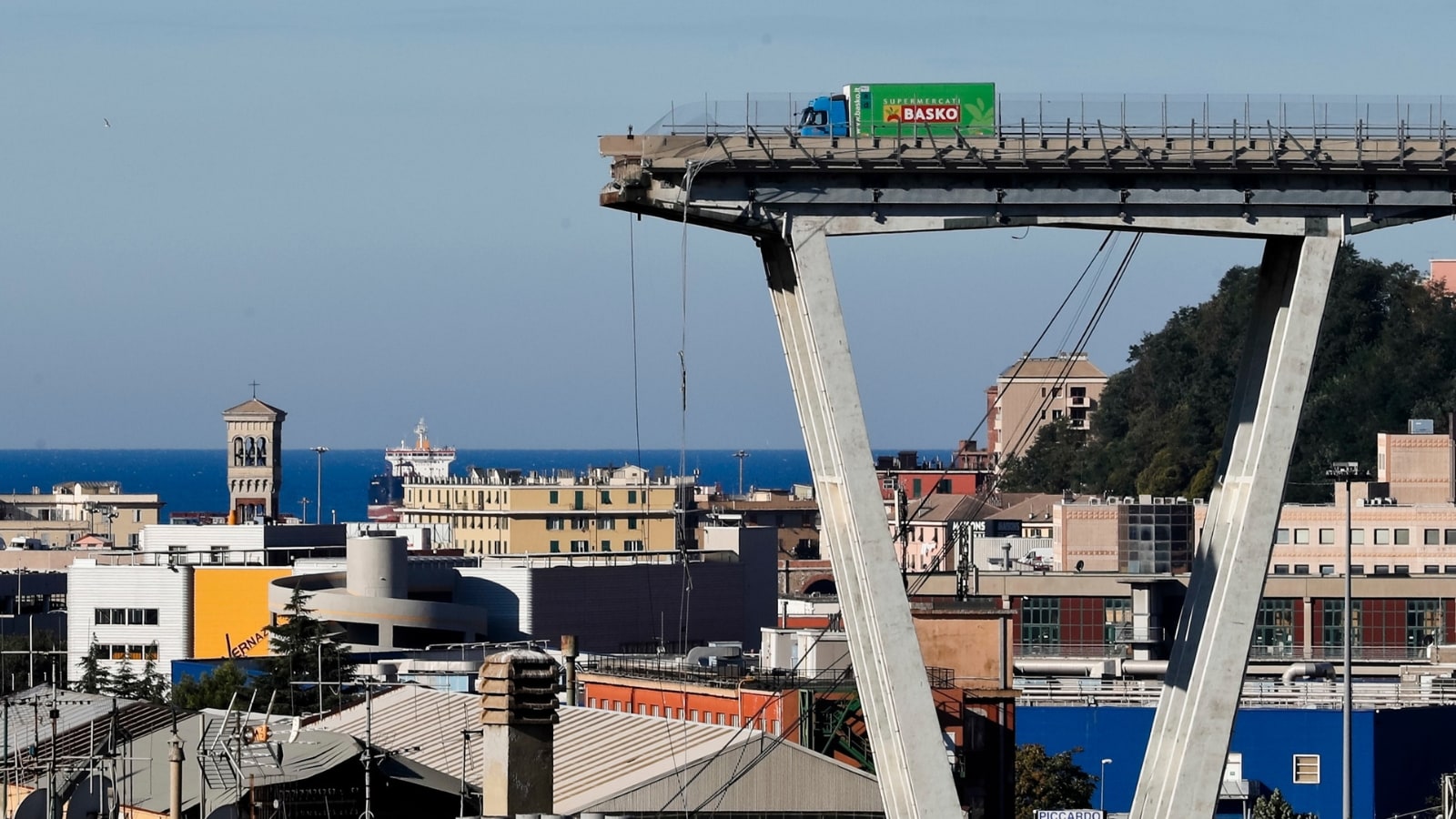
When a 200-meter segment of Genoa’s Morandi Bridge disintegrated during a rainstorm on August 14, 2018, it sent dozens of vehicles plunging into the industrial zone below, killing 43 people. While mainstream reporting framed this catastrophe as a tragic failure of concrete and steel, the July 16, 2026 judicial verdict in Genoa—resulting in the conviction of 32 defendants—proves otherwise. The collapse of the Morandi Bridge was the mathematical certainty of an economic and operational system designed to trade structural margin for short-term financial yield.
By examining the structural, financial, and regulatory variables that led to the catastrophe, we can map the exact mechanisms of this failure. The verdict—headlined by a 12-year prison sentence for Giovanni Castellucci, the former CEO of motorway concessionaire Autostrade per l’Italia (ASPI)—is not merely a moment of legal accountability. It is a brutal post-mortem on the systemic risks of privatized public infrastructure.
The Structural Mechanics of Neglect
To understand why the bridge fell, we must bypass the simplified narrative of "aging concrete" and evaluate the specific structural engineering profile of the Morandi Bridge. Opened in 1967, the bridge utilized an unconventional design engineered by Riccardo Morandi: cable-stayed spans where the steel stay-cables were encased in prestressed concrete.
This design possessed a fatal vulnerability: a complete lack of structural redundancy. The integrity of each span rested entirely on the health of its individual tension stays. If a single stay cable failed, the entire deck span would collapse immediately.
The decay of these critical components followed a highly predictable physical timeline, driven by two primary factors:
- Corrosive Exposure: The bridge was situated in a highly corrosive coastal and industrial environment, accelerating the penetration of moisture and atmospheric chlorides into the concrete casing.
- Void Formation: During the original construction, concrete injection into the protective sheaths of the stay cables was incomplete, leaving internal voids where steel cables sat unprotected against rust.
The structural vulnerability was not a hidden anomaly; it was verified. In 1993, ASPI executed structural interventions on two of the bridge’s three main pylon systems—Pylons 10 and 11—to remediate advanced tendon corrosion. No such intervention was executed on Pylon 9, which eventually failed.
The technical defense mounted during the four-year trial argued that the collapse stemmed from an undetectable, latent construction defect within Pylon 9’s stay cables rather than maintenance failures. However, the court systematically rejected this defense.
The judicial findings established that the degradation of Pylon 9’s structural capacity was entirely foreseeable and measurable. To omit Pylon 9 from the reinforcement protocols applied to Pylons 10 and 11 was not an engineering oversight; it was a conscious allocation of capital away from risk mitigation.
The Economics of Concessionaire Incentives
The operational decay of the Morandi Bridge cannot be isolated from the economic model under which ASPI operated. Privatized in the late 1990s, the Italian toll road network shifted from state control to a concession model. Under this framework, ASPI—then controlled by Atlantia, a holding company dominated by the Benetton family—secured the exclusive right to collect toll revenues in exchange for maintaining and operating the network.
This concession structure introduced a fundamental principal-agent problem, characterized by misaligned timelines and optimization goals:
[Concession Owner: Atlantia / Benetton Family]
   │
   ├─► Strategic Mandate: Maximize short-term dividend yield
   │
[Concessionaire: Autostrade per l’Italia (ASPI)]
   │
   ├─► Operational Action: Defer non-immediate CAPEX/OPEX (Maintenance)
   ├─► Financial Result: Artificially inflated operating margins
   │
[Public Assets / General Public]
   │
   └─► Systemic Risk: Accelerated physical depreciation & catastrophic structural failure
When an infrastructure operator’s remuneration is decoupled from the long-term asset life, the mathematical optimization strategy shifts toward delaying capital expenditure (CAPEX) and operating expenditure (OPEX) on maintenance.
Every dollar spent on structural reinforcement directly reduces EBITDA and, consequently, dividend payouts to shareholders. Because concrete degradation is a slow, non-linear process, an operator can systematically underfund maintenance for years without experiencing immediate operational disruptions.
During the trial, prosecutors demonstrated that ASPI’s executive leadership actively postponed essential safety interventions on Pylon 9 to preserve cash flows and inflate corporate profitability.
The financial penalty for this strategy was externalized onto the public, while the financial gains were internalized by corporate stakeholders. This dynamic represents a classic infrastructure debt cycle, where physical assets are aggressively deleveraged to generate financial liquid yield until the system reaches its physical breaking point.
The Three-Tiered Governance Deficit
The Morandi Bridge disaster was ultimately enabled by a comprehensive failure of the tripartite governance system designed to protect public safety. The court’s guilty verdicts directly mapped onto these three distinct organizational tiers:
1. The Operator (ASPI)
As the primary concessionaire, ASPI held direct operational responsibility for the safety of the asset. Executive leadership, including Castellucci (sentenced to 12 years) and former head of maintenance Michele Donferri Mitelli (sentenced to 11 years), prioritized corporate cost-containment over physical asset integrity.
The court found that ASPI systematically failed to conduct rigorous, objective safety monitoring. It relied on obsolete standards, including a 1967 Ministry of Public Works circular, to justify superficial inspections that ignored internal cable corrosion.
2. The Inspectorate (SPEA)
SPEA, the engineering subsidiary of Atlantia, was tasked with conducting independent safety assessments of ASPI's network. This arrangement created a severe structural conflict of interest.
Because SPEA was financially dependent on the same parent company as the operator it was supposed to audit, it lacked the organizational independence required to deliver objective assessments.
The conviction of Antonino Galatà, former CEO of SPEA, to five and a half years in prison underscores how this structural conflict compromised technical auditing. Rather than acting as a rigorous defensive gatekeeper, SPEA functioned as an operational rubber stamp for ASPI's cost-saving strategies.
3. The Regulator (Ministry of Infrastructure and Transport)
The Italian Ministry of Infrastructure and Transport was legally mandated to oversee ASPI’s concession compliance and protect the public interest. In practice, the regulator suffered from severe information asymmetry and resource constraints.
Ministry officials lacked the independent technical diagnostic capabilities required to verify ASPI’s self-reported engineering data. This regulatory capture allowed ASPI to operate with minimal state oversight, turning public safety monitoring into an exercise in bureaucratic paper-pushing.
Structural Reforms and Regulatory Realignment
The fallout from the Morandi Bridge collapse forced a complete restructuring of Italy’s infrastructure management model. In 2021, following a prolonged legal and political standoff, the Benetton family surrendered its stake in ASPI, selling it to a consortium led by Italy’s state-controlled lender, Cassa Depositi e Prestiti (CDP). This transition effectively nationalized the motorway network, realigning the operator's incentives with public safety rather than private equity yield.
Additionally, ASPI and SPEA avoided corporate trial by agreeing to a €29 million ($30 million) out-of-court settlement with the public prosecutor’s office. This settlement allowed the corporate entities to be excluded from the criminal proceedings, which focused strictly on individual criminal liability.
While the immediate structural risk of the Morandi Bridge was resolved through its demolition and the subsequent construction of the Renzo Piano-designed Genoa San Giorgio Bridge, the broader lessons of the disaster remain highly relevant to global infrastructure.
Managing aging infrastructure assets requires a fundamental shift in regulatory design:
- Separation of Audit and Operations: Safety auditing must be entirely decoupled from the asset operator. Third-party engineering firms must be hired, compensated, and managed by an independent regulator rather than the concessionaire.
- Mandatory Non-Destructive Testing (NDT): Regulatory frameworks must mandate advanced diagnostic techniques—such as radiographic imaging, acoustic emission monitoring, and ultrasonic testing—rather than relying on visual inspections to evaluate internal structural health.
- EBITDA-Linked Maintenance Covenants: Infrastructure concessions should include legally binding, minimum maintenance spend thresholds. Failure to meet these physical CAPEX targets must trigger immediate financial penalties or the forfeiture of the concession, preventing operators from inflating profits by deferring critical maintenance.
The Genoa court's verdict demonstrates that when infrastructure is treated purely as a financial asset to be optimized for cash flow, the physical laws of material degradation will eventually override financial modeling.
Without strict regulatory oversight, independent technical audits, and aligned economic incentives, the privatization of critical public infrastructure risks turning essential public works into ticking financial and physical liabilities.
An Italian court sentenced 32 defendants for their role in the deadly Morandi bridge disaster, highlighting the systemic maintenance failures that preceded the collapse. For a detailed legal and structural breakdown of the trial's outcome, watch Genoa Bridge Collapse Trial Highlights Italy's Ageing Infrastructure Issue.
http://googleusercontent.com/youtube_content/1