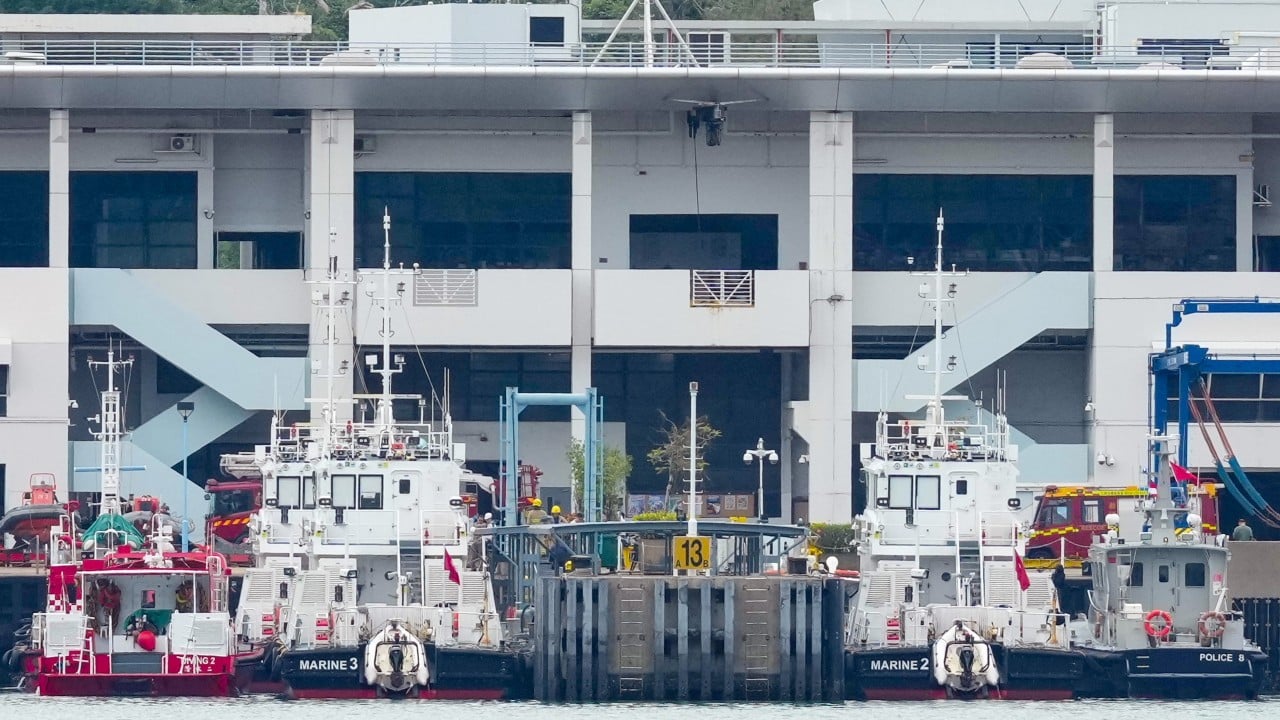
The morning over the Rambler Channel usually carries a specific, industrial rhythm. It is a symphony of clanking containers, the low thrum of massive diesel engines, and the wet slap of gray water against concrete piers. At Stonecutters Island, the air often smells of salt and heavy fuel oil—a scent that signifies the relentless gears of global commerce are turning exactly as they should.
Then, the rhythm broke.
It wasn’t a sound at first. It was a pressure wave. A sudden, violent displacement of air that rattled the teeth of dockworkers and sent birds spiraling into the smoggy sky. On the deck of a vessel moored near the Ngong Shuen Chau Naval Base, a routine repair job transformed into a nightmare of twisted metal and searing heat.
Six men were there. They weren't "casualties" or "data points" in a maritime safety report. They were technicians and laborers, the kind of people who spend their lives in the belly of steel beasts, making sure the world’s logistics don't grind to a halt. When the explosion ripped through the hull, their world didn't just change. It ended and began again in a flash of white light.
The Invisible Architecture of Risk
To understand what happened at Stonecutters, you have to look past the scorched paint. Modern vessels are marvels of engineering, but they are also pressurized environments where the margin for error is measured in millimeters.
When a ship enters a maintenance phase, it is at its most vulnerable. Systems are opened. Gases that are usually contained within high-pressure lines can leak into voids. All it takes is a single spark—a grinding wheel, a faulty light fixture, or a welder’s torch—to turn a workspace into a combustion chamber.
Think of it like a kitchen with a gas leak you can’t smell. You go to strike a match for a candle, and suddenly the walls are moving outward. On a ship, those walls are inch-thick steel. When they move, they don't just bend; they shrapnel.
The emergency calls started flooding in at 11:15 AM. The Fire Services Department didn't just send trucks; they sent a small army. Fireboats churned the water, and ambulances lined the pier like a row of white-and-red sentinels. The rescue crews who boarded that vessel weren't just fighting flames. They were navigating a labyrinth of heat-weakened structures and toxic fumes to find the six men who had been at the center of the blast.
The Human Cost of a Spark
We often talk about industrial accidents as if they are inevitable glitches in the system. They aren't. They are moments where human skin meets industrial failure.
Of the six injured, the reports categorized them by the severity of their trauma. But those labels—"conscious," "unconscious," "stable"—mask the visceral reality of the scene. Imagine being one of those workers. One moment you are discussing the afternoon’s tasks or perhaps thinking about what you’ll have for dinner in Kowloon. The next, you are being lifted onto a stretcher, the air around you thick with the smell of burnt electrical insulation and the metallic tang of blood.
Three of the victims were rushed to Princess Margaret Hospital. Others were diverted to Queen Mary and Caritas Medical Centre. In the waiting rooms of these hospitals, the story shifted from a maritime disaster to a family crisis. For every worker on that deck, there is a circle of people—parents, spouses, children—whose lives were suspended the moment the news broke.
Industrial safety is often dismissed as a chore, a series of boxes to check to satisfy a regulator. But when you see a man being wheeled into an Emergency Room with his face blackened by soot and his clothes shredded by a pressure wave, safety ceases to be an abstract concept. It becomes the difference between a father coming home and a permanent empty chair at the table.
Why the Harbor Never Sleeps
Hong Kong is one of the busiest ports on the planet. Its efficiency is legendary. But that efficiency creates a silent pressure. Ships need to be repaired fast. Turnaround times must be minimized. The faster a vessel gets back to sea, the more money it makes.
In that rush, the "hot work" permits and the atmospheric testing protocols can sometimes feel like hurdles. We live in a society that demands everything immediately. We want our packages delivered tomorrow and our fuel prices low. We rarely stop to consider the men in grease-stained jumpsuits working in the dark, cramped quarters of a ship's engine room to make that happen.
The Stonecutters Island explosion is a reminder that the "stuff" of our lives—the electronics, the clothes, the raw materials—is moved by people who operate in inherently dangerous environments. The vessel was a cargo ship, a workhorse of the sea. It wasn't a sleek cruise liner or a high-tech naval asset. It was a functional, gritty part of the global machine.
When that machine breaks, it breaks hard.
The Anatomy of an Investigation
In the aftermath, the police and the Marine Department began the slow, methodical process of "why." They look at the logs. They test the valves. They interview the survivors.
Was it a mechanical failure? A lapse in protocol? Or was it simply the cruel mathematics of probability catching up with a high-risk environment?
The investigation will eventually produce a document. It will be bound in a folder, filed in a government office, and cited in future safety briefings. It will use words like "ignition source" and "structural integrity." But it won't be able to capture the sound of the blast or the terrifying silence that followed it.
It won't mention the way the sunlight looked hitting the smoke as it rose over the harbor, or the look on a young paramedic's face as they realized the extent of the injuries. Those details are the "human element," the part of the story that doesn't make it into the official record but is the only part that actually matters.
The Weight of the Aftermath
Healing from an explosion is a slow process. It isn't just about skin grafts or broken bones. It's about the psychological shadow that follows. For the six men who were on that deck, the sound of a loud bang will likely never be just a sound again. It will be a trigger, a sudden jolt of adrenaline that brings back the heat and the vibration of the steel beneath their boots.
We often look at these headlines and move on within minutes. "6 injured." We process the number, feel a momentary pang of sympathy, and then scroll to the next story.
But for a small community in Hong Kong, the world stopped at 11:15 AM on a Monday.
The harbor continues to move. Other ships are docking. Other workers are picking up their tools. The cranes are still swinging containers through the air with the grace of giant metal giraffes. The rhythm of Stonecutters Island has returned to its industrial hum.
Yet, if you stand on the pier and look toward the spot where the smoke rose, you can almost hear the echo of the moment the steel screamed. It is a reminder that behind every statistic is a person, and behind every industrial "glitch" is a story of survival, a family waiting for a phone call, and the fragile line between a normal day at work and a life-altering catastrophe.
The machines are powerful, but they are also indifferent. They don't care about the people who maintain them. That responsibility falls solely on us—to remember that the true cost of our global commerce isn't measured in dollars, but in the safety of those who keep the gears turning in the dark.
The six men are still fighting their battles in hospital beds. The ship sits quiet, a hollowed-out witness to a force it couldn't contain. And the water of the Rambler Channel keeps flowing, indifferent to the scars left on the men and the metal alike.
Would you like me to look into the specific safety regulations for "hot work" on vessels in Hong Kong to see how they might have been breached in this instance?