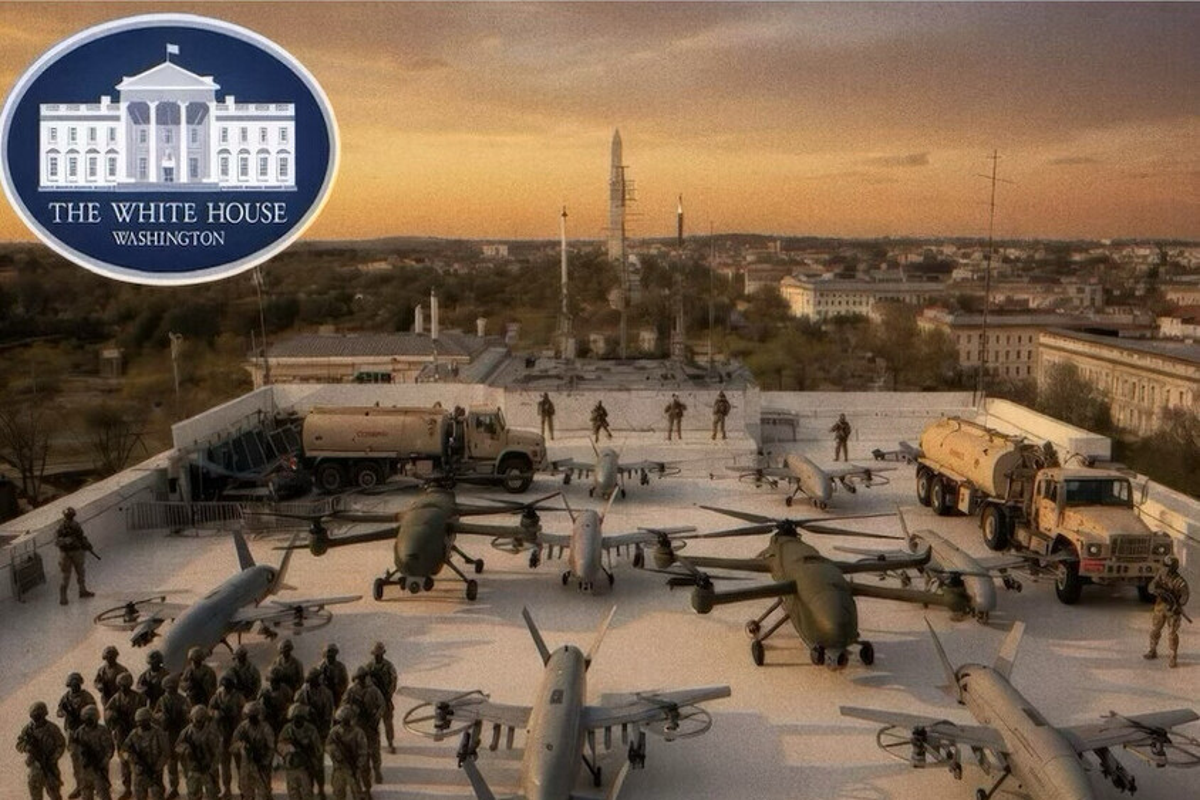
The mainstream media is having a collective meltdown over architectural sketches. Columns are dripping with condescension, treating Donald Trump’s proposed White House ballroom roof installation—complete with a designated military drone port—as a vanity project gone unhinged. Critics look at AI-generated mockups of tactical aircraft, refueling trucks, and armed personnel stationed atop a social venue and scream about aesthetics, historic preservation, and the sanctity of D.C. zoning laws.
They are missing the entire point.
The lazy consensus among legacy pundits is that turning a presidential ballroom into a localized military staging ground is an absurd escalation of architectural ego. They frame it as a fight over congressional appropriations and architectural oversight. They treat urban airspace as if it still belongs to 19th-century ground armies.
They are wrong. The White House is already indefensible using traditional perimeter security models. If you think a brick wall, a heavy iron fence, and Secret Service agents with handguns can intercept a coordinated swarm of low-altitude, commercially available autonomous munitions, you are living in a military daydream.
The Physics of Modern Airspace Denial
Let us define the actual threat environment. Modern conflict has decentralized aerial lethality. In active combat zones across Eastern Europe and the Middle East, multi-rotor quadcopters carrying shaped charges have rendered multimillion-dollar armor obsolete.
Washington, D.C. is a restricted flight zone, technically speaking. Practically speaking, it is a sieve. A low-flying, pre-programmed commercial drone launched from a park three miles away can cross the executive mansion's perimeter in under two minutes. Traditional air defense batteries stationed miles outside the city cannot react fast enough to close-range, low-altitude vector changes.
When the administration argues that the capital can no longer be defended with rifles and pistols alone, that is not hyperbole. It is basic tactical literacy.
Critics chide the incorporation of military infrastructure into a civilian gathering space as an unprecedented cross-contamination of functions. But dual-use engineering is the oldest survival strategy in military architecture. Castles were fortresses first and residences second. Pretending the executive branch of a global superpower should remain an exposed, aesthetic museum piece wrapped in glass and historic sentimentality is a security failure waiting for a tragedy.
The Architectural Hypocrisy
The National Trust for Historic Preservation and various legal challengers argue that the project requires explicit congressional sign-off, weaponizing procedural red tape to halt construction. They claim the primary issue is unauthorized expansion.
Imagine a scenario where a drone swarm penetrates the executive campus during a state dinner, resulting in catastrophic loss of life. Do you think the public will care whether the roof panels complied with historic preservation guidelines? Of course not. The same critics shrieking about architectural integrity today would be leading congressional inquisitions tomorrow, asking why the administration failed to harden the most targeted piece of real estate on earth.
The architectural layout of the executive mansion has evolved with every single century. Thomas Jefferson added colonnades. Harry Truman gutted the entire interior because the building was literally collapsing on its foundations. The obsession with freezing the White House in an amber of pristine, defenseless 18th-century innocence is a luxury born of prolonged peace. We no longer live in that era.
Decentralizing Defense
Critics mock the literal imagery of the drone port mockups. They focus on the visual spectacle of tactical gear on a rooftop rather than the functional necessity of counter-UAS (Unmanned Aerial Systems) interception nodes.
Effective counter-drone defense requires proximity, rapid reaction times, and persistent stationing. You cannot intercept a micro-drone from a base in Virginia if the threat materializes over Pennsylvania Avenue. The defense must be integrated directly into the physical footprint of the asset being protected.
Placing interceptor launch capability, sensor arrays, and hardening infrastructure onto high-elevation urban structures is standard urban warfare doctrine adapted for defense. The ballroom roof offers a high-vantage command geometry that eliminates blind spots created by surrounding foliage and masonry.
The Real Cost of Inaction
Opponents point to the ballooning price tag and private donor funding models as structural anomalies. I have watched organizations waste millions on cosmetic compliance while ignoring foundational vulnerabilities. The financial debate is a proxy war for political opposition. If the project were styled as a purely subterranean bunker upgrade, it would still face the same bureaucratic obstructionism.
The uncomfortable truth is that modern executive protection requires militarization. The illusion that a President can perform constitutional duties in an open, unprotected fishbowl is dead.
Stop evaluating national security infrastructure through the lens of interior design. The future belongs to those who harden their positions before the threat arrives, not those who draft lawsuits while the airspace overhead remains wide open.
This video provides context regarding the ongoing political and architectural debates surrounding the White House ballroom construction and security proposals.
http://googleusercontent.com/youtube_content/1