We measure our lives in ounces of gold. A wedding band. A grandmother’s heavy heirloom necklace. A thin wafer locked away in a bank vault, representing a lifetime of hard labor and sweat. For thousands of years, humanity has agreed on a collective fiction: that these shiny, heavy yellow rocks are rare, precious, and the ultimate anchor of wealth.
Now, look up at the night sky.
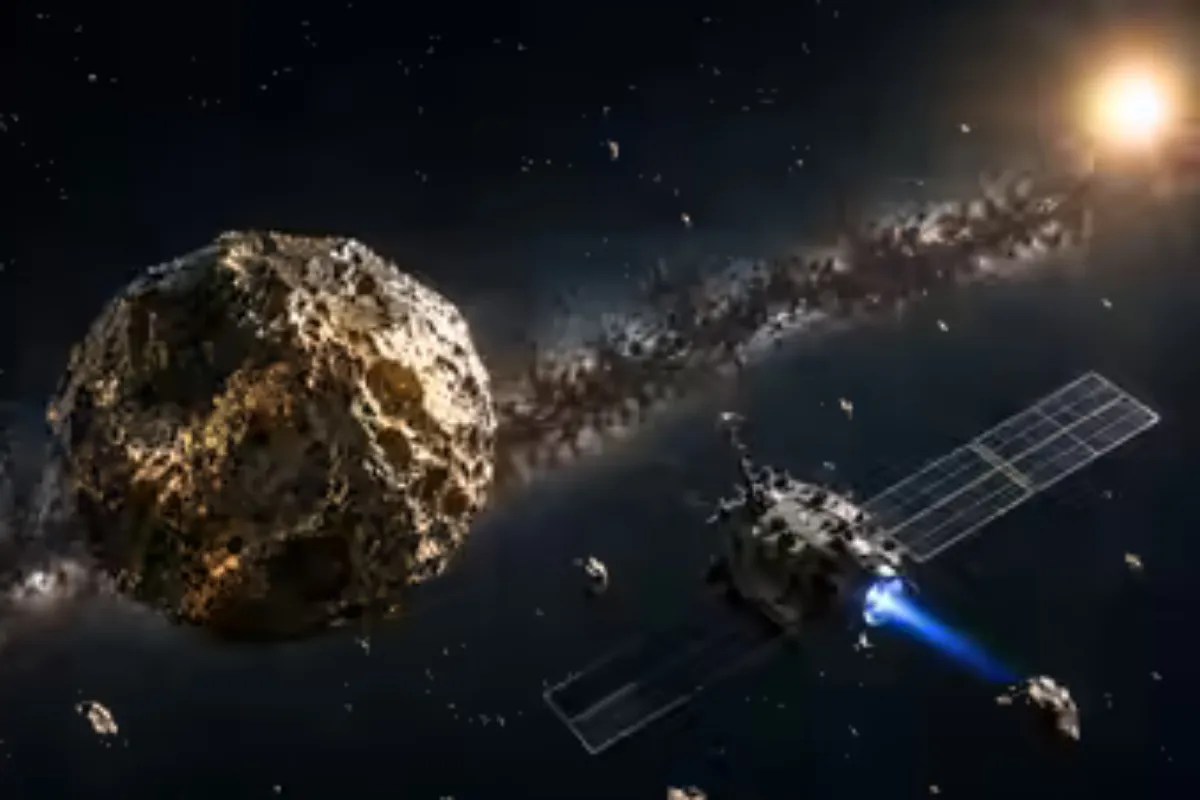
Somewhere between Mars and Jupiter, floating in the freezing, absolute silence of space, is a giant lump of metal shaped like a potato. It is roughly the size of Massachusetts. It doesn't look like much—just a dark, pitted rock drifting through the cosmic void. But if you could somehow bring this single asteroid down to Earth and carve it up, it would hand every single human being on this planet nearly a hundred billion dollars.
It is called 16 Psyche. And it is about to change everything we understand about value, scarcity, and the future of our species.
The Cosmic Iron Core
Most asteroids are just clumped-up cosmic dust and ice. They are the frozen leftovers of the early solar system. But Psyche is a freak of nature. Astronomers believe it is the exposed, battered heart of a dead planet—a world that was smashed to pieces by violent collisions billions of years ago before it could ever fully form.
When a planet forms, the heaviest elements sink to the center. Our own Earth has a molten iron-nickel core, but we can never touch it; it is buried beneath thousands of miles of crushing rock and magma. Psyche is that exact same kind of core, totally naked. It is stripped of its rocky mantle, exposed to the vacuum of space, and waiting.
The sheer numbers are numbing. Scientists estimate that Psyche is packed with iron, nickel, and gold valued at roughly $10,000 quadrillion. To put that in perspective, the entire global economy of Earth—every factory, every tech company, every grain of wheat, and every dollar circulating across the globe—is worth about $100 trillion. Psyche is worth one hundred thousand times more than our entire world's annual economic output.
But numbers that big lose their meaning. They sound like science fiction. To understand what this actually means, we have to look at a regular person living on Earth today.
Let’s call him Ramesh. He is a jeweler in a bustling market, carefully weighing a gold chain on a digital scale. Every milligram matters to his livelihood. The price of that gold is determined by one simple rule: it is hard to find. Miners have to dig miles into the earth, moving tons of rock just to extract a few flakes of the precious metal. Scarcity creates value.
Now, imagine what happens to Ramesh’s shop, his life savings, and the global financial system when a mountain of gold millions of times larger than all the gold ever mined in human history suddenly becomes accessible. Value plummets. The anchor breaks.
The Robotic Pioneer
We aren't just looking at this metal star through telescopes anymore. The human race is already on its way there.
In late 2023, a sleek spacecraft about the size of a tennis court launched into the Florida sky. Packed with high-resolution cameras, gamma-ray spectrometers, and a revolutionary laser communication system, the Psyche probe began a multi-billion-mile journey into the dark.
Right now, as you read these words, that small robotic pioneer is silently coasting through the deep solar system. It is utilizing gravity assists, stealing a bit of momentum from Mars, and constantly adjusting its trajectory. By the year 2029, if everything goes according to plan, the spacecraft will finally catch up with the asteroid. It will fire its thrusters, slip into orbit, and begin to map this metallic monster.
The scientists monitoring the mission from control rooms on Earth aren't looking to mine it yet. They want to understand our own origins. They want to look at Psyche and see what the core of our own Earth looks like. It is a journey backward in time to the violent birth of our solar system.
But you cannot dangle a quadrillion-dollar fortune in front of humanity without triggering a gold rush. The tech is catching up to the imagination. We are moving from the era of space exploration to the era of space exploitation.
The Mirage of Infinite Wealth
There is a profound irony at the heart of the Psyche mission.
Many people read the headlines about this asteroid and feel a surge of excitement. They picture a future where scarcity is erased, where resources are infinite, and where the riches of the heavens solve the poverty of Earth. It sounds like a utopia.
But economics is a brutal master. If you bring a dump truck full of diamonds into a small village, diamonds become as worthless as gravel. If we were to successfully mine Psyche and flood the Earth with thousands of tons of gold and platinum, the market wouldn't celebrate. It would collapse. The very concept of precious metals would cease to exist.
The real value of Psyche isn't in bringing gold back to Earth to make jewelry or to stack in bank vaults. The real value lies in leaving it up there.
Consider what it takes to build a colony on Mars or a massive space station in orbit. Shipping heavy steel, iron, and structural components from the surface of Earth into space is staggeringly expensive. Every pound of cargo requires an immense amount of rocket fuel to escape Earth's gravity. It is like trying to build a skyscraper in the desert while flying in every single brick from thousands of miles away.
Psyche is a cosmic shipyard already floating in orbit.
It is an infinite supply of raw structural materials that never has to be lifted off the Earth. Future generations won't look at Psyche as a treasure chest to be plundered for terrestrial wealth. They will look at it as a foundation. It is the fuel, the metal, and the machinery required to build a true spacefaring civilization.
The New Horizon
We stand at a strange, uncomfortable crossroads in human history. We are trapped between our ancient, earthbound tribal instincts and the terrifying, beautiful vastness of outer space. We still fight wars over small patches of land, while overhead, single rocks hold enough resources to sustain humanity for millennia.
The 2029 arrival of the Psyche probe will be a mirror held up to our species.
It will force us to ask what wealth really means. Is it a rare metal locked in a dark room, or is it the technological capability to reach across the void and touch the heart of a dead planet?
The small robotic spacecraft continues its lonely trek through the solar system, falling toward a destination made of solid iron and gold. Back on Earth, the jeweler continues to weigh his gold chains, oblivious to the fact that the sky is getting ready to fall.


