The Triad Of Mediterranean Thermal Vulnerability
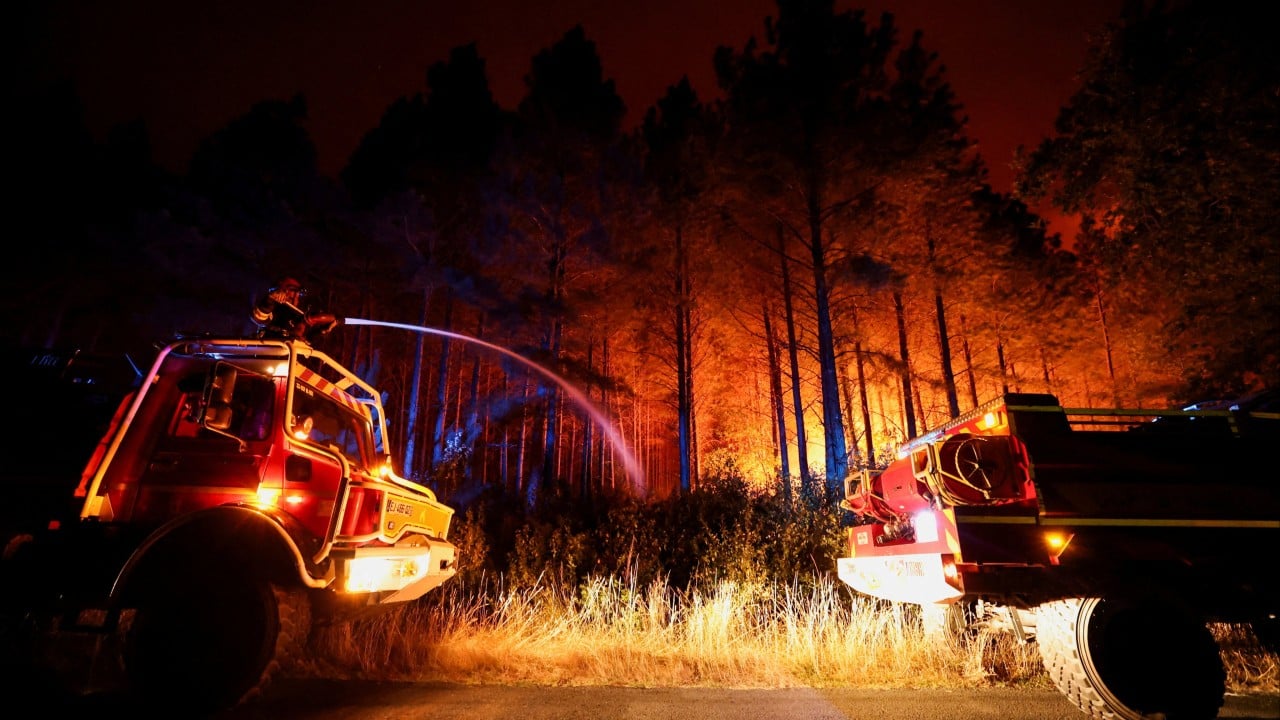
The recurrence of catastrophic wildfire events across Southern Europe—specifically France, Italy, and Spain—is not an unpredictable environmental anomaly. It is the deterministic outcome of three intersecting systemic vectors: prolonged atmospheric blockings, structural fuel accumulation, and topographically driven wind vectors. When these three variables converge, local suppression capacities experience non-linear failure rates.
Understanding Mediterranean fire regimes requires evaluating the physics of wildland fire behavior alongside human land-use changes over multi-decade horizons. For an alternative view, read: this related article.
+------------------------+      +-------------------------+      +------------------------+
|  Atmospheric Heat Dome |  +   | Fuel Load Accumulation  |  +   | Topographic Winds      |
|  (Vapor Deficit > 4kPa)|      | (Biomass Density High)  |      | (Mistral/Tramontane)   |
+------------------------+      +-------------------------+      +------------------------+
                                             |
                                             v
                                +--------------------------+
                                | Fire Vector Escalation   |
                                | (Rate of Spread > 3 km/h)|
                                +--------------------------+
The Atmospheric Vector: Vapor Pressure Deficit (VPD)
Standard meteorology focuses on surface air temperature. However, the primary physical driver of extreme fire behavior is Vapor Pressure Deficit (VPD)—the difference between the amount of moisture the air holds and the moisture it can hold when saturated.
During Mediterranean heatwaves, persistent high-pressure systems (heat domes) lock dry, subsiding air masses over the Iberian Peninsula, the Italian Peninsula, and Occitanie. Similar insight on the subject has been shared by The New York Times.
When VPD values cross a critical threshold (~4.0 kPa), vegetation enters extreme physiological stress:
- Stomatal Closure: Plants close their stomata to prevent water loss, halting transpiration.
- Foliage Desiccation: Internal plant moisture drops below critical live fuel moisture content (LFMC) thresholds (<60%).
- Volatile Compound Emission: Stressed Mediterranean flora (e.g., Pinus halepensis, Quercus ilex) exude highly flammable volatile organic compounds (terpenes and alpha-pinene), significantly reducing ignition temperatures.
The Biomass Vector: Fuel Connectivity And Rural Abandonment
The second structural failure point stems from shifts in rural demographics over the last half-century. Historical agricultural practices—livestock grazing, timber harvesting, and terraced farming—maintained fragmented landscapes that served as natural firebreaks.
Decades of rural depopulation across rural Spain (the España Vaciada), southern Italy, and the French Massif Central have created continuous canopy cover and dense understory fuel accumulation.
The structural biomass load increases systematically without natural or human intervention:
- Fine Fuels (<0.6 cm diameter): Grasses and leaf litter respond rapidly to hourly changes in relative humidity. These dictate the initial Rate of Spread (ROS).
- Coarse Woody Debris (>7.5 cm diameter): Fallen logs and dense brush dictate total fuel consumption and energy release rate (kW/m), controlling the intensity of the fire front.
Continuous, unmanaged fuel beds allow surface fires to transition into high-intensity crown fires via ladder fuels (intermediate shrub layers).
The Wind Vector: Topographic Acceleration
Southern Europe’s topography creates localized wind channels that act as force multipliers during combustion events.
- France: The Mistral (down the Rhône Valley) and Tramontane (between the Pyrenees and Massif Central) drive fire fronts south towards coastal population centers at sustained high velocities.
- Italy: Föhn winds descending the Alps and Apennines undergo adiabatic heating, drying out fuel beds within hours before accelerating down slope.
- Spain: The Iberian thermal low creates strong sea-breeze convergence zones that abruptly shift wind directions mid-day, turning active flank fires into massive secondary fire fronts.
Suppression System Failure Dynamics
Suppression operations fail when fire behavior exceeds the thermodynamic thresholds of human intervention equipment. Aerial firefighting assets (Canadair CL-415s, Eurocopter Super Pumas) and ground crews operate under hard physical boundaries defined by Byram’s Fire Line Intensity:
$$I = H \cdot w \cdot r$$
Where:
- $I$ = Fire line intensity ($\text{kW/m}$)
- $H$ = Heat yield of fuel ($\text{kJ/kg}$)
- $w$ = Mass of available fuel per unit area ($\text{kg/m}^2$)
- $r$ = Rate of forward spread ($\text{m/s}$)
Suppression Thresholds by Fire Line Intensity (kW/m)

0 kW/m ------------------ 2,000 kW/m ------------------ 4,000 kW/m ------------------ 10,000+ kW/m
   |                          |                          |                           |
   | Direct Manual Control    | Aerial Water Drops       | Indirect Control Only     | Complete Suppression
   | (Hand tools, hose lines) | (Retardant & Direct)     | (Backfiring, Anchor points| Failure (Evacuations Only)
Direct ground attack becomes unsafe and ineffective when intensity exceeds $2,000\text{ kW/m}$. Direct aerial drops become ineffective above $4,000\text{ kW/m}$ due to immediate evaporation before reaching the fuel bed.
When fire line intensity surges past $10,000\text{ kW/m}$, pyrocumulonimbus (PyroCb) columns develop. These extreme convective plumes generate localized thunderheads, unpredictable downdrafts, and long-range spotting (flying embers ignited up to 5 kilometers ahead of the main front). At this operational stage, suppression assets are rendered ineffective; containment efforts shift entirely to defensive evacuation.
Cross-Border Operational Bottlenecks
While the European Union Civil Protection Mechanism (UCPM) coordinates asset sharing across member states, operational integration faces several systemic friction points during concurrent regional outbreaks.
                              [ Regional Emergency Request ]
                                            |
                                            v
                        [ Emergency Response Coordination Centre ]
                                            |
                 +--------------------------+--------------------------+
                 |                                                     |
                 v                                                     v
    [ Asset Allocation Strategy ]                         [ Deployment Impediments ]
                 |                                                     |
  +--------------+--------------+                       +--------------+--------------+
  |                             |                       |                             |
  v                             v                       v                             v
[ Fleet Size Limits ]   [ Simultaneous Demand ]   [ Tanker Compatibility ]  [ Interoperability Gaps ]
Resource Allocation Friction
During generalized Mediterranean heatwaves, France, Italy, Spain, and Greece request aerial assets simultaneously. The European Union’s dedicated reserve (rescEU) maintains a finite fleet of amphibious aircraft. When all southern member states experience critical fires concurrently, localized asset density drops below effective operational minimums.
Infrastructure and Interoperability Limits
- Dip Site Access: Amphibious air tankers require calm open water bodies (lakes, reservoirs, or sheltered bays) within a 15-minute flight radius to maintain high drop frequencies. Heavy sea states or low reservoir levels disrupt these supply chains.
- Ground Crew Integration: Differences in radio spectrum allocations, command structures, and backfiring legal authorizations delay real-time tactical alignment between visiting international task forces and local incident commanders.
Strategic Reconfiguration Matrix
Addressing Mediterranean thermal risk requires shifting capital expenditure from reactive suppression asset procurement to proactive landscape architecture and predictive logistics.
Landscape-Scale Fuel Break Engineering
Rather than attempting total vegetation control across millions of hectares, land management authorities must establish Strategic Management Zones (SMZs):
- Shaded Fuel Breaks: Thinning dense timber stands along ridgelines and major road networks while leaving mature canopy trees to limit solar drying of understory vegetation.
- Targeted Prescribed Burning: Executing low-intensity winter burns within high-priority corridors to clear fine fuel loads before seasonal VPD spikes occur.
- Agro-Forestry Buffer Re-establishment: Subsidizing livestock grazing (goats, sheep) specifically along urban-wildland interfaces to maintain low surface fuel loads adjacent to infrastructure.
Predictive Computational Logistics
Deployment of firefighting units based solely on current fire locations guarantees lagging response times. Optimization requires shifting to predictive risk modeling:
- Real-time High-Resolution Fuel Moisture Sensing: Deploying satellite synthetic aperture radar (SAR) data to map live fuel moisture content across regional fuel beds continuously.
- Pre-positioning Tactics: Moving ground strike teams and aerial assets to high-risk micro-regions 24 to 48 hours before critical atmospheric VPD and wind thresholds are breached, cutting initial attack times from hours to minutes.
Deploy capital directly into landscape-level fuel break construction and pre-positioning algorithms rather than relying exclusively on additional aerial suppression fleets. Immediate deployment of winter prescribed burns along primary mountain pass corridors across Southern France, Italy, and Spain must take priority before the next seasonal heat dome locks over the basin.