Political commentators love a good historical copy-paste. The moment a politician steps onto a deck, speaks in front of a engineered backdrop, or attempts to claim victory before the dust settles, television talking heads race each other to standard-issue historical tropes.
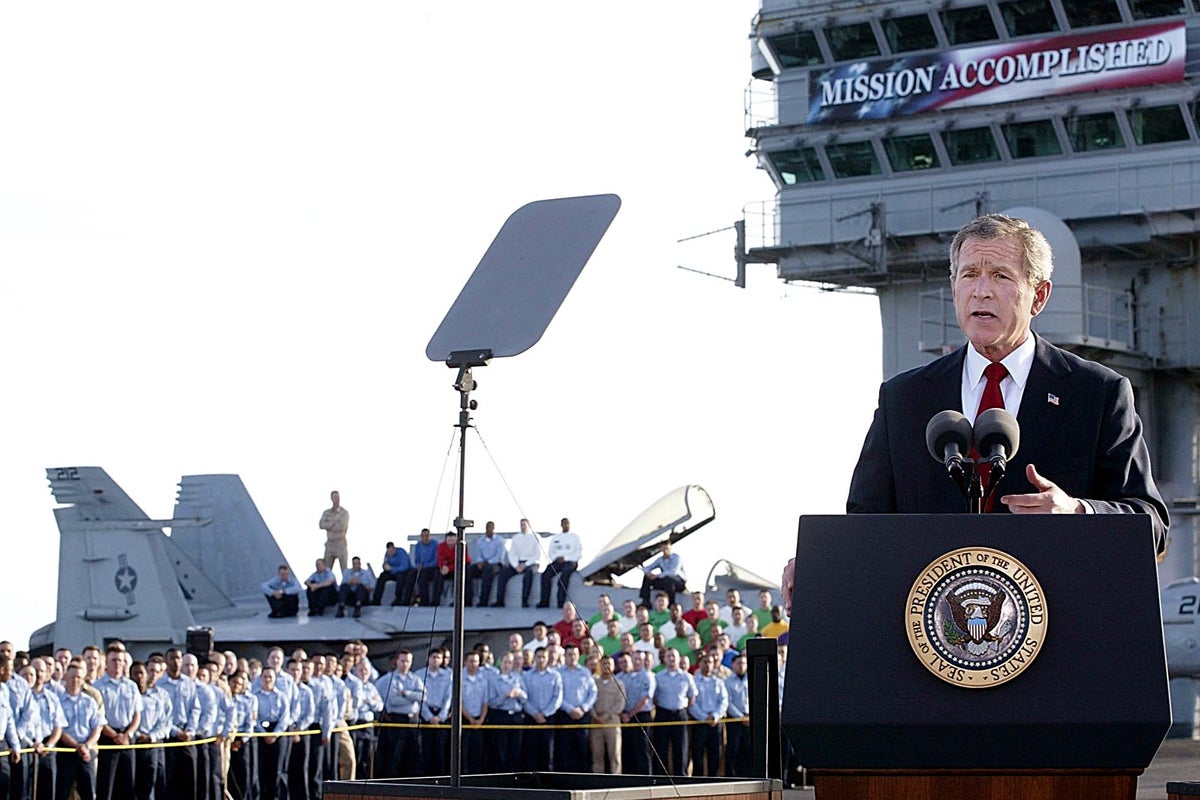
The undisputed favorite in that catalog? George W. Bush’s May 2003 speech aboard the USS Abraham Lincoln.
Whenever Donald Trump or any modern political figure attempts to project premature triumph or theatrical strength, pundits immediately drag out the ghost of that "Mission Accomplished" banner. It is lazy. It is comfortable. And it completely fundamentally misunderstands how political iconography functions in a hyper-fragmented media environment.
Comparing modern political spectacles to Bush’s 2003 carrier landing isn't just an oversimplification—it misses the entirely different operational mechanics at play today.
The Illusion of the Universal Narrative
When Bush landed on the USS Abraham Lincoln in a flight suit, the American media landscape still operated under a centralized, broadcast-era paradigm. A single image could dominate the nightly news across three major networks and front pages nationwide.
The risk of the "Mission Accomplished" backdrop wasn't just that it was premature policy-wise. The risk was that everyone saw the exact same image with the exact same context, making the contrast undeniably stark when history contradicted the narrative.
Modern political theater doesn't operate under those rules anymore.
To evaluate a modern political figure through the lens of 2003 is to completely misunderstand the contemporary attention economy.
Broadcast Era vs. Fragmented Era Dynamics
| Mechanical Dimension | 2003 "Mission Accomplished" Era | Modern Political Iconography |
|---|---|---|
| Media Distribution | Centralized broadcast networks | Decentralized algorithmic silos |
| Audience Reception | Monolithic public square | Custom-tailored echo chambers |
| Primary Goal | Broad consensus creation | Core base mobilization |
| Vulnerability | Unified counter-narrative | Immediate polarization / memeification |
When commentators try to construct an equivalence between Bush’s stunt and modern political moments, they assume the public still consumes imagery the same way. They don't.
Why the "Mission Accomplished" Metaphor Fails Today
I have spent years analyzing media strategy and audience sentiment across political campaigns. The mistake analysts continuously make is evaluating a 2020s media event using a 2000s playbook.
When a candidate creates a high-visibility, staged victory moment today, they are not trying to convince the swing voter sitting in Ohio watching the 6:30 PM CBS Evening News. That voter barely exists in the same capacity anymore.
1. Polarization Is a Feature, Not a Glitch
Bush’s team attempted to project broad national leadership to unite a country behind an ongoing conflict. Modern political theatrics do the exact opposite: they are designed as weaponized content for the base.
When a modern figure stands before a staged backdrop, the outrage from opposition media isn't a downside—it is the goal. The mockery on one network serves as direct proof of bias to the viewers of another. Bush’s team viewed the eventual backlash as a disaster. Today’s strategists view negative opposition coverage as fuel that extends the content cycle.
2. Context Decay and Information Silos
In 2003, you couldn't easily escape the reality of unfolding events in Iraq. The counter-evidence was broadcast on the same channels that carried the speech.
Today, information silos allow audiences to selectively consume only the metadata that confirms their existing worldview. An image that signals "arrogance" or "failure" to one demographic signals "defiance" and "strength" to another. The concept of an undisputed, universal "gotcha" moment is largely dead.
The political press corps keeps waiting for a single visual gaffe to shatter a campaign's momentum, completely blind to the fact that their own coverage merely reinforces the tribal walls keeping those audiences intact.
Addressing the Common Objections
When you challenge the standard punditry on this, the counter-arguments usually fall into predictable patterns. Let's address those directly.
"Isn't premature victory framing inherently damaging to any politician?"
Only if your target audience values institutional policy milestones over tribal defiance.
For Bush, the primary metric of success was actual policy completion in Iraq. When the war dragged on, the banner became a symbol of incompetence. For modern populist figures, the primary metric of success is often cultural confrontation itself. The physical policy outcome is frequently secondary to the symbolic posture of fighting against institutional gatekeepers.
"Doesn't the opposition use these moments effectively in campaign ads?"
They do, but only to preach to the converted.
An opposition ad highlighting a staged political blunder solidifies the votes you were already going to get. It rarely crosses the digital divide to alter the perception of the opposition’s loyal base. In an era where elections are won on base turnout rather than persuasive center-converting appeals, the calculus shifts entirely.
The True Danger of Misreading Political Spectacle
By constantly reaching for twenty-year-old analogies, media analysts blind themselves to the real mechanics of modern political influence.
When you frame every staged photo op as a potential "Mission Accomplished" blunder, you miss what is actually happening:
- The Gamification of Outrage: Staged moments are engineered to invite critique, driving engagement algorithms to push the content to millions of feeds for free.
- The Death of Shared Reality: Assuming an image carries an objective, consensus meaning ignores the reality that visual media is now interpreted entirely through partisan filters.
- The Invalidation of Standard Fact-Checking: Fact-checking a aesthetic projection or symbolic posture with policy realities misunderstands why the audience responded to the image in the first place.
Stop looking for the ghost of 2003 on aircraft carriers that no longer exist in our digital architecture. The rules of political gravity changed the moment the monoculture died. Treating modern spectacle like a legacy PR mistake isn't sharp analysis—it's political archaeology.
The commentators waiting for the definitive visual blunder that breaks the spell aren't just late to the party. They are standing in an empty room, shouting at a television that was turned off a decade ago.