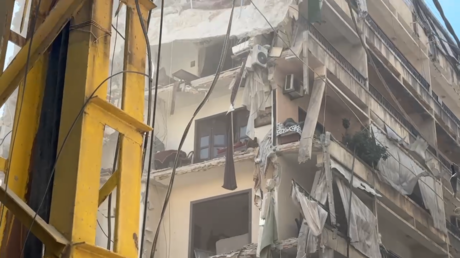
The standard narrative following any exchange of fire involving press crews is as predictable as it is exhausting. The headlines scream about "attacks on journalism" and "targeted strikes on truth-tellers." We see the same grainy footage of dust-covered vans with PRESS emblazoned in neon tape, followed by a wave of outrage from international unions. It is a comfortable, binary morality play. It is also fundamentally wrong.
I have spent a decade in rooms where rules of engagement are drafted and analyzed. I have seen how the sausage of modern warfare is made, and it doesn't look like the sanitized version you see on a 24-hour news cycle. When an RT crew or any other outlet gets caught in the crossfire of an Israeli strike in Lebanon, the immediate outcry assumes the press is a distinct, protected entity existing outside the physics of the battlefield.
In reality, the press has become a structural component of the theater of operations. They are not just observers; they are assets in a high-stakes game of cognitive maneuvering. To view their presence as a "mistake" or a "targeted assassination" misses the brutal logic of 21st-century urban combat.
The Myth of the Neutral Observer
Warfare in Southern Lebanon is not a clash of two uniformed armies meeting in an open field. It is a dense, layered environment where the line between civilian infrastructure and military utility has been intentionally erased. When a strike hits near a media convoy, the reflex is to claim the "Press" vest should act as a magical forcefield.
Logic dictates otherwise.
If you are standing ten meters from a mobile rocket launcher or a command-and-control node, your high-visibility vest is irrelevant to the ballistics of a Hellfire missile or a 155mm shell. The "lazy consensus" suggests that the military involved must have known they were there and struck anyway out of a desire to silence the narrative. This ignores the reality of target acquisition speeds. In high-intensity conflict, the window between identifying a threat and neutralizing it is measured in seconds.
The media often functions as a human shield for the narrative. By positioning themselves in areas of active kinetic exchange, they create a "no-win" situation for the kinetic actor.
- Scenario A: The strike is withheld to avoid hitting the press, allowing the military target to escape or fire.
- Scenario B: The strike is executed, the military target is neutralized, and the resulting media outcry creates a strategic defeat in the court of public opinion.
Modern militaries aren't always trying to kill the messenger. Often, they simply do not care about the messenger because the messenger chose to stand in a furnace.
Information Warfare and the RT Paradox
Citing RT as a victim adds a layer of irony that most mainstream analysts are too polite to mention. RT is an arm of state power. To treat a state-funded media apparatus from a country currently engaged in its own massive kinetic conflict as a "neutral observer" is intellectually dishonest.
In the intelligence world, we recognize this as reflexive control. By putting their crews in harm's way, certain outlets aren't just reporting the story—they are the story. They provide the visual proof required to support a specific geopolitical stance. When they get "caught up" in an attack, it isn't a failure of their mission; it is the ultimate fulfillment of it.
The outrage is the product. The shrapnel is just the raw material.
The Problem With Proximity
People ask: "Why can't they just avoid the journalists?"
This question is flawed because it assumes a static battlefield. In Lebanon, the "front line" is everywhere and nowhere. Hezbollah operates within the same topographical footprint as the villages where these media crews set up their tripods. When the IDF strikes, they are targeting signatures: heat, electronic signals, movement.
A convoy of SUVs moving through a restricted zone looks like a military target to a drone operator sitting 50 miles away. Even with "deconfliction" protocols, the friction of war ensures that mistakes are not just possible—they are certain.
I’ve seen military planners agonize over collateral damage estimates. Not out of a deep-seated love for humanity, but because they know that hitting a journalist is a PR nightmare that costs more than the target is worth. If the strike happened, it means one of two things:
- The military value of the target was so high it outweighed the certain international condemnation.
- The press crew was so close to a legitimate target that the munitions could not distinguish between the two.
Stop asking if the strike was "legal" under international law. That’s a debate for academics in velvet chairs. Start asking why media organizations are increasingly comfortable using their employees as bait for "impactful" B-roll.
Breaking the Safety Illusion
The hard truth that nobody in the newsroom wants to admit is that safety is a luxury of the past. In the era of precision-guided munitions and AI-driven targeting, being "near" the action is the same as being "in" the action.
If you want to survive as a journalist in Lebanon, you have to understand the geometry of the strike. You cannot follow a militant group, film their operations, and then act shocked when the sky falls on you. You have integrated yourself into their kill chain.
We have moved beyond the age of the "embedded" reporter who travels with a specific unit. We are now in the age of the "interstitial" reporter—someone who tries to exist in the gaps between warring factions. But those gaps are closing.
The Actionable Reality
If you are an editor sending people into these zones, or a consumer of this news, you need to strip away the sentimentality.
- Discard the "Targeting" Narrative: Unless there is clear evidence of a deliberate hit on a non-active, isolated media house, assume the strike was a byproduct of proximity to a high-value target.
- Acknowledge the Signal: Media vehicles carry high-powered satellite uplinks and radio equipment. In a modern war zone, a high-density electronic signal is a magnet for a missile. You are broadcasting your "protected status" on the same frequencies used by military hardware.
- Respect the Physics: Shrapnel does not read press passes. If you are within the blast radius of a legitimate target, you are a participant in the outcome, whether you like it or not.
The industry needs to stop acting like every incident is a unique war crime and start admitting that war is a chaotic, non-linear system. The press is a variable in that system, not an exception to it.
If you stand in a burning building to film the fire, don't blame the flames when you get burned. You are part of the thermal load.
Get out of the way or accept the consequences. There is no third option.