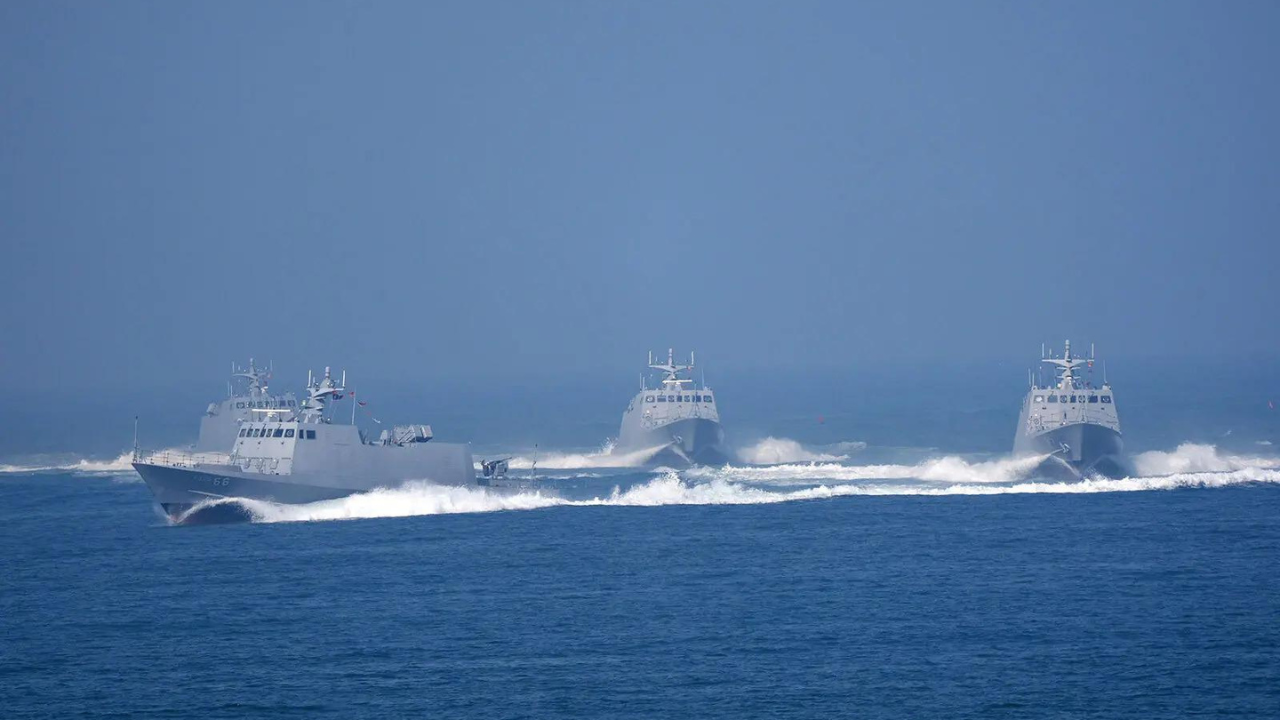
Every time the mainstream press reports on Chinese military aircraft and naval vessels crossing the median line of the Taiwan Strait, the collective foreign policy establishment breaks into a predictable, synchronized sweat. The headlines write themselves. They scream of imminent invasion, escalating aggression, and a region teetering on the brink of kinetic war.
It is lazy journalism. It is worse geopolitical analysis.
The media treats these daily sorties like a countdown clock to D-Day. They are looking at the wrong map, measuring the wrong variables, and completely missing the true mechanism of modern coercion. Beijing is not rehearsing a 1944-style amphibious assault when it sends J-16s over the water. They are running a high-tech, psychological attrition campaign designed to hollow out Taiwan’s defense capabilities without firing a single shot.
If you are tracking troop transports and waiting for a massive buildup of landing craft on the shores of Fujian, you have already lost the plot. The real war is happening right now, quietly, in the logistics logs of Taiwan’s Air Force and the cognitive stamina of its pilots.
The Myth of the Coming Amphibious Invasion
Let's clear up the foundational misunderstanding that dominates Western cable news. An amphibious invasion of Taiwan would be the most complex military operation in human history, dwarfing Operation Overlord. The geography of the Taiwan Strait is a defender's dream. The mudflats, the sheer cliffs, the unpredictable weather windows in spring and autumn—these are brutal realities that do not change based on political rhetoric.
When the media reports that twenty Chinese aircraft crossed the median line for a "second straight day," they imply that Beijing is testing the waters for a surprise attack. This ignores basic military logic. You do not telegraph an existential, high-risk invasion by running predictable, daily aerial loops for years on end.
What those sorties actually achieve is a phenomenon known as gray-zone warfare. It sits comfortably between peace and open conflict. The goal is not to conquer territory today; it is to dominate the operational tempo and exhaust the adversary over time.
The Real Cost of "Gray-Zone" Attrition
Every time a People’s Liberation Army (PLA) fighter jet enters Taiwan's Air Defense Identification Zone (ADIZ), Taipei faces a brutal mathematical equation.
- Airframe Fatigue: Fighter jets are built to operate for a specific number of flight hours before requiring extensive, costly maintenance overhauls. Taiwan’s fleet of F-16Vs, Mirage 2000s, and domestic IDF fighters is being run ragged. By forcing Taiwan to scramble jets or keep them on high alert, Beijing is burning through the operational lifespan of Taiwan’s air force without spending a single piece of ammunition.
- Fuel and Logistics: Avgas is not cheap. The pilot hours are not infinite. I have talked to defense logistics experts who watch these numbers closely; the budgetary strain of constantly responding to asymmetric aerial pressure is a massive drain on Taipei's overall defense spending.
- Pilot Burnout: There is a human cost to this perpetual state of alarm. Taiwan’s pilot pool is relatively small. The constant cycle of scrambling, monitoring, and landing creates chronic fatigue, which leads to mistakes, lower retention rates, and decreased combat readiness when it actually matters.
The media tracks the presence of Chinese ships. The smart money tracks the maintenance schedules of Taiwanese aircraft.
Dismantling the "People Also Ask" Flawed Premises
If you look at what people actually search regarding this conflict, the questions themselves reveal how deeply the public has been misinformed by sensationalist reporting.
"Why doesn't Taiwan just shoot down the encroaching planes?"
This question assumes that an ADIZ is sovereign airspace. It is not. An Air Defense Identification Zone is a self-declared buffer zone in international airspace where a country requests incoming aircraft to identify themselves for national security.
Shooting down a PLA aircraft in the ADIZ, outside of Taiwan's actual 12-nautical-mile territorial airspace, would legally make Taiwan the aggressor. It would give Beijing the exact justification it needs to escalate into a hot war. Beijing’s strategy relies on provocations that fall just short of triggering a military response, trapping Taipei in a reactive loop.
"Is the US military obligated to defend Taiwan if China invades?"
The consensus answer is usually a vague reference to the Taiwan Relations Act of 1979. But let’s look at the actual text. The United States is legally bound to provide Taiwan with "arms of a defensive character" and to maintain the capacity to resist any resort to force that would jeopardize the security of the people on Taiwan.
It does not contain a blanket, Article 5-style guarantee of direct military intervention. This calculated ambiguity has served as a deterrent for decades, but it becomes a liability in a gray-zone scenario. If China chokes off Taiwan via a digital blockade and a maritime quarantine rather than a kinetic invasion, the legal threshold for US intervention becomes incredibly murky.
The Tech Frontier: Cyber and Cognitive Domination
The physical aircraft and naval vessels reported in the news are often just kinetic theater. The real operational shifts are happening in the electromagnetic spectrum and the digital infrastructure of the island.
While the world watches gray hulls in the strait, the PLA's Strategic Support Force focuses on deep network penetration. The goal here is psychological destabilization. If you can convince the population of Taiwan that their defense forces are incompetent, that their energy grid is fragile, and that Western support is an illusion, you can win the conflict without ever putting boots on a beach.
Traditional Warfare Approach:
Mass Troops -> Kinetic Bombardment -> Amphibious Landing -> Territorial Control

Modern Gray-Zone Approach:
ADIZ Pressure (Physical Exhaustion) + Cyber Scans (Infrastructure Vulnerability) + Information Operations (Cognitive Despair) -> Political Capitulation
This is an asymmetric equation. A single Chinese drone sortie costs Beijing peanuts compared to what it costs Taiwan to monitor, track, and analyze the flight path.
The Strategic Pivot Western Analysts Miss
Stop looking at the Taiwan Strait through the lens of twentieth-century military history. The metrics of success have changed. China’s primary objective with its daily military presence is to normalize its operations within the region.
A decade ago, crossing the median line was a rare, escalatory event that triggered international diplomatic outrage. Today, it happens on a Tuesday, and it barely merits a blurb on the back pages of major news outlets unless the numbers hit a new record high.
By normalizing this high-intensity presence, Beijing achieves two things:
- Shorter Warning Windows: When military maneuvers are constant, it becomes incredibly difficult for intelligence agencies to differentiate between a routine exercise and the actual preparation for a localized blockade or strike.
- Jurisdictional Erosion: Step by step, the physical boundaries that defined the status quo for fifty years are being erased. The median line is functionally dead. The contiguous zone boundaries are being tested. It is a slow-motion cartographic creep.
The Uncomfortable Truth About Taiwan’s Defense Strategy
The contrarian reality that many defense analysts hesitate to state publicly is that Taiwan’s traditional procurement strategy has played right into China’s hands. For decades, Taipei focused on buying prestige platforms—expensive fighter jets, large naval frigates, and heavy tanks.
These assets are highly visible, politically popular, and completely unsuited for the asymmetric threat they actually face. A multi-million-dollar fighter jet is an incredibly inefficient tool for intercepting an inexpensive, mass-produced Chinese reconnaissance drone.
I have seen defense departments worldwide fall into this trap: prioritizing shiny, legacy hardware over resilient, distributed capabilities.
Taiwan needs to pivot completely toward what is known as the "porcupine strategy." This means investing heavily in thousands of mobile anti-ship missiles, sea mines, short-range air defense systems, and decentralized drone swarms. You do not match a superpower plane-for-plane when your adversary has a defense budget that outspends yours many times over. You make the cost of entry unacceptably painful.
The downside to this approach is that it requires a cultural shift. It means admitting that the glamorous era of dogfights and massive naval engagements is over. It requires building a civilian defense infrastructure that is resilient, highly trained, and prepared for prolonged, asymmetric resistance. It requires fewer F-16s and far more engineers, drone operators, and decentralized logistics nodes.
Stop counting the planes. Start counting the missile stockpiles, the fuel reserves, and the cyber vulnerabilities of the semiconductor foundries. The daily news reports on the Taiwan Strait are giving you an accurate count of objects in the sky while leaving you completely blind to the actual mechanics of the conflict.