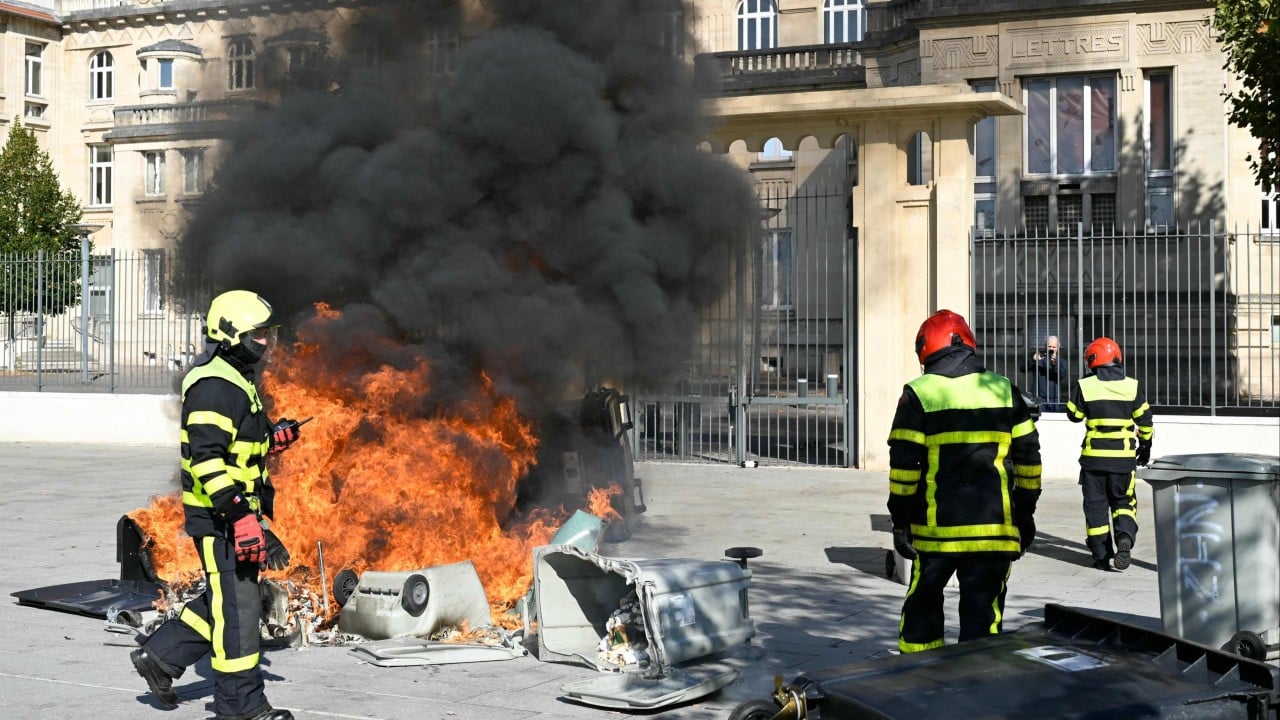
We love a clean narrative. We crave the clear line between victim and villain, between the righteous anger of youth and the brute force of the state. When headlines flashed across the globe about a teenager losing a hand to a grenade during French school protests, the outrage machine spun up instantly. The media served up the standard, pre-packaged tragedy: innocent student exercising democratic rights, met with disproportionate, militarized police brutality.
It is a clean story. It is also an intellectual fraud. Expanding on this theme, you can find more in: The Twenty Thousand Foot Fall That Almost Broke the Middle East.
I have spent years watching how civil unrest is manufactured, managed, and monetized in Western Europe. I have walked the barricades in Paris, watched the Molotovs arc through the night air, and listened to union leaders orchestrate chaos from air-conditioned backrooms while teenagers become the cannon fodder.
The lazy consensus says this is simply about pension reform, education cuts, or police overreach. That framing treats young people like passive objects pushed around by historical forces. Peel back the righteous noise, and you find a much uglier, more systemic reality. The tragedy of that mutilated hand was not an isolated accident of state oppression. It was the predictable, calculated end-state of a protest culture that has normalized urban combat as a political hobby. Analysts at USA Today have provided expertise on this situation.
Let us dismantle the mythology piece by piece.
The Myth of the Peaceful Student Bloc
The primary deception in every major French student mobilization is the insistence on the innocent civilian narrative. Walk into any Parisian high school blockade at seven in the morning during a national strike. You will see burning garbage bins, overturned construction barriers, and a core group of masked agitators who do not even attend the institution.
They are professional provocateurs. They drift from campus to campus, orchestrating the escalation. They treat police lines not as security per se, but as an interactive video game designed to generate viral footage.
When a crowd surrounds a security perimeter, throws paving stones, fires mortar-style fireworks directly at riot squads, and hurls improvised explosives, the physics of urban engagement changes. Police units do not deploy heavy munitions into empty courtyards; they respond to volleys of projectiles.
Yet the reporting consistently strips away the prelude. It freezes the frame at the exact second of impact, erasing the twenty minutes of urban guerrilla tactics that preceded it. By pretending that students are simply standing around discussing philosophy when the state opens fire, the media creates a dangerous illusion. It teaches every disaffected teenager that throwing objects at armed security forces carries zero personal agency and zero real-world risk.
That lie is what maimed that kid.
The Weaponization of Victimhood
Let us talk about the device itself. A tear gas canister or a flash-bang does not detonate on impact like a fragmentation grenade. French security forces use specific crowd-control munitions—primarily the GLI-F4 and its successors—which combine tear gas with an explosive charge designed to create a loud concussive blast.
Are these weapons hazardous? Absolutely. They have maimed protesters before. Civil rights lawyers and watchdog organizations have campaigned against their use for years, and rightly so. The state bears immense responsibility for arming police with munitions that blur the line between dispersal and kinetic destruction.
However, treating a live military-grade or heavily modified explosive device found on the streets as a mysterious hazard ignores the reality of what circulates in these protests. Molotov cocktails, acid vials, and industrial-grade fireworks are routinely smuggled into student blockades. When you pick up an unexploded military munition or an improvised explosive device in the middle of a riot zone, you are not exercising your right to protest. You are playing Russian roulette with a live round.
The media refuses to state this clearly because nuance destroys the headline. They want you to believe that teenagers are strolling through a peaceful quad and stepping on landmines. The truth is much more uncomfortable: our tolerance for radicalized street theater has created an environment where kids treat high explosives like discarded party favors.
The Political Architecture of Chaos
Why does this keep happening? Because institutional leaders in France benefit from the cycle.
Every time a youth protest turns violent, the political ecosystem freezes. The government enters defensive communications mode. The opposition parties salivate over the drop in presidential approval ratings. The unions use the chaos as leverage for their backroom negotiations. Everyone gets what they want, paid for with the physical safety of children from the banlieues and working-class suburbs.
Notice who is never on the front line. You will not find the children of senior civil servants, wealthy XVIth arrondissement elites, or prominent politicians standing in front of a police charge holding a concrete block. The foot soldiers of French street unrest are disproportionately working-class kids from vocational schools and peripheral suburbs who are sold a romanticized myth of rebellion by middle-class organizers who go home to warm apartments before dinner.
This is the dirty secret of modern radical chic. It uses the marginalized as a battering ram against the establishment while insulating the architects of the movement from any personal consequence.
The Counter-Intuitive Fix Nobody Wants to Hear
If we actually cared about protecting teenagers, we would stop romanticizing street violence. We would implement policies that hold instigators accountable regardless of their age or political affiliation. We would strip public funding from any student union or political faction documented smuggling weapons into school zones.
More importantly, we would stop treating the escalation of civil disobedience as a romantic cultural tradition. France has a proud history of revolution, but there is a vast gulf between storming the Bastille to overthrow an absolute monarchy and high schoolers burning Fiat Pandas because they do not want to take a standardized test on a Tuesday.
Until we have the courage to tell young people the unvarnished truth—that actions
Why Blaming Teenagers For Street Chaos Is Lazy Journalism
news
The headlines following the tragic incident in France involving a teenager picking up an unexploded grenade during student protests followed a predictable, comforting script. Media outlets rushed to frame the tragedy through the lens of youth recklessness, administrative failure, or a sudden escalation of adolescent radicalism. It is a neat narrative. It allows politicians to wail about law and order and commentators to lecture about youthful impulsivity.
It is also entirely backward.
When a kid loses a hand to explosive ordnance near a high school protest, the primary failure is not adolescent curiosity. It is the normalization of militarized crowd control tactics that turn urban civilian centers into logistical staging grounds for high-impact ordnance. We have built an environment where civil unrest is met with equipment designed for asymmetric warfare, and then we pretend to be shocked when the collateral damage leaks into civilian populations.
The Comfort of the Scapegoat
Let us dismantle the lazy consensus. The standard commentary surrounding these protests treats civil disobedience as a pathology unique to restless teenagers seeking an excuse to riot. This framing ignores the structural mechanics of modern public dissent. When structural grievances accumulate—pension reforms, educational funding cuts, economic stagnation—protests are the pressure valves.
When you deploy elite intervention units equipped with heavy munitions into civilian school zones, you change the physical safety calculus of the street. A tear gas canister or a sting-ball grenade is not a Nerf toy. Treating a chaotic street skirmish like an active combat zone means accepting combat zone hazards. Yet, official reports frequently treat the deployment of these devices as background noise, focusing instead on the actions of the victims.
I have watched public order strategies evolve over the last two decades. The prevailing doctrine has shifted away from de-escalation and containment toward rapid psychological shock. Police forces increasingly rely on munitions that sit in a legal grey area between non-lethal compliance tools and military explosives. When these devices malfunction, fail to detonate immediately, or are left behind in the chaos of a charge, they become landmines in municipal streets.
Blaming the teenager for picking up a strange, heavy metal cylinder in the middle of a smoke-filled street is like blaming someone for getting wet while standing in the middle of a firehose blast. The presence of the hazard is the primary variable.
The Mechanics of Escalation
To understand why these tragedies keep happening, we have to look at the procurement pipeline of domestic security. Law enforcement agencies across Western Europe have increasingly adopted surplus or specialized military-grade crowd control technology. These are not standard-issue batons; they are pyrotechnic charges capable of shredding flesh, breaking bones, and amputating limbs.
The tactical training required to deploy these items assumes a sterile, controlled environment. The real world of a student protest is anything but. It is chaotic, noisy, smoky, and crowded. Shouting dispersal orders over the roar of a crowd is difficult; expecting teenagers to maintain strict perimeter awareness around volatile chemical agents is absurd.
When authorities deploy munitions that can sever a hand, they assume a profound liability. By shifting the public conversation to the behavior of the victim, institutions evade accountability for their own tactical escalation.
Dismantling the Safety Theater
The institutional response to such incidents always follows the exact same playbook:
- Express profound regret.
- Announce an internal inquiry that takes eighteen months.
- Conclude that protocols were technically followed, or that a single officer acted outside guidelines.
- Double down on purchasing heavier equipment to maintain order.
This loop must be broken. True public safety requires matching the response to the reality of civil protest, not treating high school students as insurgent combatants. If a security apparatus cannot manage a civilian demonstration without leaving live explosives in the gutter, the apparatus is broken.
Stop asking why teenagers make poor risk assessments in the heat of a riot. Start asking why the state is bringing weapons to a high school.
The next time a street protest turns catastrophic, do not look at the hands of the kids picking up the pieces. Look at the policies that dropped them there in the first place.