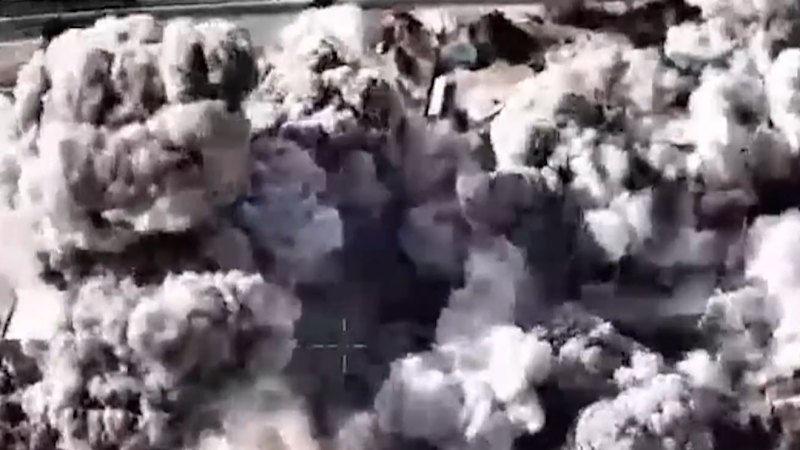
The headlines are predictable. They scream about "fresh strikes," "escalation," and the "danger of regional war." If you get your news from the usual outlets, you are likely clutching your pearls, convinced we are one button-press away from global catastrophe.
Stop buying it.
The mainstream narrative treats every kinetic exchange as a chaotic, unpredictable spiral. It’s an easy story to sell because it relies on the same tired tropes of irrational actors and sudden aggression. As someone who has spent years analyzing state-level signal intelligence and security protocols, I see something entirely different. These are not unhinged outbursts. They are carefully calibrated, high-stakes communication acts.
What the breathless reports fail to tell you is that silence is the most dangerous weapon, not the noise.
The Myth of Irrational Escalation
Most observers view the current situation through a lens of raw emotion. They believe leaders are acting on impulses, responding in kind, and pushing toward a cliff. This is a fundamental misunderstanding of statecraft. When high-level military decisions are made, they are governed by risk tolerance and signaling theory, not vengeance.
Imagine a scenario where two poker players are bluffing. One player slams their chips down. The other matches the bet. To a novice, this looks like the start of a fight. To a pro, this is a calculation. The goal isn't necessarily to take the pot; the goal is to show the other player that you are willing to lose the money to defend your position.
Israel’s strikes against Iran—and the corresponding responses—are not intended to destroy the opponent. If Israel truly wanted to eliminate Iranian infrastructure, we wouldn't be reading about surgical strikes; we would be witnessing a massive, multi-front, total-force application. Instead, we see measured, restricted, and often telegraphed actions.
Deciphering the Signal
Why do these strikes keep happening? Because both parties are locked in a game of establishing deterrence thresholds.
When Iran conducts a massive drone or missile launch, they aren't trying to level cities. They are testing response times, radar saturation, and the physical limits of air defense networks. They are "mapping" the terrain for a future contingency. Israel, in turn, strikes back to demonstrate that there is no sanctuary for specific high-value assets or intelligence hubs.
The "experts" on cable news love to talk about "red lines." I suggest you throw that concept in the trash. There are no red lines, only price tags.
- The Price of Deterrence: Every strike is a transaction. Israel pays the price of international criticism and economic friction to buy the knowledge that their defensive systems work and to signal to Tehran that their reach is absolute.
- The Price of Sovereignty: Iran pays the price of damaged facilities to maintain its influence in the region and to show its proxies that they remain the dominant force, regardless of Israeli technological superiority.
The Real Danger Is Not The Strike
If you want to know what to worry about, stop looking at the explosions. Look at the logistics.
The real danger isn't the exchange of missiles. It’s the breakdown of back-channel communication. In past decades, even during the height of the Cold War, the U.S. and the Soviet Union maintained hotlines. They knew the rules of the game. Today, the problem is that both Israel and Iran have become so adept at the "gray zone" of conflict that they are starting to misinterpret each other’s signals.
When a strike is too precise, the recipient might think it was an accident. When a strike is too weak, the recipient might think it was a sign of weakness. That is where the actual risk of a regional conflict lies. It isn't in the aggression; it's in the potential for a miscalculation of intent.
Stop Asking About War
People constantly ask, "Are we going to see a full-scale war?" This is the wrong question. It implies that war is a binary event—a switch that flips from "peace" to "total destruction."
War is not a light switch. It is a spectrum. We are already in a state of conflict. The current reality is a permanent, simmering friction that serves the domestic political needs of both regimes.
- For Israel: Showing a firm, kinetic hand against Iranian assets serves to unify a fractured domestic political landscape. It reinforces the image of the state as a defensive fortress.
- For Iran: Highlighting "Zionist aggression" provides a perfect external enemy to distract from internal socio-economic instability and suppression of dissent.
Both regimes are feeding off this tension. The perpetual state of near-conflict is a feature, not a bug, for those currently in power.
A Brutal Truth About Your News Sources
If you rely on major news conglomerates for your understanding of this conflict, you are being fed a curated diet of fear. Fear drives clicks. Anxiety keeps you refreshing the page.
They won't tell you about the economic constraints limiting both sides. They won't tell you about the internal pressure within the IRGC to avoid a direct confrontation that would expose their structural vulnerabilities. They won't tell you that both sides are terrified of a total war, precisely because they know it would result in their own potential collapse.
I have watched companies and analysts lose their shirts by ignoring the underlying incentives. Don't be them. When you see a new headline about a strike, ignore the emotional framing. Ask yourself: What is the signaling goal? What is the cost of the response? Who benefits from the optics of this attack?
Stop watching the fireworks and start looking at the people holding the fuses. They aren't trying to burn the house down; they are using the light to see who is watching.


