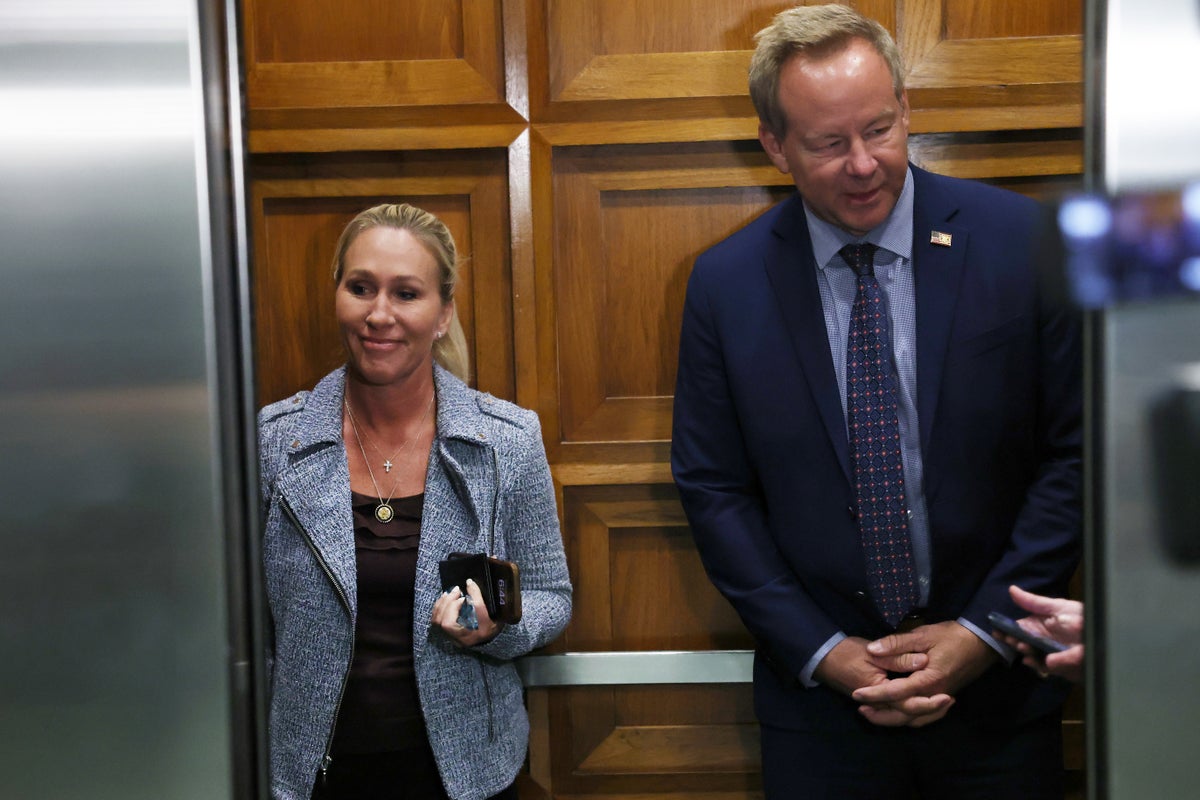
The resignation of Brian Glenn from Right Side Broadcasting Network (RSBN) is not a standard personnel departure; it is a case study in the friction between personal political affiliation and professional journalistic optics. When Glenn, the fiancé of Representative Marjorie Taylor Greene, exited his role shortly after a high-profile exchange with White House Press Secretary Karine Jean-Pierre, he highlighted the inherent fragility of partisan media roles. This event serves as a framework for understanding how proximity to power dictates the lifecycle of a media operative.
The Triad of Journalistic Credibility Erosion
The intersection of a reporter’s personal life and their professional output creates a specific set of pressures that eventually make a position untenable. In Glenn’s case, three distinct factors accelerated his exit:
- Access Asymmetry: A journalist’s primary asset is the ability to extract information from officials. When a reporter is romantically or legally tethered to a high-profile politician, every question asked is viewed through the lens of a coordinated political strategy rather than an inquiry for the public record. This nullifies the perceived independence necessary to operate within the White House press pool.
- Brand Contamination: RSBN positions itself as a platform for MAGA-aligned commentary. However, even within niche media, there is a requirement for "performative objectivity" to maintain access to federal briefings. Glenn’s presence became a liability for the network’s ability to claim it was conducting "reporting" rather than acting as a direct extension of a specific Congressional office.
- The Zinger Penalty: During the White House Q&A, Glenn’s engagement with Jean-Pierre was characterized by an aggressive, confrontational style. In a vacuum, this is standard for partisan media. Within the context of his engagement to Greene, the "zinger" ceased to be a journalistic tool and became a personal grievance. This shift changes the cost-benefit analysis for the employer, as the reporter becomes the story, distracting from the platform's broader messaging goals.
The Mechanical Breakdown of the Resignation Timeline
The proximity of the "zinger" to the resignation suggests a causal link driven by institutional pressure. The White House Correspondents' Association (WHCA) and the White House Press Office operate on a system of social and professional capital.
The first mechanism at play is Credentialing Risk. If a network’s lead reporter is seen as a direct surrogate for a political figure, the network risks its hard pass or its standing in the briefing room. While the First Amendment provides broad protections, the administrative hurdles for a network can increase if their representative is deemed a "political actor" rather than a "media actor."
The second mechanism is Audience Saturation. For RSBN, Glenn’s value was his proximity to the Trump-Greene orbit. Yet, there is a point of diminishing returns. Once the relationship with Greene became the defining feature of his identity, his ability to "cover" her or her allies lost the thin veneer of external validation. The audience no longer sees a reporter covering a movement; they see a family member documenting a business trip.
The Economic Reality of Partisan Media Operatives
Media personnel in hyper-niche markets often operate under high-risk, high-reward contracts. These roles are rarely about long-term institutional stability and are instead focused on "Moment Capture."
Glenn’s exit signals a transition from the Media Revenue Model to the Political Surrogacy Model. In the media model, revenue is generated through clicks, views, and ad placements based on perceived journalistic output. In the surrogacy model, value is generated through political consulting, campaign appearances, and fundraising.
The resignation is a strategic pivot. By leaving the "reporting" role, Glenn removes the conflict of interest barrier, allowing him to lean fully into the political infrastructure surrounding Greene and the broader Trump campaign. This move eliminates the "Access Asymmetry" problem because he no longer needs to pretend to be an objective observer. He becomes a full-time stakeholder.
Structural Conflict in Modern News Cycles
The modern media environment has blurred the lines between the "Fourth Estate" and the "Political Machine." We can categorize these conflicts into three tiers of severity:
- Tier 1: Institutional Conflict. A reporter covers a beat where their spouse holds a minor administrative role. This is usually managed via disclosure.
- Tier 2: Strategic Conflict. A reporter covers a beat where their partner is a decision-maker. This usually requires a change in beat or a leave of absence.
- Tier 3: Identity Conflict. The reporter and the subject’s identities are so intertwined that they are viewed as a single political unit.
Glenn’s situation occupied Tier 3. At this level, the "reporting" is no longer a transfer of information but a broadcast of personal brand alignment. The friction generated by a Tier 3 conflict is too high for any organization that seeks to maintain a relationship with federal institutions like the White House.
The Inevitability of the Departure
The "White House zinger" was the catalyst, but the resignation was a mathematical certainty. In any system where a participant holds dual roles—as an observer and an íntimate associate of the subject—the observer role will eventually be cannibalized by the association.
The move from RSBN allows Glenn to bypass the constraints of the White House Press Office. He is now free to engage in unrestricted advocacy, which arguably holds higher market value in the current political economy than a credentialed reporting seat. This is a common trajectory for media figures who realize that their personal brand has outgrown the platform that requires them to adhere to even minimal standards of journalistic decorum.
The strategic play for any operative in this position is to exit the media role at the peak of their visibility. By leaving immediately following a viral confrontation, Glenn preserved his "combatant" status within his base while shielding his former employer from the administrative fallout of his personal associations. The move isn't a retreat; it is a reallocation of human capital to a more efficient political engine.
Future media entities must now account for the "Greene-Glenn Factor": the reality that in the age of the celebrity-politician, the traditional firewall between the press and the subject is not just cracked—it is being dismantled for parts. Organizations should expect higher turnover among reporters with high-profile political ties, as the financial and social incentives for direct advocacy now far outweigh those of traditional or even partisan reporting. Any media strategy that relies on "reporting" from within a political family unit is building on a foundation designed to collapse once the primary subject reaches a certain threshold of national controversy.