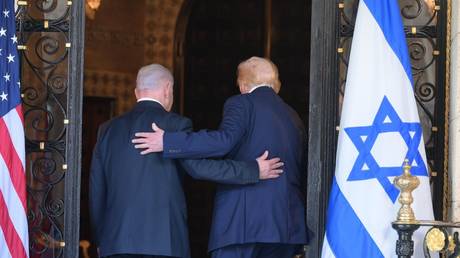
Mainstream political journalism thrives on theater. When reporters drop a book alleging that Donald Trump threatened Benjamin Netanyahu with a political "divorce," the pundit class treats it like a tectonic shift. They paint a picture of a shattered alliance, a profound geopolitical rupture, a sudden betrayal of a historic partnership.
They are missing the entire point.
The pearl-clutching over this "divorce" comment exposes a fundamental misunderstanding of how modern statecraft operates. The media views international diplomacy through the lens of a soap opera, tracking personal slights and emotional outbursts as if nations act based on hurt feelings. They fail to understand that transactional hostility is a feature of high-stakes negotiations, not a bug.
This was not a foreign policy failure. It was a textbook demonstration of strategic volatility.
The Myth of the Unconditional Alliance
For decades, the consensus in Washington dictated that the relationship between the United States and Israel must remain entirely uniform in public. Any sign of friction was treated as an existential threat to regional stability. Journalists look at Trump’s reported anger toward Netanyahu after the 2020 election—specifically Netanyahu congratulating Joe Biden—and conclude that the alliance fractured due to personal ego.
That interpretation is lazy. It ignores historical precedent and the cold realities of national interest.
The United States and Israel have never had a friction-free relationship. Presidents have routinely used harsh, behind-the-scenes pressure to force Israeli compliance with American strategic goals.
Consider the historical record:
- 1956 (Eisenhower): President Dwight D. Eisenhower threatened severe economic sanctions and the termination of private aid to Israel if it did not withdraw from the Sinai Peninsula during the Suez Crisis.
- 1981 (Reagan): President Ronald Reagan suspended the delivery of F-15 fighter jets to Israel following the bombing of the Osirak nuclear reactor in Iraq and a raid in Beirut.
- 1991 (Bush Sr.): President George H.W. Bush threatened to withhold $10 billion in loan guarantees unless Israel halted settlement expansion in the West Bank.
Compared to Eisenhower threatening economic strangulation or Bush freezing billions in vital credit, a rhetorical threat of "divorce" from a president known for theatrical hyperbole is remarkably standard. Yet, the current media narrative treats this specific episode as an unprecedented anomaly.
The Utility of Planned Volatility
Political commentators love predictability. They prefer diplomats who speak in carefully managed, sterile platitudes. When an outsider uses unpredictable rhetoric, the immediate assumption is that the strategy is chaotic or broken.
They fail to recognize the immense strategic value of artificial volatility.
When a superpower leader signals that their support is not guaranteed, it forces the client state to recalibrate its positions. For too long, the established diplomatic consensus allowed foreign leaders to take American backing for granted, operating under the assumption that Washington would always underwrite their security choices regardless of domestic American interests.
By introducing the threat of a "divorce," a leader breaks the complacency of the status quo. It signals to the counterpart that the relationship requires active maintenance, not just passive expectation. It creates a sense of urgency.
Imagine a scenario where a corporate CEO tells a long-term supplier that their contract is on the verge of termination. A naive observer might assume the business relationship is over. An experienced executive knows the CEO is simply setting the stage for a more favorable renegotiation. This is basic bargaining behavior, translated onto the global stage.
The Flawed Premise of Media Disruption
The books produced by Washington insiders frequently suffer from the same structural flaw: they mistake the noise for the signal. They focus on the private shouting matches, the colorful insults, and the emotional flare-ups because those elements sell copies.
The actual policy results tell a completely different story.
During the exact period when these reported tensions were supposedly ruining the relationship, the tangible geopolitical alignment between the two nations achieved historic milestones. The relocation of the American embassy to Jerusalem, the recognition of sovereignty over the Golan Heights, and the brokering of the Abraham Accords all occurred under the same administration.
If the relationship were genuinely broken by personal animosity, these massive policy shifts would have stalled entirely. They did not. The institutional, military, and intelligence cooperation between the two nations remained completely intact. The public and private friction did not hinder policy execution; it ran parallel to it.
The lesson here is simple: watch what leaders sign, not what they shout in closed rooms.
Dismantling the Consensus on Diplomatic Etiquette
The mainstream analysis operates on a flawed premise. It assumes that good diplomacy requires polite agreement.
This is backward. Polite diplomacy frequently leads to stagnation. When two nations are locked in a permanent embrace where neither can criticize the other, strategic errors go uncorrected. True alignment requires the ability to apply pressure when interests diverge.
The media asks: "Did Trump's erratic behavior damage the US-Israel bond?"
The question itself is wrong. The correct question is: "Did the introduction of personal accountability change the dynamic of the alliance?"
The answer is yes, and it was necessary. For decades, the Washington foreign policy establishment ran on a script that yielded minimal progress in the Middle East. Breaking that script required a rejection of standard diplomatic etiquette.
The threat of a "divorce" is not evidence of a crumbling foreign policy. It is evidence that the old, ineffective rules of engagement were discarded. The alliance survived because the structural realities of shared intelligence, defense integration, and geopolitical strategy are far more powerful than any individual rhetorical outburst.
Stop reading political gossip as if it were strategic analysis. The theater of diplomacy is meant to distract you. Look at the balance sheet instead.