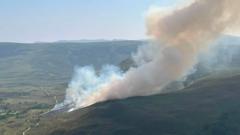
Sub-arctic peatlands and ancient Caledonian pine forests are not supposed to burn with pyrophytic intensity, yet changing climatic baselines have transformed these carbon-dense ecosystems into highly volatile fuel complexes. When a wildfire breaches the boundary of the Cairngorms National Park, suppression operations face a distinct set of physical and logistical constraints that differ fundamentally from Mediterranean or North American forest fires. Fighting these fires is not merely a matter of deploying water; it is an optimization problem balancing fuel moisture thresholds, subterranean smoldering kinetics, and severe geographical isolation.
To understand the trajectory of upland wildfire suppression, one must look beyond the immediate imagery of night-time firefighting and analyze the underlying mechanics of fire behavior in highly organic soils and fragmented canopy ecosystems.
The Fuel Complex Anatomy of the Scottish Highlands
Upland ecosystems in the Cairngorms present a dual-layer fuel challenge. The surface layer consists of dry dwarf-shrub heath, predominantly Calluna vulgaris (heather), while the subsurface is comprised of deep organic peat deposits. This stratification creates two distinct combustion regimes operating simultaneously.
Flaming Combustion in Canopy and Shrub Layers
The above-ground fuel load is characterized by fine, woody fuels with high surface-area-to-volume ratios. Under dry conditions, these fuels exhibit low moisture of extinction, meaning they require very little pre-heating to ignite.
- The Heather Cycle: Regenerating heather provides a continuous horizontal fuel bed. In older stands, senescent wood increases the ratio of dead-to-live fuel, accelerating flame propagation.
- Caledonian Pine Canopies: Pinus sylvestris (Scots Pine) contains high levels of volatile terpenes. When heated, these compounds vaporize, lowering the ignition temperature of the canopy and facilitating rapid transition from surface fires to crown fires under high wind speeds.
Smoldering Subsurface Combustion
Beneath the vegetation lies peat, a highly concentrated carbon sink. Unlike the rapid, oxygen-rich flaming combustion observed on the surface, peat fires are dominated by smoldering combustion.
- Oxygen Limitation: Smoldering is a low-temperature, flameless combustion process sustained by the heat of oxidation occurring directly on the surface of the solid fuel.
- Thermal Inertia: Peat has an exceptionally high thermal inertia. Once ignited, the combustion zone can migrate vertically and horizontally beneath the surface, insulated from external weather conditions. This allows the fire to persist undetected for days or weeks, bypassing surface-applied water.
- The Moisture Threshold: Peat ignition is governed by a critical moisture threshold, typically around 130% to 250% gravimetric water content. Once peat falls below this threshold due to prolonged dry spells or drainage, it transitions from a thermal sink into an active fuel source.
The Physics of Nocturnal Suppression Operations
The decision to battle wildfires through the night is dictated by a shifting meteorological window. During diurnal cycles, solar radiation drives down relative humidity and heats surface fuels, maximizing fire intensity. At night, the thermodynamic profile shifts, offering tactical advantages alongside severe operational hazards.
The Thermal Inversion Opportunity
As solar radiation ceases, the ground cools rapidly, creating a temperature inversion layer. This atmospheric stabilization reduces convective activity.
- Relative Humidity Recovery: Ambient temperatures drop toward the dew point, raising the relative humidity of the air. This moisture is absorbed by fine surface fuels, slowing the rate of spread and lowering flame lengths.
- Wind Decoupling: Boundary layer winds often decouple from regional gradient winds at night, resulting in lower velocities at the surface. This reduces the rate of head-fire propagation, allowing ground crews to transition from defensive containment to direct attack.
Operational Bottlenecks of Night Operations
While the physics of fire behavior favor night-time suppression, the physical geography of the Cairngorms severely limits operational efficiency.
- Topographical Disorientation: The Cairngorms plateau is characterized by erratic, boulder-strewn terrain, peat hags, and deep drainage gullies. Navigating this terrain in low-visibility conditions increases the risk of slip, trip, and fall injuries.
- Aviation Redundancy: Helicopters carrying water-dropping buckets are grounded during hours of darkness due to the extreme risk of low-altitude flight over unlit, complex topography. Suppression becomes entirely reliant on ground crews using manual tools and high-pressure fogging units.
- Microclimatic Drainage Winds: While regional winds may decrease, local cooling on the high plateaus causes cold, dense air to sink. These catabatic winds flow down valleys and glens, creating localized, unpredictable wind shifts that can trap crews in narrow valleys.
Tactical Optimization and Logistics in Remote Terrain
Suppressing fires in protected wilderness areas requires a delicate balance between aggressive containment and minimizing ecological damage. Heavy machinery, such as bulldozers creating firebreaks, is heavily restricted due to the permanent damage it inflicts on sensitive peat profiles and archaeological sites. Operational success relies on precise, low-impact containment strategies.
                  [Wildfire Front]
                         │
                         ▼
        ┌────────────────────────────────┐
        │     Tactical Containment       │
        └────────────────┬───────────────┘
                         │
         ┌───────────────┴───────────────┐
         ▼                               ▼
┌─────────────────┐             ┌─────────────────┐
│ Direct Attack   │             │ Indirect Attack │
│ (Low Intensity) │             │ (High Intensity)│
└────────┬────────┘             └────────┬────────┘
         │                               │
         ├───────────────────────────────┤
         ▼                               ▼
┌─────────────────┐             ┌─────────────────┐
│ High-Pressure   │             │ Defensive       │
│ Fogging Units   │             │ Wet-Lines       │
└─────────────────┘             └────────┬────────┘
                                         │
                                         ▼
                                ┌─────────────────┐
                                │ Burnout         │
                                │ Operations      │
                                └─────────────────┘
The Water Delivery Problem
The primary limiting factor in remote upland suppression is water logistics. The Cairngorms contain vast areas inaccessible by standard fire appliances.
- High-Pressure Fogging vs. High-Volume Flows: To conserve water, crews utilize high-pressure, low-volume fogging units mounted on All-Terrain Vehicles (ATVs). These systems atomize water droplets, maximizing the surface area available for heat absorption without depleting limited onboard tanks.
- High-Volume Pumps and Relay Systems: When fighting deep-seated peat fires, high-pressure fogging is insufficient. Crews must establish high-volume pump relays from natural water sources (burns and lochs). This requires laying kilometers of flexible hose over steep elevation profiles, resulting in significant hydraulic friction loss that must be compensated for by intermediate booster pumps.
- Wet-Line Creation: Rather than attempting to extinguish the entire perimeter, crews apply water to create a continuous "wet-line" along the flanks, guiding the fire toward natural barriers like scree slopes or wide riverbeds.
Manual Suppression Tactics
Where water is unavailable, crews rely on manual containment.
- Flail and Beater Lines: Ground crews use heavy rubber beaters to smother flames in short heather, depriving the fire of oxygen.
- Mineral Soil Firebreaks: Hand tools (such as Pulaskis and McLeod tools) are used to scrape away the organic litter layer down to the inorganic mineral soil, creating a fuel-free barrier.
- Controlled Burnouts: Under highly specific conditions, suppression teams will set backfires from a secured anchor point, burning out the fuel between the containment line and the advancing wildfire front. This eliminates the fuel load before the main fire arrives, stopping its progress.
The Ecological Paradox of Suppression
Protecting the Cairngorms National Park from wildfire involves managing a complex ecological paradox. Fire is a natural disturbance agent in some ecosystems, but the current frequency, scale, and intensity of upland blazes are historically unprecedented, driven by artificial drainage and historical land management.
The Degradation of Peat Hydrology
Centuries of agricultural drainage, muirburn (prescribed burning for grouse moor management), and peat cutting have lowered water tables across the Highlands. This hydrologic alteration has dried out the upper layers of peat, making them susceptible to ignition.
- When a wildfire sweeps over dried peat, it destroys the living Sphagnum moss layer.
- Sphagnum acts as a natural sponge, retaining up to twenty times its dry weight in water. Without this living layer, the peat becomes hydrophobic, repelling moisture and accelerating surface runoff during subsequent rainfall events. This leads to severe soil erosion and silting of salmon-spawning rivers downstream.
Carbon Release Feedbacks
The Caledonian forest and surrounding peatlands represent massive terrestrial carbon stores.
- A deep peat fire does not merely burn vegetation; it combusts ancient carbon that has been locked away for millennia.
- The smoldering combustion of peat releases disproportionately high volumes of carbon monoxide ($CO$), methane ($CH_4$), and particulate matter ($PM_{2.5}$) compared to flaming canopy fires.
- This localized release contributes to a positive feedback loop: increased carbon emissions drive regional warming, which dries out the peatlands further, increasing the frequency and severity of subsequent fires.
Systemic Vulnerabilities in Current Suppression Frameworks
The escalating scale of upland fires exposes critical gaps in current emergency response structures. The traditional fire and rescue model, designed primarily for structural firefighting and municipal incidents, faces structural bottlenecks when deployed in wilderness environments.
Equipment and Training Incongruity
Urban fire engines are heavy, low-clearance vehicles designed for paved roads. They cannot access the interior of the Cairngorms. While specialized rural units exist, they are often under-resourced compared to their urban counterparts.
- Crews must be trained in wildland fire behavior, which differs fundamentally from structural fire dynamics.
- Understanding wind-terrain interactions, fuel moisture calculations, and escape route protocols requires specialized training that is not universally integrated into standard firefighter curricula.
Inter-Agency Coordination Gaps
Large-scale wildfire suppression requires seamless integration between municipal fire services, land estates, conservation organizations, and helicopter charter companies.
- Communication Protocols: Different agencies often operate on distinct radio frequencies or telemetry systems, creating communication bottlenecks during rapidly evolving incidents.
- Asset Allocation: Private estates often possess highly specialized equipment, such as low-ground-pressure ATVs and high-capacity water bowsers, but lack the command-and-control framework to integrate these assets safely into a coordinated public sector response.
Re-Engineering the Upland Fire Strategy
Mitigating the threat of catastrophic wildfires in the Cairngorms requires transitioning from a reactive suppression model to a proactive landscape-scale resilience framework.
Rather than relying solely on mobilizing hundreds of firefighters to battle deep-seated blazes under worst-case conditions, resources must be directed toward altering the physical properties of the landscape to make it inherently fire-resistant. This involves blocking historical drainage ditches to raise water tables, restoring native broadleaf trees to act as natural green firebreaks, and establishing unified command structures that integrate local estate workers directly into emergency response plans. Only by changing the hydrological and structural state of the fuel bed can the cycle of destructive upland fires be broken.