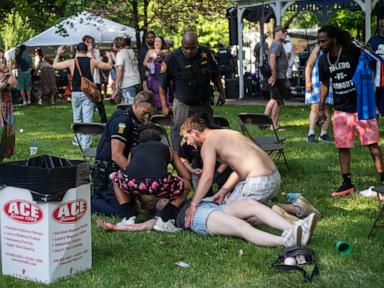
Mass public gatherings present a distinct operational vulnerability: the transformation of dense, open-access environments into high-risk ballistic zones when localized friction occurs. The June 6, 2026, shooting near the Old West End Festival in Toledo, Ohio, which left 12 individuals wounded, serves as a textbook study in crowd security failure modes and multi-jurisdictional suspect apprehension. By analyzing the structural breakdown of the event, the physics of indiscriminate crossfire, and the investigative mechanics that led to the arrest of two primary suspects, municipalities can map out predictable vectors of urban violence and refine intervention protocols.
The Micro-Escalation Failure Mode
The incident at the 53rd annual Old West End Festival illustrates how quickly an unmitigated physical altercation can destabilize a soft target environment. According to eyewitness accounts and verified mobile footage, the sequence initiated not as an active shooter scenario targeting a crowd, but as a localized conflict involving a group of juveniles attacking an individual.
In public safety analytics, this transition is understood through a specific three-stage escalation matrix:
- Friction Core: A physical confrontation occurs between small, discrete factions (in this case, identified by law enforcement as rival groups).
- Asymmetric Escalation: One or more participants introduce ballistic weapons to compensate for numerical or physical disadvantages, shifting the conflict from a fistfight to a lethal engagement.
- Indiscriminate Dispersion: The actors fire at one another within a dense perimeter. Because both shooters are in motion and under physiological stress, accuracy degrades, transforming bystanders into a statistical backdrop for stray rounds.
In Toledo, the two suspects—identified in court documents as 20-year-old Ka Nye Taylor and 20-year-old Eljay Crisp-Carr—allegedly engaged in a direct shootout. Neither suspect was struck by gunfire. Instead, the trajectory of the rounds intercepted 12 civilian bystanders ranging in age from 14 to 61, with two victims sustaining critical injuries. This outcomes profile confirms that the casualty count was a function of crowd density and spatial confinement rather than intentional, targeted mass murder.
Spatial Constraints and the Bystander Casualty Rate
The Old West End historic district features specific architectural and spatial variables that compounded the lethality of the exchange. Characterized by Victorian homes, narrow neighborhood streets, and temporary park structures such as tents, food trucks, and performance stages, the environment offered high visual obstruction but minimal ballistic cover.
When gunfire initiated at approximately 5:30 p.m., the spatial bottleneck created immediate tactical disadvantages for the crowd. The physics of the scene can be categorized by three distinct environmental variables:
High Spatial Density
The concentration of festival-goers per square meter reduces the mean free path of any fired projectile. In a high-density crowd, a bullet fired horizontally or at a downward angle along a crowded street has a near-certain probability of striking human tissue before losing kinetic energy or hitting a permanent structure.
Acoustic Confusion
Mobile footage from the perimeter documented at least ten rapid, successive gunshots. In urban street corridors, echo and reverberation off architectural facades obscure the precise origin of the threat. This acoustic distortion delays the crowd's recognition of the danger zone, causing individuals to flee toward the line of fire rather than away from it.
Lack of Structural Cover
Temporary festival assets like canvas tents and aluminum food trailers provide concealment but possess zero ballistic stopping power. Bystanders seeking immediate shelter behind these structures remained completely vulnerable to intermediate-caliber handgun rounds passing through the material.
The immediate consequence of these variables was a rapid displacement of hundreds of civilians. The operational response required local emergency medical services and police units to pivot instantly from crowd control to triage and field trauma management, demonstrating the necessity of staging medical assets inside the inner perimeter of municipal events.
Investigative Analytics and Multi-Jurisdictional Apprehension
The subsequent criminal investigation highlights the modern synthesis of digital forensics, local intelligence networks, and federal law enforcement tracking. Capturing suspects who flee a chaotic scene requires a systematic compression of the investigative funnel, moving from open-source intelligence to targeted multi-agency execution.
[Crime Scene Media / Social Media Video]
       │
       ▼
[Biometric/Visual Identification via NORIS]
       │
       ▼
[Local Eyewitness Verification]
       │
       ▼
[Geographic Flight Tracking (Toledo to Columbus)]
       │
       ▼
[Multi-Agency Tactical Apprehension (U.S. Marshals)]
The identification of the first suspect, Eljay Crisp-Carr, and the second suspect, Ka Nye Taylor, relied heavily on immediate digital footprints. According to criminal complaints filed in Toledo Municipal Court, investigators utilized cellphone video captured by bystanders alongside social media footage. The visual evidence explicitly detailed the mechanics of the shootout: Taylor was captured on video firing a weapon toward another individual during the altercation, while a separate detective report noted that video evidence showed Crisp-Carr firing indiscriminately into the gathered crowd.
The data-matching protocol followed a precise sequence:
- Visual Extraction: Law enforcement isolated high-resolution frames of the shooters' faces, clothing, and unique physical markers from civilian cellphone recordings and localized security platforms.
- Database Cross-Referencing: Toledo police cross-referenced these images with the Northwest Ohio Regional Information System (NORIS) data and existing law enforcement databases to confirm legal identities.
- Field Interrogation: Investigators paired the digital matches with on-scene interviews and direct eyewitness identifications to establish probable cause for arrest warrants, charging both men with 11 counts each of felonious assault.
Once identification was established, the operational focus shifted from local forensics to regional fugitive tracking. Crisp-Carr was taken into custody relatively quickly on June 11, five days after the shooting. Taylor, however, leveraged geographic mobility to exit the immediate jurisdiction, fleeing approximately 140 miles southeast to Columbus, Ohio.
Locating a mobile suspect requires a coordinated network. The Toledo Police Department engaged the U.S. Marshals Service, the Ohio State Highway Patrol, and the Franklin County Sheriff’s Office. By combining federal tracking resources with local county tactical units, law enforcement executed a synchronized arrest of Taylor in Columbus on June 17, eleven days after the initial incident. Taylor now awaits extradition back to Lucas County to face formal prosecution.
Strategic Recommendations for Municipal Vulnerability Mitigation
The cancellation of the second day of the Old West End Festival highlights the severe economic, social, and reputational liabilities that municipalities face when public safety infrastructures fail to adapt to modern threat profiles. Relying solely on a visible police presence at the perimeter is insufficient for open-access events.
To mitigate the risk of localized group conflicts escalating into mass-casualty bystander events, municipal planners and law enforcement agencies must implement a more structured, proactive containment model.
- Implement Micro-Sectoring: Divide expansive street festivals into distinct, physically barriers-separated sectors. This layout prevents large-scale crowd surges during panics and limits the clear line of sight for mid-range ballistic exchanges.
- Deploy Elevated Mobile Observation Platforms: Stationing tactical observers above the crowd level allows for the early detection of physical altercations (the Friction Core) before weapons can be drawn and deployed.
- Integrate Real-Time Video Intercepts: Establish an on-site command center capable of pulling live feeds from civilian streams, private security cameras, and municipal assets. This enables immediate identification of armed actors, cutting the latency between the first shot and suspect identification down to minutes.
- Pre-Position Trauma Kits and Extraction Corridors: Because urban layouts cause immediate bottlenecks, specialized medical assets must be distributed evenly throughout the interior vendors' row, accompanied by dedicated, barricade-protected lanes for emergency vehicles.
The structural limitation of any open-access public event is that complete security cannot be guaranteed without converting a community celebration into a locked down checkpoint environment. Municipalities must accept a baseline level of structural risk. The optimization target, therefore, is not the absolute elimination of human conflict, but the systematic reduction of escalation speed. By disrupting the transition from physical friction to ballistic discharge through rapid tactical intervention, cities can protect civilian populations from the catastrophic dynamics of indiscriminate crossfire.