The Strategic Function of Excess in State Protocol
Diplomatic protocol is often dismissed as mere ornamentation, yet in the context of high-stakes bilateral negotiations—specifically the 2017 "State Visit Plus" accorded to Donald Trump by Xi Jinping—it functions as a sophisticated signaling mechanism designed to alter the psychological and political cost-benefit analysis of the visiting head of state. This wasn't a performance of friendship; it was the deployment of asymmetric hospitality to neutralize a disruptive foreign policy agenda.
To understand why China invested so heavily in "pomp," one must view the state visit through the lens of a Cost-Benefit Matrix of Sovereign Interaction.
The visit operated on three distinct structural layers:
- The Information Asymmetry Layer: Using historical grandeur to recontextualize the visitor as a temporary figure in a multi-millennial continuity.
- The Domestic Validation Layer: Leveraging the visitor's presence to signal internal strength to a domestic audience.
- The Negotiation Buffer Layer: Using elaborate scheduling and ceremonial density to reduce the available time for substantive, contentious policy debate.
The Architecture of the State Visit Plus
China’s designation of a "State Visit Plus" for the Trump administration was a calculated deviation from standard protocol. Traditional state visits include a welcoming ceremony, a formal banquet, and a meeting at the Great Hall of the People. The "Plus" added a private dinner in the Forbidden City, a rare honor that serves a specific tactical purpose: Atmospheric Anchoring.
By hosting the U.S. President in the Jianfu Palace, the Chinese Communist Party (CCP) utilized architectural prestige to establish a hierarchical frame. The Forbidden City is not a neutral venue; it is a physical manifestation of the "Middle Kingdom" philosophy. In diplomatic theory, the physical environment dictates the conversational pace. A leader surrounded by 600 years of imperial history is less likely to lead with aggressive, transactional demands regarding trade deficits or intellectual property theft. The environment imposes a requirement for "gravitas" that naturally suppresses the impulse for disruptive rhetoric.
The Mechanism of Psychological Disarmament through Grandeur
The "Plus" components of the visit targeted the specific personality profile of the American executive. While typical diplomatic engagement relies on white papers and bilateral working groups, this strategy relied on Visual Validation.
- Sensory Overload as a Tactical Delay: Every minute spent touring the Three Grand Halls or watching Peking Opera is a minute removed from the "Situation Room" style confrontation.
- The Debt of Hospitality: Reciprocity is a fundamental tenet of international relations. By over-delivering on ceremonial honors, China creates a "social debt" that the visitor feels pressured to repay, often through moderated public statements or softened stances on sensitive issues like the South China Sea or the Yalu River trade.
Economic Signaling vs. Structural Reality
The $250 billion in deals announced during the visit provides a perfect case study in the difference between Nominal Diplomatic Value and Real Economic Impact.
An analysis of the "250 billion" figure reveals that a significant portion of these agreements consisted of non-binding Memorandums of Understanding (MOUs) or multi-year purchase frameworks that had already been in the pipeline. For example, Boeing’s $37 billion deal for 300 aircraft was largely a reaffirmation of existing demand rather than new, incremental growth triggered by the visit.
The Two-Tiered Deal Structure
- The Optic Tier: Large, rounded numbers (e.g., $10 billion for Goldman Sachs/CIC investment fund) designed for press releases and "home-front" consumption. These provide the visiting leader with a "win" to show their constituency.
- The Structural Tier: The underlying reality where China maintains its industrial policy, Made in China 2025, and non-tariff barriers.
By offering the Optic Tier, China successfully protected the Structural Tier. The pomp of the visit facilitated a transaction where the U.S. received "headlines" while China preserved "policy space."
Protocol as a Tool for Domestic Legitimation
For Xi Jinping, the visit was less about the U.S. President and more about the 1.4 billion people watching the broadcast. The imagery of the leader of the world's superpower being treated with such deference—and in turn, showing respect to Chinese history—validates the CCP’s narrative of national rejuvenation.
The logic follows a clear causal chain:
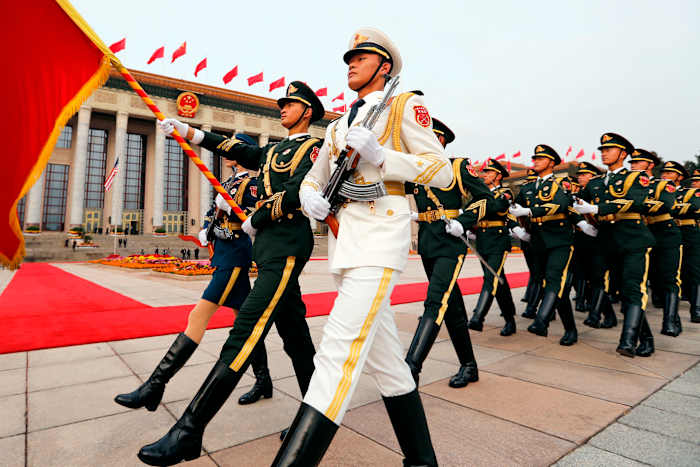
- Step 1: Display immense historical wealth and modern military discipline.
- Step 2: Embed the foreign leader within this display.
- Step 3: Extract visual confirmation that the foreign leader recognizes China as an equal, or at least a formidable, peer.
- Step 4: Broadcast this recognition to the domestic populace to solidify internal stability and loyalty.
This is the Legitimacy Feedback Loop. The visitor becomes a prop in the host's domestic political theater.
The Cost Function of Protocol Failure
The risk of protocol is not that it is "too much," but that it becomes a Friction Point if mismanaged. We see this in instances where minor slights—a missing staircase for Air Force One, a botched handshake, or a seated translation error—derail entire summits.
The 2017 China visit was a masterpiece of "Zero-Friction Diplomacy." By controlling every variable—the temperature of the tea, the path of the motorcade, the duration of the opera—the host minimizes the "Chaos Variable." In a controlled environment, the host dictates the narrative. When the environment is chaotic, the visitor’s personality dictates the narrative. For the CCP, the latter is a high-risk scenario.
The Strategic Miscalculation of the Transactional Approach
The primary limitation of the American strategy during this period was the conflation of Symbolic Deference with Geopolitical Concession.
The U.S. delegation operated under a transactional framework: If they give us this level of respect and these trade deals, it means they are bending to our pressure.
The Chinese delegation operated under a structural framework: If we give them this level of respect and these symbolic deals, we buy the time and political capital to continue our long-term trajectory without immediate interference.
This creates a Strategic Disconnect. The pomp wasn't a sign of weakness or "kowtowing" to the visitor; it was a sophisticated method of containment.
Quantifying the "Pomp" ROI
To measure the success of such a visit, we must look at the Decay Rate of Diplomatic Goodwill.
- Short-term (1-3 months): High. Public statements are positive; trade threats are muted.
- Medium-term (6-12 months): Moderate. The structural tensions (IP theft, regional security) re-emerge as the "glow" of the visit fades.
- Long-term (1-2 years): Zero. The fundamental geopolitical competition resumes its natural course.
The ROI for China was the temporary suspension of a trade war during a critical period of internal consolidation. The cost was merely the expense of some banquets and a few days of diverted traffic—a negligible price for a geopolitical breathing room.
Operational Recommendations for Future Engagement
If protocol is a weapon, then future delegations must treat it as such. This requires a shift from being a "consumer" of protocol to a "disrupter" of it.
- Demand Variable Venues: To avoid the "Atmospheric Anchoring" of places like the Forbidden City, visiting delegations should insist on meetings in neutral, modern, or even "functional" environments (factories, tech hubs) where the historical weight is diminished.
- Separate Symbolism from Substance: Negotiators must be decoupled from the ceremonial team. The team attending the banquet should not be the team negotiating the trade annex. This prevents the "social debt" of the banquet from bleeding into the trade discussions.
- Audit the "Plus" Factor: Every additional ceremonial honor offered by a host should be viewed as a tactical maneuver to avoid a specific discussion point. Analysts must ask: "What are they trying to keep us away from by spending four hours at this cultural site?"
The 2017 visit proved that in the realm of high-stakes diplomacy, the most effective way to manage a disruptor is to bury them in gold-leafed tradition. The pomp was not an honor; it was a strategy of envelopment. Future actors who fail to recognize the tactical nature of a red carpet will invariably find themselves walking exactly where their host wants them to go.
Focus on neutralizing the Environmental Advantage of the host by insisting on "Working Sessions" that prioritize data density over ceremonial duration. This shifts the leverage from the provider of the venue to the provider of the agenda.