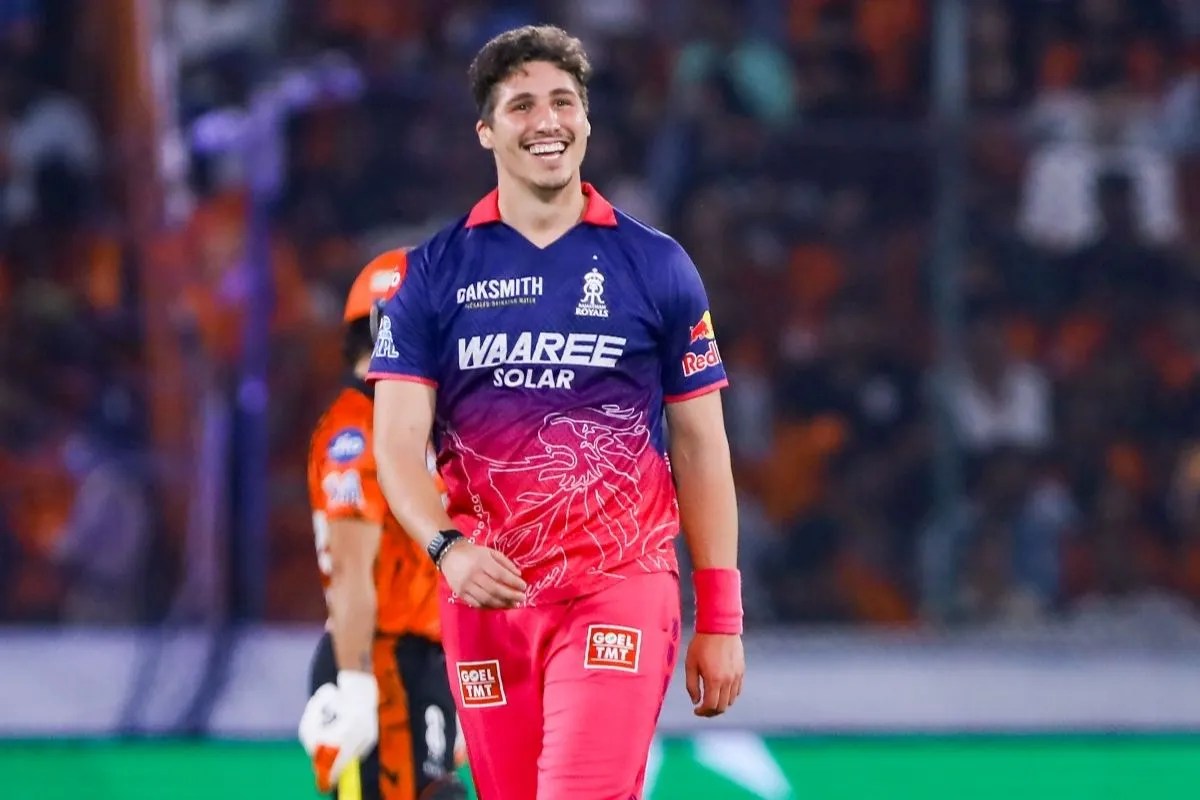
The transition of Nandre Burger from a recreational tennis player to a primary strike bowler in the Indian Premier League (IPL) serves as a case study in latent athletic potential and the efficiency of modern scouting systems. Burger did not follow the traditional high-performance pathway of a cricketer. Instead, his career trajectory provides a blueprint for understanding how non-linear development, when met with specific physical advantages and late-stage technical intervention, can disrupt established scouting models.
The Biomechanical Pivot From Tennis to Cricket
Burger’s late entry into cricket—beginning seriously only during his university years—highlights a critical distinction between skill acquisition and physical literacy. In most cricketing nations, the talent identification process begins at age 10. By the time a player reaches 20, they have typically logged thousands of hours of muscle memory. Burger bypassed this, which, while creating a technical deficit, preserved his physical longevity and prevented the overuse injuries common in teenage fast bowlers.
The primary driver of Burger’s success is a specific set of physical levers. Standing at 6'2", he possesses a high release point that generates steep bounce. Because he spent his developmental years playing tennis, his overhead shoulder mechanics were already optimized for high-velocity movements. The transition from a tennis serve to a fast-bowling action involves a similar kinetic chain:
- Leg Drive: Power generation starts in the back foot.
- Core Rotation: Transferring force from the lower body to the torso.
- Shoulder Internal Rotation: The final whip that produces ball speed.
Burger’s lack of early-age specialization meant his body was not "locked" into the rigid technical flaws often seen in players coached in traditional academies. He arrived at the professional level as a blank slate with elite-level explosive power.
The Role of Academic Infrastructure in Talent Discovery
Unlike many South African cricketers who emerge from the elite school system (such as Grey High or Afro-Asian), Burger’s inflection point occurred at the University of the Witwatersrand (Wits). This shift highlights the importance of tertiary scouting ecosystems.
At Wits, Burger was not looking for a professional contract; he was pursuing a degree in psychology. His entry into the university's cricket program was functional—a means to secure a scholarship. This created a low-pressure environment for skill development. The intervention of Coach Neil Levenson was the catalyst. Levenson identified that Burger’s "natural" left-arm angle—a rare commodity in global cricket—could be weaponized if paired with consistent pace.
The "Left-Arm Advantage" is not merely aesthetic; it is a mathematical disruption for right-handed batsmen. The angle of delivery forces the batsman to adjust their "guard" and alters the visual cues they use to judge length. When a bowler like Burger maintains speeds in excess of 145 kph from that angle, the reaction time for a batsman is reduced by approximately 0.15 seconds compared to a standard right-arm medium-fast bowler.
Risk Assessment and the IPL Auction Logic
The Rajasthan Royals’ decision to acquire Burger for his base price of 50 Lakh (INR) during the 2024 auction reflects a high-efficiency value-investing strategy. In the context of IPL squad construction, overseas fast bowlers are often the highest-cost assets. By identifying Burger, the Royals secured a high-velocity left-arm option at a fraction of the cost of established stars like Mitchell Starc or Pat Cummins.
The logic behind this acquisition was based on three specific performance metrics:
- Release Speed Consistency: Burger consistently clocks above 140 kph, putting him in the top 5% of active global fast bowlers.
- The Powerplay Impact: His ability to swing the new ball back into the right-hander creates a high probability of "LBW" or "Bowled" dismissals in the first six overs.
- Adaptability to Hard Lengths: In Indian conditions, where pitches often lack traditional "sideways" movement, Burger’s ability to hit a "heavy" length—making the ball jump from a spot where the batsman expects it to stay low—is essential.
The scouting report on Burger likely emphasized his performance against India during the 2023-24 home series. International performance is the ultimate stress test. Taking 11 wickets in his debut Test series against a world-class batting lineup provided the "proof of concept" required for IPL franchises to override the risk of his late-blooming status.
Technical Limitations and the Threshold of Sustainability
While Burger’s rise appears meteoric, it is constrained by the inherent limitations of late-stage development. The most significant risk factor is technical fragility. Because his action was refined in his early twenties rather than his early teens, it is more susceptible to "breaking down" under the fatigue of a 14-game IPL season or the heavy workloads of multi-format international cricket.
To maintain his 145 kph+ velocity, Burger relies on a high-intensity "slinging" motion. This places immense strain on the lumbar spine and the front-foot ankle. The management of his workload is not just a health concern; it is a performance necessity. A 5% drop in velocity renders his "heavy length" far less effective, as elite batsmen can adjust their weight distribution more easily at 135 kph.
Furthermore, Burger’s "control" remains a secondary metric. His primary role is "enforcer"—to create chaos and take wickets. This creates a strategic bottleneck for captains. If Burger is not taking wickets, his economy rate can become a liability. He lacks the "slower ball" repertoire and the nuanced "death bowling" skills of a specialist like Jasprit Bumrah. He is a specialized tool designed for the start of an innings.
The Psychological Profile of the Accidental Professional
Burger’s background in psychology and his initial lack of professional ambition provide a unique mental edge. Most young cricketers suffer from "performance anxiety" driven by the fear of losing a career they have worked for since childhood. Burger’s perspective is fundamentally different. Having viewed cricket as a secondary path to an education, he possesses a degree of emotional detachment.
In high-stakes environments like an IPL Super Over or a World Cup knockout, this detachment allows for better execution of the "process" over the "result." He is less likely to be paralyzed by the magnitude of the occasion because his identity is not solely tied to his bowling statistics.
Strategic Allocation of International Talent
The rise of Nandre Burger signals a shift in how franchises will approach the South African market. Historically, the focus was on top-order batsmen. However, the South African domestic circuit is currently producing high-velocity bowlers who are undervalued because they do not play for "big market" international teams or haven't been through the U-19 World Cup cycle.
For a franchise to replicate the Rajasthan Royals' success with Burger, they must look beyond the standard "Performance Center" data and look for multi-sport crossover athletes. The specific physiological requirements for fast bowling—lateral hip explosiveness and shoulder mobility—are often found in high-level tennis, javelin, or rugby.
The strategic play for the next three-year cycle is clear: identify "unrefined" pace assets in the 22-25 age bracket who possess the raw physical tools but have lacked the high-performance coaching to translate that into match-winning consistency. Burger is not an anomaly; he is the first successful output of a new, more aggressive scouting filter that prioritizes "ceiling" (maximum potential) over "floor" (current reliability).
The final assessment of Burger’s career will not be measured by total wickets, but by his ability to develop a "Plan B" when his raw pace is neutralized by slow, low-turning tracks. Until then, his utility lies in his ability to act as a physical disruptor, a role he earned by failing to become a professional tennis player.