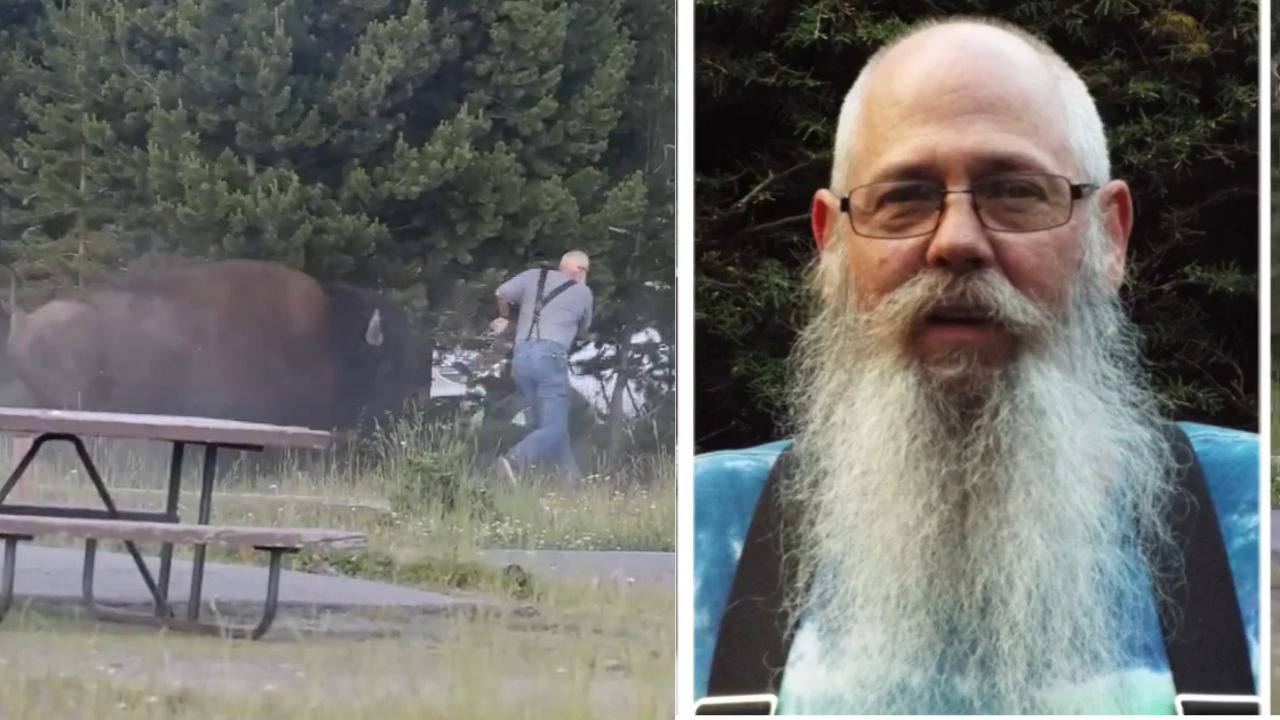
Wildlife-human interactions in national parks represent a complex intersection of kinetic energy, biological vulnerability, and acute psychological stress management. The recent survival of a 65-year-old male following a close-range encounter with a Yellowstone bison highlights a critical paradigm in trauma survival: the decoupling of severe physical injury from immediate psychological collapse. Evaluating this incident requires an objective dissection of the biomechanical forces exerted during megafauna interactions and the neurobiological coping mechanisms that govern survival outcomes.
Biomechanical Analysis of Megafauna Impact Forces
Understanding the severity of a bison encounter requires calculating the kinetic energy transfer involved. A mature male American bison (Bison bison) can mass up to 900 kilograms and achieve sprint velocities of 15.6 meters per second (approximately 35 miles per hour).
The kinetic energy ($E_k$) generated during a full-velocity charge is expressed by the formula:
$$E_k = \frac{1}{2}mv^2$$
Substituting these operational variables yields:
$$E_k = \frac{1}{2}(900 \text{ kg})(15.6 \text{ m/s})^2 = 109,512 \text{ Joules}$$
This figure exceeds 109 kilojoules of energy, roughly equivalent to the kinetic profile of a light vehicle traveling at urban speeds. When this energy is focused through a highly concentrated surface area—specifically the animal's horn structure or frontal cranium—the resulting impact pressure forces human skeletal structures well past their ultimate tensile strength.
The primary trauma profile in these scenarios involves a two-stage deceleration injury:
- Primary Impact Stage: Direct energy transfer resulting in localized comminuted fractures, severe blunt force trauma to the thoracic cavity, and immediate soft tissue disruption.
- Secondary Impact Stage: The trajectory phase, where the victim is launched into the air and subjected to a secondary deceleration impact upon striking the ground. This phase typically introduces rotational forces, leading to compound fractures of the extremities, spinal compression, and traumatic brain injuries (TBIs).
In the specific case of the 65-year-old survivor, the presentation of multiple broken bones without catastrophic internal organ rupture suggests a glancing or non-centered primary impact vectors, which distributed the kinetic energy across non-lethal structural zones of the musculoskeletal system.
The Neurobiology of Acute Humor and Stress Dissociation
The manifestation of levity or "cracking jokes" while sustaining major skeletal trauma is often misinterpreted as mere bravado. In clinical reality, this response represents a highly evolved neurobiological defense mechanism designed to mitigate shock and maintain cognitive continuity during catastrophic physical failure.
Under conditions of extreme physical trauma, the sympathetic nervous system triggers an immediate, maximum-velocity activation of the sympathomedullary (SAM) pathway and the hypothalamic-pituitary-adrenal (HPA) axis. This results in a systemic flood of catecholamines (epinephrine and norepinephrine) alongside endogenous opioids (beta-endorphins).
[Catastrophic Physical Trauma]
          │
          ▼
[SAM Pathway & HPA Axis Activation]
          │
          ├────────────────────────┐
          ▼                        ▼
[Catecholamine Surge]     [Beta-Endorphin Flood]
(Epinephrine/Norepinephrine)        │
          │                        ▼
          ▼               [Systemic Analgesia]
[Vasoconstriction &                │
 Tachycardia]                      ▼
          │               [Blunted Pain Perception]
          └────────┬───────────────┘
                   │
                   ▼
       [Cognitive Dissociation]
                   │
                   ▼
     [Exogenous Humor Production]
This chemical cascade serves two primary survival functions:
- Systemic Analgesia: Beta-endorphins bind to mu-opioid receptors in the central and peripheral nervous systems, effectively blunting the immediate perception of intense pain. This creates a temporary physiological window where the patient remains conscious and communicative despite possessing injuries that would otherwise induce spinal shock or unconsciousness.
- Cognitive Dissociation: The massive surge of dopamine and epinephrine can induce a state of psychological detachment. Humor, in this specific state, functions as an exogenous cognitive strategy to reassert control over an uncontrollable environment, downregulating the amygdala's panic response and preventing a fatal descent into neurogenic or hypovolemic shock.
The survival advantage of this response is clear. A patient who maintains vocal communication and cognitive clarity assists first responders in rapid triage, providing real-time data on respiratory status and neurological function, which directly accelerates the deployment of targeted trauma protocols.
Structural Failures in Wilderness Risk Mitigation
The frequency of wildlife-induced trauma in national parks points to a systemic breakdown in visitor risk perception. The National Park Service mandates a minimum stand-off distance of 25 yards (23 meters) from bison. Analysis of human behavior within these ecosystems reveals that visual proximity biases frequently override rational risk calculations.
- The Habituation Trap: Animals that appear docile or stationary create a false sense of security. Because bison spend significant periods grazing passively, visitors systematically miscalculate the animal’s acceleration capacity, failing to recognize that a 900-kilogram organism can close a 25-yard gap in less than two seconds.
- The Anthropomorphic Error: Visitors frequently misinterpret animal body language. Tail elevation, pawing of the earth, and head-shaking are not benign behaviors; they are explicit pre-charge indicators signaling that the animal's defensive perimeter has been breached.
When these behavioral indicators are ignored, the window for evasive action drops below human reaction thresholds, shifting the scenario from risk avoidance to active trauma management.
Protocol for Managing Close-Range Megafauna Encounters
When preventative distance thresholds fail, survival depends on the immediate execution of a structured, non-instinctual tactical protocol.
- Immediate Distance Stabilization: If the animal detects your presence but has not charged, freeze. Do not maintain direct eye contact, which is interpreted as a predatory challenge. Back away slowly without turning your back to the animal, utilizing lateral movement vectors to place substantial natural obstacles (large trees, boulders, vehicles) between yourself and the organism.
- Defensive Structural Positioning: In the event of an active charge where evasion is mathematically impossible, drop your center of gravity immediately. Protect the most critical biological vulnerabilities—the brain, carotid arteries, and visceral organs. Lie prone, interlock your fingers behind your neck to shield the cervical spine, and use your forearms to protect the temporal regions of the skull. Tuck your knees tightly into your thoracic cavity to minimize the exposure of abdominal organs to puncture or blunt force perforation.
- Post-Impact Stabilization: If struck, remain stationary. Do not attempt to stand immediately, as large herbivores frequently return to eliminate perceived moving threats. Wait until the animal has moved outside of its active defensive radius before attempting to self-assess or signal for medical extraction.