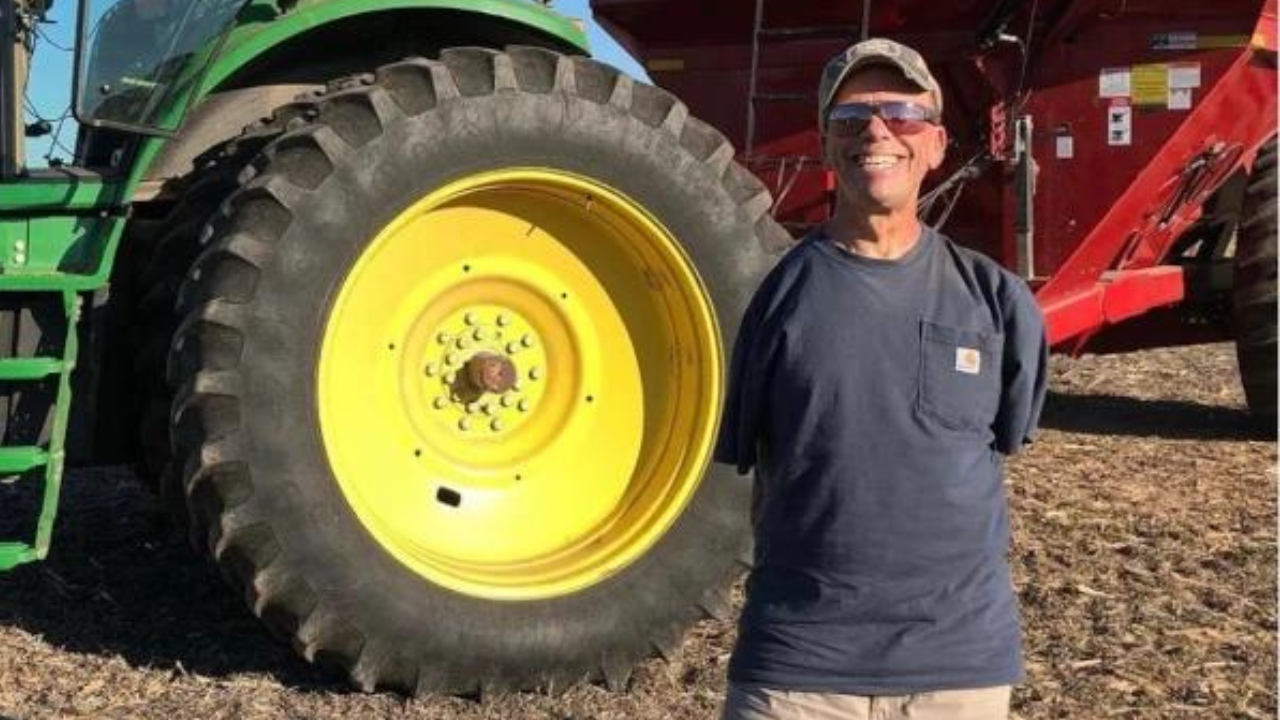
Operating a 1,300-acre corn and soybean operation requires massive capital expenditure, precise timing, and continuous mechanical maintenance. In standard agricultural operations, human labor is assumed to have a baseline physical configuration: two hands for three-point hitch connection, hydraulic lever manipulation, steering, and high-torque mechanical repair. When an operator lacks upper extremities, the traditional physical workflow of farming fails.
Analyzing the operational model of late agriculturalist Andy Detwiler reveals a profound case study in industrial adaptation, physical process engineering, and digital diversification. By translating standard manual controls into pedal and lower-extremity interfaces, Detwiler managed a large-scale commercial farm in Ohio while simultaneously scaling a digital content business to over 134,000 subscribers. This analysis breaks down the physical mechanics, operational math, and media economics that made this dual-system enterprise viable. For a closer look into this area, we recommend: this related article.
The Kinematics of Foot-Based Agricultural Mechanics
Row-crop farming is not merely a cognitive management challenge; it is a heavy physical assembly and repair business. On a 1,300-acre farm, equipment downtime during planting or harvest windows costs hundreds of dollars per hour in lost yield potential. Resolving these failures requires executing high-torque mechanical interventions.
To understand how these tasks are completed without arms, we must map standard hand-oriented mechanics to lower-limb kinematics. For broader information on the matter, detailed analysis is available on Forbes.
Torque Generation and Leverage
The human foot and leg are structurally optimized for force production rather than fine motor dexterity. However, when the motor cortex undergoes early-stage reorganization—such as after bilateral upper-limb amputation at age two—the lower extremities develop high degrees of fine motor control while retaining their natural mechanical advantage in force output.
- Rotational Torque Application: Loosening a seized bolt on a combine harvester typically requires a minimum of 80 to 120 Newton-meters of torque. A hand-operated socket wrench relies on upper-body musculature (deltoids, biceps, and pectorals). A foot-operated execution relies on the quadriceps and gluteal muscle groups, which are capable of generating significantly higher raw force. By using custom-angled wrenches and positioning the leg to apply downward force at the terminal end of the lever arm, the operator increases the effective torque output.
- The Three-Point Contact Rule: Standard safety protocols require three points of contact when mounting heavy machinery like a John Deere combine. For an armless operator, this protocol must be engineered around lower-body stabilization. The physical process involves using the torso, thighs, and steps to secure center-of-mass balance before initiating the next step upward.
Fine Motor Control in Electrical and Hydraulic Interfaces
Modern agricultural equipment uses a mix of analog hydraulic levers and digital console screens.
- Analog Hydraulics: Controlling the height of a 30-foot cutting platform on a combine harvester requires precise, incremental adjustments of a multi-axis control stick. This is managed by mapping the control layout to foot pedals or custom extensions. The foot must apply precise pressure variations (measured in millimeters of travel) to regulate hydraulic fluid flow rates.
- Welding and Fabrication: Repairing implement frames requires executing shielded metal arc welding (SMAW) or gas metal arc welding (GMAW). This task demands maintaining a constant arc gap of roughly 3 millimeters while moving the electrode along a joint. Achieving this without hands requires securing the welding torch using a specialized clamp or holding the electrode holder between the first and second metatarsal bones of the foot. The operator uses the opposing foot to steady the working leg, creating a stabilizing physical tripod on the shop floor.
The Efficiency Loss Function of Non-Standard Labor
While physical adaptation is possible, it carries a time penalty. In operations management, this can be quantified as the Operational Loss Function ($L_o$), which measures the deviation in execution time between standard manual labor and adaptive physical labor.
Let the efficiency of a given task $i$ be represented as:
$$E_i = \frac{T_{standard, i}}{T_{adaptive, i}}$$
where $T_{standard}$ is the baseline time required for an able-bodied operator to complete a task, and $T_{adaptive}$ is the time required using lower-extremity adaptation.
| Task Category | Standard Time ($T_{standard}$) | Adaptive Time ($T_{adaptive}$) | Efficiency Coefficient ($E_i$) |
|---|---|---|---|
| Cab Mounting & Ignition | 15 seconds | 45 seconds | 0.33 |
| Consumable Fluid Top-Off | 3 minutes | 12 minutes | 0.25 |
| Hydraulic Hose Coupling | 1 minute | 5 minutes | 0.20 |
| In-Field Tire Change | 45 minutes | 150 minutes | 0.30 |
| GPS Display Programming | 2 minutes | 3 minutes | 0.67 |
This table illustrates that physical setup and mechanical interventions bear the highest time penalty ($E_i \le 0.30$), whereas cognitive and digital interface tasks approach parity ($E_i \ge 0.67$).
Mitigating the Time Penalty Through Process Optimization
To run a 1,300-acre farm with a structural time penalty, the operator must restructure the operational environment to minimize high-overhead tasks. This is achieved through three tactical adjustments:
- Tool and Interface Staging: Tools are organized on low-profile vertical racks or organized directly on floor-level trays. This minimizes the vertical lift requirement, which is the most energy-intensive phase of foot-based tool retrieval.
- Preventative Maintenance Overdrive: Because in-field breakdowns carry a high time penalty, the operator must run a more aggressive preventative maintenance schedule than standard farms. Replacing belts, hoses, and bearings at 80% of their expected lifecycle rather than waiting for failure shifts unpredictable field-repair events into controlled workshop environments.
- Capital Equipment Standardization: Utilizing implements with quick-attach hitches and automated hydraulic coupling systems reduces the physical steps needed to transition from tillage to planting configurations.
The Economics of Digital Hedging: The YouTube Revenue Engine
A 1,300-acre row-crop farm in the Midwestern United States is subject to extreme commodity price volatility, weather risk, and rising input costs (fertilizer, diesel, seed). Net margins on corn and soybeans frequently dip below 10%, meaning a bad weather year can wipe out seasonal profits.
By building a YouTube channel (the "Harmless Farmer") to 134,000+ subscribers, Detwiler constructed a highly effective digital hedge against agricultural volatility.
Monetization Architecture of Agricultural Content
The business model of a modern farm-focused YouTube channel operates on completely different unit economics than traditional agriculture:
- Low Marginal Cost of Distribution: Once the capital expense of filming equipment (cameras, mounts, editing software) is paid, the cost of distributing a video to 100,000 viewers is effectively zero. In contrast, the marginal cost of producing an extra bushel of grain includes fertilizer, fuel, and crop protection chemicals.
- AdSense Revenue Dynamics: The agricultural niche on YouTube commands a high CPM (Cost Per Mille, or cost per thousand views) due to the highly targeted, high-income audience (farmers, heavy machinery buyers, rural land owners). While a gaming channel might see CPMs of $2 to $4, an industrial, machinery, or ag-focused channel can command CPMs of $8 to $15.
- Sponsorship and Merchandising Integration: Tool brands, workwear manufacturers, and agricultural parts suppliers seek authentic, high-engagement channels for product integration. An operator demonstrating the durability of a wrench or boot by using it with their feet provides a level of product validation that standard commercial marketing cannot match.
Risk Diversification: Crop Yield vs. Attention Yield
The interaction between the physical farm and the digital channel creates a counter-cyclical business portfolio.
- During high-yield, low-price years: Agricultural income is flat or depressed. However, the high volume of field operations provides abundant, visually compelling content for the channel, driving up viewership and digital ad revenue.
- During low-yield, crop-failure years: Physical farm income drops sharply. However, the dramatic narrative of managing a crisis (e.g., harvesting in mud, mechanical failures under pressure) increases viewer retention and engagement, driving up digital revenue precisely when the farm's cash flow needs a buffer.
Operational Takeaways for High-Constraint Environments
The integration of non-standard physical execution with digital media offers valuable lessons for industrial operations, ergonomics, and business strategy.
- Design for Accessibility is Design for Efficiency: Simplifying physical control loops (such as moving manual hydraulic levers to electronic joysticks or foot pedals) does not just assist operators with physical limitations; it reduces fatigue and increases cycle times for all operators.
- The Value of Process Deconstruction: To adapt a task for foot execution, one must break that task down into its foundational components: force vector, stabilization point, tool interface, and safety clearance. Applying this level of decomposition to any corporate or industrial process reveals hidden redundancies and opportunities for optimization.
- Content as a B2B Capital Asset: For capital-intensive, low-margin businesses, digital media should not be viewed as a distraction from the core business. Instead, it serves as an alternative asset class that leverages existing physical operations to generate high-margin cash flow, effectively lowering the overall cost of capital for the core enterprise.
To replicate this success in any high-constraint environment, organizations should systematically audit their physical workflows to separate high-overhead manual tasks from high-leverage cognitive tasks, using automation or specialized interfaces to shift human labor away from low-efficiency physical bottlenecks.