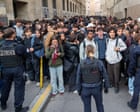
French high school blockades—known domestically as blocus—are not spontaneous outbreaks of adolescent unrest; they are highly structured, recurring tactical operations that function as a critical pressure valve and force multiplier within France's broader socio-political protest ecosystem. When secondary students barricade entrances with trash bins, metal barriers, and wooden pallets, they execute a repeatable playbook designed to halt institutional operations, command immediate media attention, and signal widespread generational dissent ahead of national labor strikes. Understanding this phenomenon requires stripping away superficial media narratives of chaotic youth rebellion and examining the operational architecture, incentive structures, and institutional vulnerabilities that make the lycée blockade one of the most durable forms of civil disruption in Western Europe.
The Structural Anatomy of the Lycée Blockade
To analyze why high school blockades recur with predictable regularity during periods of French social tension—whether over pension reforms, educational restructuring, or economic grievances—one must examine the physical and organizational design of the French secondary school system. Unlike decentralized school districts in North America, French public high schools (lycées) operate under a centralized national curriculum and uniform administrative governance managed by the Ministry of National Education. When a policy shift occurs in Paris, it impacts every student across the republic simultaneously, creating an instant, nationwide alignment of grievances.
This centralized structure is paired with a specific physical architecture that unintentionally facilitates disruption. Most French lycées are enclosed compounds featuring a small number of narrow, fortified entry gates designed for perimeter security. From an operational standpoint, this creates extreme chokepoints. A relatively small group of organized students—often fewer than thirty individuals—can effectively deny access to a student body of over a thousand simply by obstructing two or three primary gates before the 8:00 AM morning bell.
The execution of a blockade follows a distinct three-phase operational sequence:
- Pre-Dawn Logistics and Perimeter Denial: Core organizers arrive at the school perimeter between 6:30 AM and 7:30 AM, utilizing readily available municipal infrastructure such as wheeled waste containers (poubelles), construction fencing, and street furniture to construct physical barricades across entry points.
- Narrative Framing and Crowd Aggregation: Banners displaying concise political slogans are affixed to the barricades before the main student body arrives. As commuters gather outside the blocked gates, the physical inability to enter classes naturally converts passive bystanders into visible participants, creating the visual optics of mass mobilization for local press and social media.
- Escalation Management and Dispersal: Once the morning headcount is disrupted and administrative authorities register the closure, organizers either transition the crowd into downtown street marches to join adult labor unions or disperse before specialized riot police (Compagnies Républicaines de Sécurité, or CRS) execute perimeter clearance operations.
The Force-Multiplier Effect in French Protest Ecology
A critical error in standard reporting on French protests is treating student blockades as isolated events separate from adult labor movements. In reality, student mobilizations and trade union strikes operate through a mechanism of mutual reinforcement. Major French union confederations—such as the CGT (Confédération Générale du Travail) and CFDT (Confédération Française Démocratique du Travail)—rely on multi-generational visibility to establish moral legitimacy and political urgency.
When high school students block their campuses on the morning of a national day of action (journée de mobilisation), they generate three immediate strategic effects for the broader protest movement:
- Media Cycle Capture: Morning news broadcasts require immediate visual evidence of disruption before adult marches officially assemble in city centers at midday. High school blockades provide high-contrast, dynamic imagery by 8:30 AM, setting the media narrative that the country is grinding to a halt.
- Parental and Household Spillover: The closure of secondary schools forces working parents to confront the political crisis directly within their domestic routines, amplifying household-level awareness and discussion of the underlying policy disputes.
- Security Bandwidth Dilution: Law enforcement commanders in major urban centers like Paris, Lyon, Nantes, and Rennes must divert mobile policing units to monitor suburban and urban school perimeters early in the day. This stretches tactical reserves thin hours before the primary union demonstrations require heavy crowd-control deployment.
This dynamic illustrates a classic asymmetric resource allocation problem. A decentralized network of student unions—such as the Union Nationale Lycéenne (UNL) or local autonomous student collectives—can force the state to expend disproportionate policing and administrative resources at minimal organizational cost.
The Three Pillars of Student Mobilization
Why do French adolescents consistently adopt a tactic that carries risks of academic penalty, disciplinary action, and physical confrontation with police? The decision matrix is governed by three structural drivers that distinguish the French student experience from that of peers in other industrialized nations.
1. Historical Path Dependency and Cultural Legitimacy
In French political culture, street protest is not viewed merely as a breakdown of order; it is widely understood as a legitimate, constitutional-adjacent mechanism of democratic negotiation. Since the landmark student-worker uprising of May 1968, and reinforced through successful student-led reversals of government policy—most notably the 2006 defeat of the First Employment Contract (Contrat Première Embauche, or CPE)—youth mobilization carries historical prestige. Participating in a blocus functions as a civic rite of passage, socializing adolescents into the mechanics of collective bargaining and political agency.
2. Direct Exposure to State Reform Mechanics
French high school students experience national policy shifts directly and immediately. Changes to the Baccalauréat examination system, adjustments to the Parcoursup university admissions algorithm, or reforms to pension ages directly alter their immediate educational trajectory or their perceived future entry into the labor market. Because the French state acts as the primary architect of both educational credentialing and labor market regulation, students view the government as a direct counterparty rather than a distant abstraction.
3. Asymmetric Risk-Reward Calculus
For a sixteen- or seventeen-year-old student, the immediate opportunity cost of participating in a blockade is relatively low compared to an adult worker. While an adult striker forfeits a day's wages for every day off the job, a high school student risks only missed instructional hours—a cost that is further socialized when an entire school is closed, preventing individual students from falling behind their peers. Simultaneously, the psychological reward of peer solidarity, collective agency, and immediate visibility creates a powerful incentive structure that favors participation during periods of heightened national tension.
Operational Limitations and Strategic Vulnerabilities
Despite its tactical efficiency in generating short-term disruption, the blocus strategy suffers from severe structural limitations that prevent it from sustaining long-term political pressure on its own. Analysts and institutional administrators must recognize these constraints to avoid overestimating the durability of youth-led protests.
First, temporal decay sets in rapidly. While a blockade is highly effective for forty-eight to seventy-two hours, prolonged closures trigger resistance from non-participating students and parents anxious about national examination preparation. As the academic calendar advances toward fixed testing deadlines, the internal consensus within the student body fractures, allowing school administrators to isolate core organizers and reopen gates.
Second, perimeter vulnerability to external actors frequently undermines the legitimacy of student demands. When trash bins are set alight or skirmishes erupt outside school gates, the disruption attracts opportunistic individuals unaffiliated with the school—often termed casseurs—who exploit the chaos for property damage or confrontation with police. The moment a blockade shifts from peaceful access denial to violent property destruction, public sympathy evaporates, and state authorities gain political cover to deploy aggressive dispersal tactics.
Third, coordination fragmentation limits strategic coherence. Unlike trade unions with formal hierarchies, dues-paying memberships, and professional negotiators, student collectives operate through fluid general assemblies (assemblées générales). Decisions made by voice vote in a crowded courtyard can shift hour by hour, making it nearly impossible for government ministries to identify authorized representatives with whom to negotiate a formal off-ramp.
Institutional Counter-Strategies and Risk Mitigation
For school administrators, municipal authorities, and policy analysts managing the operational fallout of recurring blockades, reactive confrontation rarely yields positive results. Deploying riot police directly onto school steps frequently escalates minor obstructions into major public relations crises, hardening student solidarity and drawing condemnation from teachers' unions.
Effective operational management requires a calibrated, multi-layered response that addresses both physical vulnerabilities and communication gaps:
- Proactive Perimeter Hardening: Municipal sanitation services in high-risk districts must remove wheeled waste containers and unsecured construction materials from the immediate vicinity of school compounds prior to scheduled national strike days. Depriving organizers of heavy, movable objects forces reliance on human chains alone, which are significantly harder to maintain in cold weather and easier for administrators to negotiate through.
- Administrative De-Escalation Protocols: Principals (proviseurs) who maintain open, non-punitive communication channels with student representatives prior to a mobilization can often negotiate "filtering blockades" (blocus filtrants). Under this arrangement, protesters hold banners and distribute leaflets at the gate without physically barring entry to students who wish to attend classes, preserving both the right to political expression and institutional continuity.
- Targeted Academic Continuity: Rather than canceling instruction entirely during a perimeter blockage—which validates the disruption and rewards passive bystanders with a free day—districts should immediately transition affected classes to asynchronous digital coursework. Removing the incentive of an unscheduled holiday reduces crowd size at the gates by stripping away non-ideological participants.
The Strategic Forecast for French Civil Mobilization
As France navigates ongoing fiscal consolidation, labor market adjustments, and educational restructuring, the high school blockade will remain a permanent fixture of its domestic protest repertoire. However, the mechanics of these mobilizations are evolving. Digital coordination via encrypted messaging platforms and short-form video networks has compressed the timeline required to organize simultaneous blockades across dozens of municipalities from weeks to hours.
Consequently, institutions can no longer rely on traditional intelligence indicators—such as formal union strike notices—to predict when school disruptions will occur. The decisive metric for anticipating youth mobilization is no longer formal organizational membership, but rather the convergence of three conditions: an imminent legislative vote affecting youth prospects, an active adult union mobilization calendar, and high digital sentiment velocity among student networks. Policy makers and institutional leaders must treat the lycée blockade not as an anomaly of adolescent behavior, but as a leading indicator of broader systemic friction across the French social model.