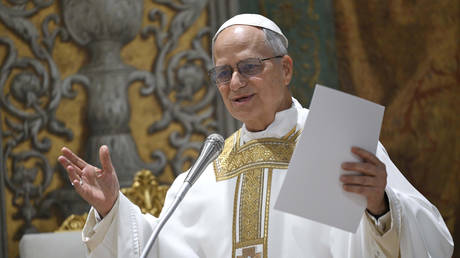
The convergence of sovereign penal policy, digital dissemination mechanics, and institutional moral authority creates a complex friction point in modern governance. When state-sanctioned executions transition from closed-system administrative procedures to high-definition digital media streams, the operational parameters of capital punishment shift. This visibility alters the feedback loops between the state, the judiciary, and the citizenry. Pope Francis's condemnation of the death penalty, issued against the backdrop of backlash surrounding recent United States execution livestreams, is not merely a moral appeal. It is a structural critique of how technological transparency interacts with state violence.
To understand this dynamic, one must examine the institutional economics of capital punishment, the friction introduced by media accessibility, and the ethical frameworks that govern state-sponsored termination of life.
The Operational Cost Function of Capital Punishment
Proponents and opponents of capital punishment frequently debate its deterrent effect, yet the empirical data reveals a more mundane reality: the financial and administrative friction of the process itself. The institutional cost function of maintaining a death row apparatus involves protracted litigation, specialized housing, and specialized medical protocols.
The primary cost drivers include:
- Extended appeals processes mandated by the Eighth Amendment and equivalent constitutional protections to mitigate the risk of executing an innocent party.
- Litigation over execution methods, particularly as pharmaceutical suppliers restrict access to lethal injection compounds, forcing correctional agencies to experiment with alternative protocols.
- Administrative overhead associated with maintaining maximum-security housing units designed for individuals serving capital sentences.
When these costs are aggregated, capital trials and subsequent incarcerations consistently consume significantly more public capital than life imprisonment without the possibility of parole. Yet, the economic argument is rarely the pivot point for public discourse. The pivot point is visibility.
The Digital Transmission of State Violence
For much of the twentieth century, state executions in developed nations moved from public squares into sterile, enclosed chambers witnessed by a curated micro-audience of officials, journalists, and victims' families. This physical quarantine insulated the general public from the visceral reality of the act. The introduction of digital broadcasting, closed-circuit viewing expansions, or procedural livestreams collapses this distance.
When execution proceedings are rendered accessible via digital networks, two competing forces collide:
- The demand for transparency and accountability from the state, which drives arguments for open observation of government actions.
- The de-sensitization and spectacle economy of digital media, where graphic content is monetized, scrutinized, and stripped of solemnity.
The recent backlash against execution livestreams highlights a structural contradiction. If a state asserts the moral and legal right to take a life, hiding the mechanism of execution can be interpreted as institutional cowardice or a recognition of the act's inherent brutality. Conversely, broadcasting the act transforms judicial execution into media content, inviting voyeurism, political polarization, and emotional contagion.
The friction arises because modern digital networks are optimized for engagement rather than deliberation. An execution livestream converts a solemn legal penalty into an interactive event, undermining the gravity that proponents argue gives the punishment its unique deterrent weight.
The Papal Framework and Institutional Moral Authority
Pope Francis's intervention operates within a tradition of Catholic social teaching that has progressively narrowed the acceptable parameters of capital punishment. In 2018, the Catechism of the Catholic Church was revised to declare the death penalty "inadmissible" because it is "an attack on the inviolability and dignity of the person."
From a strategic perspective, the Vatican’s stance is rooted in a consistent-life-ethic framework that views human dignity as non-negotiable, regardless of the individual's past actions. When applied to the contemporary context of digital executions, the papal argument identifies a profound ethical hazard: the normalisation of state violence.
When executions are beamed directly to digital devices, the state risks conditioning the populace to accept state-sponsored killing as an ordinary administrative output. The Vatican's critique posits that true justice cannot be achieved through mechanisms that degrade the moral standing of the political community carrying them out. By condemning the practice alongside the normalisation of its public broadcast, the institutional church attempts to interrupt the feedback loop between technological visibility and ethical erosion.
The Structural Limits of Deterrence and Retribution
The philosophical defense of capital punishment typically rests on two pillars: deterrence (the prevention of future crimes through fear of consequence) and retribution (the proportional repayment of a moral debt to society).
Empirical sociology has repeatedly tested the deterrence hypothesis. Criminological data demonstrates that capital punishment does not produce a statistically significant deterrent effect compared to long-term incarceration. Criminals contemplating high-stakes offenses rarely calculate the marginal difference between life imprisonment and execution.
Retribution, therefore, remains the primary intellectual engine of the practice. However, retribution relies on the assumption of a flawless judicial system. The discovery of wrongful convictions through DNA evidence and post-conviction reviews introduces a permanent error rate into the system. In a data-driven risk assessment, any policy with an irreversible outcome and a non-zero error rate carries an unacceptable systemic risk.
The Policy Trajectory
The collision between modern media technology and penal policy forces a choice for liberal democracies. As transparency initiatives push for greater visibility into state operations, institutions must decide whether practices like capital punishment can withstand the light of uncurated digital scrutiny.
If the state insists on retaining the death penalty in an era of ubiquitous digital media, it must accept that the act will be stripped of its Victorian solemnity and subjected to the volatile dynamics of the attention economy. Conversely, moving away from capital punishment requires an acknowledgment that state authority is strengthened, not weakened, by renouncing the ultimate coercive power over human life. The strategic path forward involves dismantling the infrastructure of capital punishment not out of sentimentality, but from a rigorous recognition of its economic inefficiency, its irreversible error rate, and its corrosive effect on the moral architecture of the state.