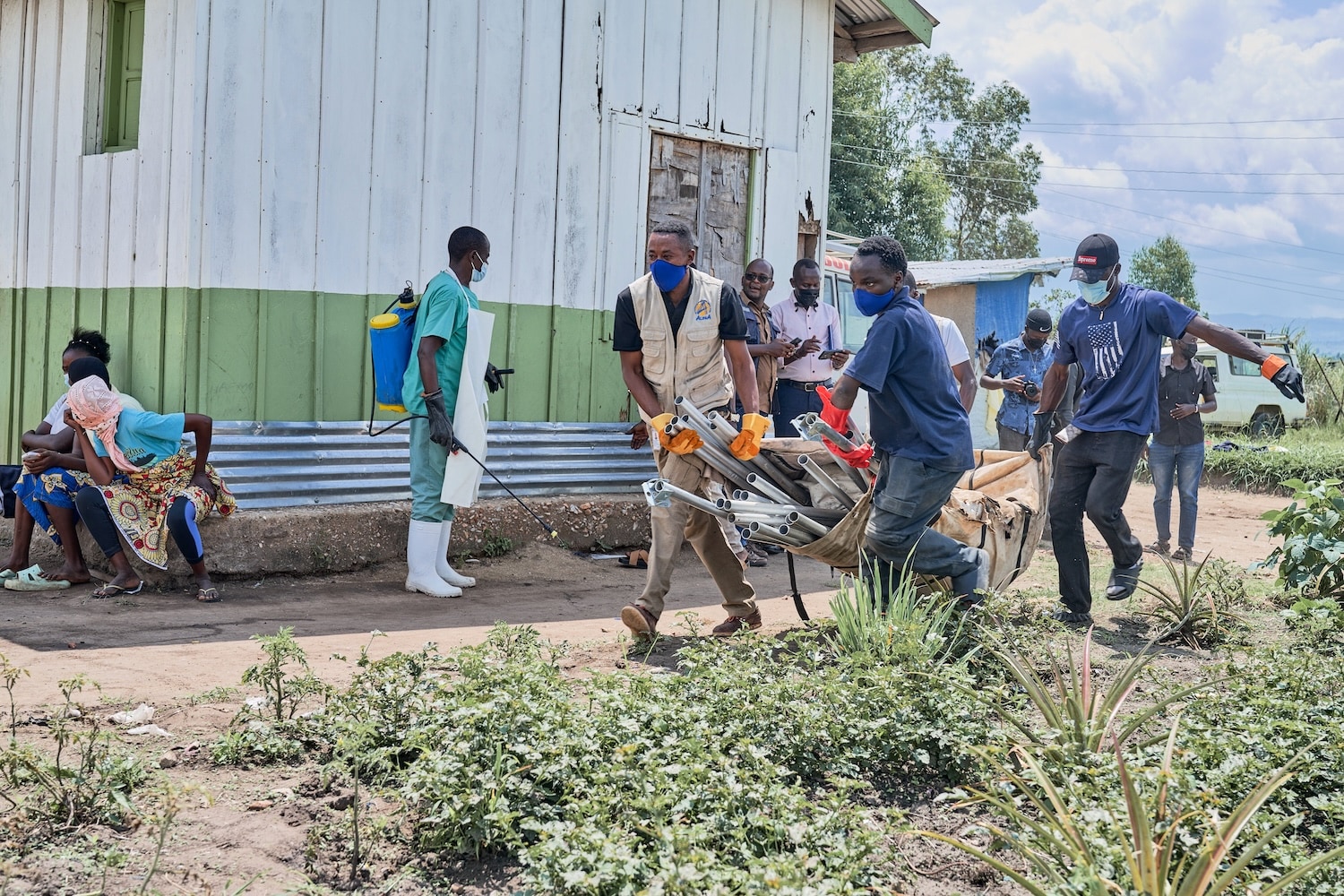
The trajectory of an Ebola virus disease (EVD) outbreak is dictated by two intersecting variables: the transmission velocity and the geographic dispersion rate. When public health officials express concern over the "scale and speed" of an outbreak, they are observing a failure to achieve epidemiological containment before the disease reaches dense transport hubs. Managing these crises requires moving past reactive alarmism and instead breaking down the crisis into a structural optimization problem. To contain an accelerating outbreak, intervention teams must solve a complex logistical equation where the rate of contact tracing and isolation must strictly outpace the pathogen's factual reproduction number ($R_t$).
Evaluating an outbreak requires looking at the raw metrics of transmission. Standard epidemiological reporting often obscures the underlying operational friction that causes containment failures. By analyzing the mechanics of viral amplification, the structural bottlenecks in health infrastructure, and the mathematical reality of contact tracing limits, we can map out a precise framework for modern epidemic intervention.
The Three Vectors of Viral Amplification
An Ebola outbreak shifts from a localized cluster to an exponential crisis through three distinct vectors. Each vector introduces unique variables into the containment equation, compounding the difficulty of regional tracking.
1. Community Transmission Mechanics and Super-Spreader Events
The fundamental baseline of Ebola transmission relies on direct contact with the bodily fluids of an infected individual. In the early stages of an outbreak, transmission clusters are typically linear, moving through immediate family networks or localized care providers.
Amplification occurs when a single index case interacts with a high-density environment while exhibiting peak viral load. This creates a super-spreader event. Peak infectivity correlates directly with advanced symptom severity, meaning individuals are most contagious when they are least mobile. However, systemic failures in early identification allow highly infectious patients to travel via public transport networks, converting localized transmission lines into highly distributed geographic webs.
2. Nosocomial Amplification Cascades
Healthcare facilities frequently act as institutional multipliers for the pathogen rather than containment zones. This nosocomial cascade triggers when unmonitored triage systems fail to isolate presenting cases immediately.
When a clinic lacks strict biometric separation between general admissions and infectious isolation wards, every staff member and patient within that ecosystem becomes an exposure risk. The infection of a single healthcare worker can paralyze an entire regional health node, stripping the system of critical diagnostic labor and instilling fear in the community, which drives infected individuals into hiding.
3. Mortuary Transmission Dynamics
Traditional burial practices involving direct contact with the deceased represent a major driver of epidemic acceleration. Post-mortem viral loads in Ebola victims are orders of magnitude higher than those found during the early stages of clinical infection.
When containment protocols fail to respect cultural dynamics while enforcing secure burial procedures, communities often resort to clandestine interments. This subverts the epidemiological surveillance network entirely, introducing completely unmonitored transmission chains into the population.
The Containment Frontier and Logistical Bottlenecks
Containing an outbreak is a race between viral reproduction and the processing capacity of the response infrastructure. The operational failure to control an outbreak can be quantified through a specific bottleneck equation:
$$C_t < I_t \times \mu$$
Where:
- $C_t$ represents the daily processing capacity for contact tracing and isolation.
- $I_t$ represents the number of active, symptomatic infections.
- $\mu$ represents the average number of high-risk contacts generated per infected individual.
Whenever the capacity ($C_t$) falls below the product of infections and contacts, containment fails, and exponential expansion becomes inevitable.
[Infected Individual] ──> [Generates Contacts (μ)] ──> [Total Contact Burden (It × μ)]
                                                                  │
                                                        Is Capacity Sufficient?
                                                                  │
                                        ┌─────────────────────────┴─────────────────────────┐
                                        ▼                                                   ▼
                           YES: Ct ≥ (It × μ)                                  NO: Ct < (It × μ)
                     [Containment Achieved (Rt < 1)]                     [Exponential Growth / Leakage]
The Diagnostic Latency Gap
The time elapsed between a patient's symptom onset and definitive laboratory confirmation constitutes the diagnostic latency gap. During this window, the surveillance network is effectively blind.
If sample transport relies on degraded road infrastructure to reach centralized reference laboratories, the latency gap can stretch to 72 or 96 hours. Throughout this delay, contact tracing teams cannot issue mandatory quarantine orders, allowing the contact pool to expand unchecked. Reducing this latency through decentralized, mobile polymer chain reaction (PCR) units is an absolute prerequisite for bending the acceleration curve.
Contact Tracing Attrition Rates
Contact tracing is inherently limited by human resources and community trust. As the raw number of cases rises, the tracking burden scales non-linearly.
A single case may generate dozens of first-tier contacts and hundreds of second-tier contacts. Attrition occurs when contacts provide false identity data, migrate out of the surveillance zone, or actively evade monitoring teams due to institutional distrust. If the attrition rate exceeds 15%, the surveillance network loses its statistical validity, rendering prospective containment impossible.
Isolation Ward Saturation Thresholds
The final operational bottleneck is the physical availability of biocontainment beds. When a region's Ebola Treatment Units (ETUs) reach 100% capacity, the triage system collapses.
Patients are either turned away—returning to their communities to create new transmission vectors—or they are held in substandard makeshift facilities lacking adequate personal protective equipment (PPE) and waste management systems. This transforms the isolation perimeter into a source of further infection.
Strategic Resource Deployment Matrix
To counteract these systemic vulnerabilities, response operations must allocate resources based on data-driven risk tiers rather than political pressure. The table below outlines the optimal allocation framework across varying phases of epidemic density.
| Phase of Epidemic | Primary Operational Focus | Core Metric to Optimize | Resource Allocation Mix |
|---|---|---|---|
| Tier 1: Localized Cluster | Deep Contact Tracing & Ring Vaccination | $R_t$ suppression below 1.0 | 60% Field Surveillance, 30% Mobile Diagnostics, 10% Bed Capacity |
| Tier 2: Regional Dispersion | ETU Expansion & Transit Node Screening | Diagnostic Latency Reduction | 40% Clinical Infrastructure, 30% Diagnostics, 30% Public Health Logistics |
| Tier 3: Systemic Outbreak | De-escalation Triage & Ring Vaccination Hardening | Excess Mortality Reduction | 50% Clinical Infrastructure, 30% Targeted Ring Ring Vaccination, 20% Logistics |
Limits of Contemporary Countermeasures
While pharmaceutical advancements like the rVSV-ZEBOV ring vaccination strategy have significantly altered the containment landscape, they do not offer a flawless solution. Acknowledging the strict operational constraints of these tools is vital for realistic strategy design.
Ring vaccination operates on the assumption that containment teams can accurately map a concentric boundary of safety around an index case, vaccinating all immediate contacts and contacts-of-contacts. This strategy suffers from immediate friction points:
- The Ultra-Cold Chain Requirement: Maintaining vaccines at storage temperatures between $-60^\circ\text{C}$ and $-80^\circ\text{C}$ in regions with intermittent power grids requires complex logistical support, involving specialized freezers and constant dry ice supply chains.
- The Velocity Gap: The vaccine requires approximately 7 to 10 days to induce protective immunity in an individual. If a contact was exposed immediately prior to vaccination, the viral replication cycle can outpace the immune response, leading to a symptomatic case within the ring.
- Sero-Group Incompatibility: Current highly effective vaccines are primarily monovalent, engineered specifically against the Zaire ebolavirus strain. If an outbreak is driven by the Sudan ebolavirus or Bundibugyo ebolavirus strains, the existing vaccine stock provides zero therapeutic or preventative efficacy, forcing containment operations to rely entirely on non-pharmaceutical interventions.
Operational Execution Protocol for Regional Containment
To arrest an accelerating outbreak, intervention strategies must pivot away from broad public awareness campaigns and toward rigid, algorithmic execution protocols.
[Index Case Confirmed]
         │
         ▼
[Activate Ring Vaccination + Deploy Mobile PCR Units] (Target: Latency < 12 Hours)
         │
         ▼
[Enforce Biometric Transit Checkpoints] (Isolate symptomatic travelers)
         │
         ▼
[Establish Decoupled Triage Perimeters] (Separate Ebola suspects from general health pool)
1. Deploy Mobile PCR Infrastructure
Establish localized testing capabilities within a 30-mile radius of any confirmed cluster. Eliminate centralized laboratory reliance by routing samples via dedicated motorcycle couriers equipped with bio-secure transport containers. The target operational metric is a total diagnostic latency of under 12 hours from sample collection to definitive digital reporting.
2. Implement Biometric Transit Verification
Incentivize local transport networks to integrate non-contact infrared thermography and digital health logbooks at key junctions between affected sub-prefectures. Individuals exhibiting febrile symptoms must be diverted immediately to holding isolation cells, preventing the cross-border seeding of new transmission hubs.
3. Establish Decoupled Triage Perimeters at All Civil Health Nodes
Construct physically separate screening areas outside the primary entrance of every hospital and clinic within the hot zone. No patient may enter a general medical ward without passing a standardized clinical screening algorithm for hemorrhagic fevers. This step protects existing healthcare infrastructure from nosocomial shutdowns and preserves the operational integrity of the medical workforce.