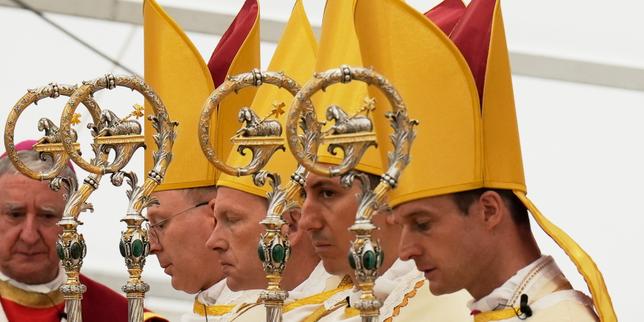
The institutional stability of the Roman Catholic Church rests on a singular structural dependency: the absolute alignment of local sacramental authority with central canonical legitimacy. When a reigning pontiff—in this instance, operating under the mantle of Leon XIV—issues a decree of excommunication against traditionalist bishops, the action is rarely a sudden burst of theological anger. It is a calculated exercise in institutional risk management. The enforcement of the Second Vatican Council (Vatican II) is not a debate over aesthetics or liturgical preferences; it is a structural battle over the location of sovereignty within the global ecclesiastical hierarchy.
Traditionalist factions operate on a model of strategic non-compliance. They leverage the Church’s historical continuity to claim that their defiance of post-conciliar reforms is an act of superior loyalty to historical dogma. By invoking the maximum canonical penalty—excommunication latae sententiae or ferendae sententiae—the Vatican disrupts this strategy. The central authority shifts the conflict from a theological debate to a structural binary: absolute communion or total institutional disenfranchisement.
The Tri-Partite Framework of Ecclesiastical Defiance
To understand why the Holy See deploys its ultimate legal sanction, one must isolate the three distinct vectors where traditionalist bishops challenge the modern magisterium. Traditionalist resistance is never merely a refusal to say the modern mass; it is a systemic rejection of three interconnected pillars of authority.
                  [ Ecclesial Authority ]
                             |
       +---------------------+---------------------+
       |                     |                     |
[ Hermeneutics ]     [ Canonical Order ]    [ Sacramental Legitimacy ]
 (Rupture vs. Continuity) (Unauthorized Ordinations) (Parallel Hierarchies)
1. The Hermeneutical Fracture
The primary intellectual battleground is the interpretation of Vatican II texts. The magisterium demands adherence to a "hermeneutic of reform in continuity," asserting that the council developed doctrine without breaking historical continuity. Traditionalist bishops counter with a "hermeneutic of rupture," arguing that documents like Dignitatis Humanae (on religious liberty) and Nostra Aetate (on interreligious relations) contradict prior papal encyclicals. By treating the Council as a historical aberration, these bishops create an ideological framework that justifies systematic disobedience.
2. The Canonical Breach
The ideological fracture becomes an existential crisis for the institution when it manifests as an unauthorized exercise of holy orders. In canon law, specifically Canon 1382 of the 1983 Code, a bishop who consecrates another bishop without a pontifical mandate incurs an automatic excommunication (latae sententiae). This mechanism is designed to prevent the fragmentation of the global hierarchy. When traditionalist leaders ordain priests or consecrate bishops independently, they are not merely celebrating an older liturgy; they are constructing an unauthorized, parallel governance structure.
3. The Liturgical Divergence
Liturgical forms are the physical manifestation of ecclesial law. The restriction of the pre-conciliar Latin Mass via apostolic letters like Traditionis Custodes was not a matter of taste. It was an explicit recognition that the continuous, exclusive use of the pre-conciliar rite serves as a rallying point for the rejection of the Council itself. When bishops refuse to enforce these restrictions, they compromise the principle of liturgical unity, turning the altar into a site of political and theological secession.
The Canon Law Cost Function: Analyzing the Vatican’s Retaliatory Mechanics
The decision to excommunicate is governed by a strict institutional cost-benefit analysis. The Holy See must balance the risk of creating a formal, permanent schism against the risk of internal erosion caused by unchecked insubordination.
The canonical cost function of non-action can be modeled through the steady devaluation of papal authority. If a regional bishop openly defies a universal directive without facing structural penalties, the systemic value of papal decrees decreases across all unrelated jurisdictions.
Institutional Cost of Non-Action = (Rate of Open Defiance) x (Loss of Central Authority Value)
Excommunication solves this by shifting the cost entirely onto the defiant party. The penalty inflicts immediate operational damage on the rebel faction:
- Loss of Faculty: The individual is stripped of the legal right to govern a diocese, render judgments, or administer sacraments legitimately within the eyes of the global communion.
- Asset Disconnection: While local property laws vary by nation, canonical excommunication provides the legal basis for the Holy See to strip rebellious clerics of their administrative rights over diocesan properties, bank accounts, and cathedrals.
- Theological Isolation: It forces the laity to make a binary choice. The vast majority of adherents are willing to support traditionalist aesthetics, but they draw the line at participating in a formal schism that jeopardizes their own sacramental standing.
This structural isolation breaks the economic and social feedback loops that sustain rebel movements. By drying up the supply of mainstream diocesan funds and marginalizing the movement to the fringes of global Catholicism, the Vatican effectively starves the rebellion of oxygen.
Structural Bottlenecks in the Enforcement Process
Despite the absolute theoretical power of the papacy, the execution of canonical discipline faces significant operational bottlenecks that explain why Rome often waits years before issuing a final decree.
The first bottleneck is the requirement of canonical warnings. Canon law is fundamentally pastoral, meaning it prioritizes the amendment of the offender over the protection of the institution. The Vatican must issue formal, documented warnings (monitions), giving the defiant bishop explicit windows of time to recant. A hasty excommunication can be challenged on procedural grounds, undermining its authority and giving the traditionalist faction a public relations victory.
The second bottleneck is the variation in global legal systems. While canon law governs the internal spiritual reality of the Church, civil law governs the physical assets. In countries with strict property trust laws, the Vatican can easily replace a rebellious bishop and retain the physical cathedral. In jurisdictions where the local bishop holds property as a corporation sole without explicit, legally binding ties to the Holy See, an excommunication can trigger protracted civil litigation over real estate, school systems, and charitable foundations.
The Strategic Path Forward: Enforcing Continuity
The excommunication of traditionalist bishops is not a victory for the Vatican; it is an admission that diplomatic containment has failed. To prevent these legal actions from degenerating into a multi-decade schism that permanently drains institutional energy, the central administration must pivot from a reactive legal posture to a proactive structural strategy.
The papacy must aggressively enforce the principle that the Second Vatican Council is not an optional theological upgrade, but an integral component of the ongoing magisterial tradition. This requires a uniform application of liturgical law across all global dioceses, eliminating the geographic inconsistencies where one bishop permits what a neighboring bishop bans.
Furthermore, the Vatican must reform the selection criteria for future bishops. Candidates must be vetted not merely for orthodox piety, but for their demonstrated capacity to manage institutional polarization without alienating traditionalist-leaning laity. The goal must be to reintegrate the legitimate desire for liturgical solemnity into the mainstream ecclesial framework, thereby neutralizing the recruitment mechanisms of parallel, unauthorized hierarchies. The survival of the post-conciliar institutional model depends entirely on making the rebel positions redundant before they can formalize their separation.