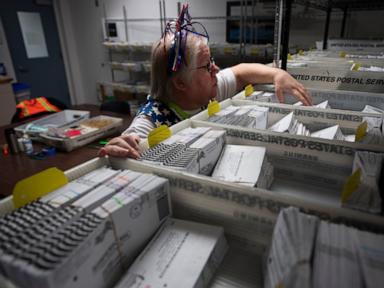
Postal logistics frameworks dictate democratic inclusion far more than statutory voting deadlines. When the United States Postal Service altered operational guidelines regarding mail transport frequency and postmark application rules, the immediate casualty was vote-by-mail integrity in high-density universal mail states like Washington and Oregon.
Examining the mechanics of this failure requires moving past political rhetoric to evaluate the underlying operational friction. A ballot is not merely a legal instrument; it is a time-sensitive parcel subject to strict supply chain constraints. When processing center rules shift, the systemic rejection rate scales predictably.
The Mechanics of Postmark Latency
The core vulnerability stems from a fundamental divergence between postal processing definitions and statutory voting windows. Under updated guidelines finalized by the Postal Service, a postmark does not legally or operationally reflect the moment an agency takes physical possession of an item in a local blue box or rural post office. Instead, the postmark timestamp corresponds strictly to the date the piece is handled inside a designated regional processing center.
This redefinition introduces a variable delay function into the election supply chain. Consider the geographical friction:
- Local collection transport frequencies have dropped from twice daily to once daily in areas exceeding a fifty-mile radius from a distribution hub.
- Rural post offices must batch outgoing mail for extended holding periods before dispatch.
- Regional hubs process high-volume mail streams asynchronously, meaning a ballot deposited on a Monday afternoon may not encounter automated sorting machinery until Wednesday or Thursday.
If a voter deposits an envelope into a postal receptacle within the statutory legal window—such as three days prior to an election—the operational reality of reduced transport frequency ensures that the physical item often misses the local processing threshold. The resultant late postmark triggers automatic legal disqualification during county canvassing.
Geographical Disparities and Network Friction
The systemic failure manifests unevenly across regional topologies. Urban centers experience lower friction due to proximity to primary processing hubs and frequent collection cycles. Conversely, rural jurisdictions suffer exponential increases in disqualification rates because their logistical pathways are longer and less frequent.
Data from recent primary cycles in the Pacific Northwest expose this structural inequality. In select rural counties of Washington, such as Stevens and Mason, the proportion of ballots rejected for late postmarks quadrupled compared to baseline metrics from prior election cycles. In Oregon, rejection rates for ballots arriving during the post-election grace period climbed to thirteen percent, up significantly from historical averages.
This variance shatters the principle of uniform franchise administration. Two voters depositing identical envelopes into separate collection boxes on the exact same afternoon experience entirely different supply chain realities based solely on their geographic distance from a central processing plant.
The Cost Function of Alternative Mitigation
Elections administrators and legislative offices have attempted to offset postal friction by expanding physical infrastructure, primarily through the deployment of secure drop boxes. While drop boxes bypass the postal network entirely—removing postmark dependency and transport delays—they introduce capital allocation and accessibility bottlenecks.
- Capital Expenditure Intensity: Scaling secure drop box networks requires municipal investment in physical security, video monitoring, and daily retrieval logistics.
- Geographic Coverage Limits: Low-density rural districts face prohibitive cost-per-capita metrics when attempting to match the box-per-voter ratios found in metropolitan municipalities.
- Behavioral Inertia: A significant baseline of voters maintains institutional habituation toward using home mailboxes and local post offices, ignoring administrative advisories to alter their deposit methods.
Relying on public relations campaigns that urge citizens to mail ballots a week in advance fails to resolve structural latency. Consumer compliance with vague timeline recommendations is notoriously low, meaning systemic bottlenecks will continue to trap delinquent or last-minute filings.
Strategic Infrastructure Overhaul
Resolving the friction between postal operations and ballot validity requires an explicit decoupling of processing definitions from standard commercial mail handling. Election mail demands dedicated routing protocols, prioritized sorting schedules, and mandatory localized postmarking at the point of initial intake rather than downstream distribution hubs.
Until postal service transport frequency standards are restored for rural zones or election administrators transition entirely away from reliance on postal postmark validity, mail-in voting systems will continue to penalize participants based on geographic logistics rather than civic intent.
Washington sees 32% jump in ballots rejected for late postmarks after USPS rule change
This video provides visual context on the statewide data and legislative responses surrounding the surge in mail ballot rejections.