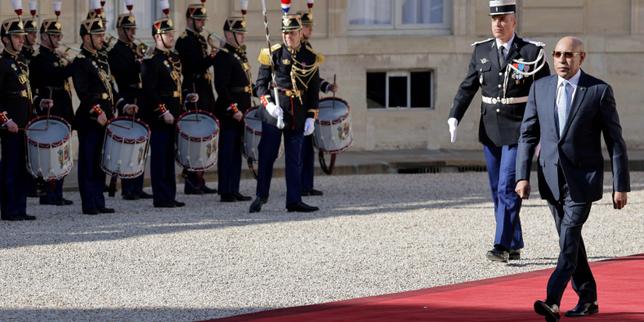
The mainstream press loves a "last man standing" narrative. It is clean, it is dramatic, and in the case of Mauritania, it is completely delusional. As France watches its influence evaporate across Mali, Burkina Faso, and Niger, the Quai d'Orsay has pivoted to Nouakchott with the desperation of a drowning man grabbing a jagged rock. They call President Mohamed Ould Ghazouani the "faithful ally." They talk about "reinforcing military cooperation" as if adding more French boots to Mauritanian sand will somehow reverse a decade of strategic failure.
They are wrong. They are misreading the map, the history, and the man.
The assumption that Mauritania is the final domino in a French-aligned Sahel ignores the reality that Mauritania never truly played the game by Paris's rules. If you think Ghazouani is preparing to be the new regional sheriff for French interests, you haven't been paying attention to how Nouakchott actually survives.
The Myth of the Faithful Proxy
Let’s dismantle the "faithful ally" tag immediately. In the world of Sahelian geopolitics, "faithful" is usually code for "currently dependent on our checks." But Mauritania isn't Mali. It didn't wait for Operation Serval to save its skin in 2013. While the rest of the G5 Sahel was busy collapsing under the weight of jihadist insurgencies, Mauritania remained eerily quiet.
The lazy consensus suggests this was due to superior French-style military training. The reality is far more pragmatic and, for Paris, far more insulting. Mauritania secured its borders through a mix of ruthless domestic intelligence and what many analysts quietly acknowledge as a non-aggression understanding with radical groups. They didn't win the war; they opted out of it.
When Paris talks about "reinforcing cooperation," they think they are exporting stability. In truth, they are trying to buy a seat at a table where they are no longer welcome. Ghazouani isn't looking for a French shield; he is looking for French funding to diversify his options. He is the master of the "multi-vector" foreign policy. One day he is hosting French generals; the next, he is nodding toward Beijing’s infrastructure projects or welcoming Russian diplomats.
To call him a loyal subordinate isn't just patronizing—it’s a tactical error.
The Military Cooperation Trap
The proposed "reinforcement" of military ties usually involves three things: intelligence sharing, tactical training, and base access. On paper, this looks like a win for France. In practice, it’s a liability.
I have watched Western powers pour millions into "capacity building" across West Africa for twenty years. The result? A series of highly trained special forces units that eventually realize they are better at running the country than protecting the president who hired them. By doubling down on military aid to Mauritania, France is repeating the exact script that led to the coups in Bamako and Ouagadougou.
- The Hubris of Training: We assume Western military doctrine is the gold standard. It isn't. Not in the Sahel. French doctrine relies on air superiority and high-tech surveillance. The insurgencies in this region thrive on the exact opposite: invisibility and low-tech persistence.
- The Sovereignty Tax: Every time a French Rafale takes off from a Sahelian runway, the local government loses a bit of its soul in the eyes of its people. Anti-French sentiment isn't a "Russian disinformation" campaign—though Moscow certainly fuels it. It is a grassroots reaction to the perceived permanence of colonial-era oversight.
If Ghazouani lets the French military footprint grow too large, he invites the same domestic instability that toppled his neighbors. He knows this. He is playing a high-stakes game of keeping the French close enough to pay the bills, but far enough away to avoid the "puppet" label. Paris, blinded by its need for a "win," is walking straight into the trap.
The Great Saharan Pivot
People often ask: "If not France, then who?" This is the wrong question. It assumes the Sahel needs a colonial parent. The real shift isn't from Paris to Moscow or Washington; it’s a shift toward regional autonomy or, at the very least, a more cynical brand of shopping for partners.
The UAE, Turkey, and China are all offering something France cannot: investment without the lecture. When France provides military aid, it comes with strings attached to "governance" and "human rights"—even if those strings are often frayed and ignored. When Turkey sells drones or China builds a port, it's a transaction.
Mauritania is currently looking at its coastline. The Grand Tortue Ahmeyim (GTA) gas project is the real future of the country, not a few more French platoons in the desert. Ghazouani's interest in Paris is purely transitional. He needs the security umbrella while the gas money starts to flow. Once the revenue stabilizes, the French "alliance" will be discarded like a used bandage.
Why the French Strategy is DOA
The current French strategy is based on the domino theory, a Cold War relic that should have stayed in the 1960s. The idea is that if Mauritania "falls" to Russian influence or jihadist chaos, the rest of West Africa follows.
This logic is flawed because it treats these nations as passive objects. Mauritania has a distinct history of balancing the Arab world against Sub-Saharan Africa, and the West against the East.
- Religious Legitimacy: Unlike the secular-leaning juntas in Mali, the Mauritanian state derives significant power from its Islamic identity. This gives it a layer of protection against jihadist "purity" narratives that France can't even begin to understand.
- Tribal Complexity: The power structures in Nouakchott are built on intricate tribal alliances. French "expertise" in these social dynamics is superficial at best.
By trying to "reinforce" the relationship, Paris is effectively trying to micromanage a system it doesn't comprehend. It's like trying to fix a Swiss watch with a sledgehammer.
The Hard Truth About Security
The "security" France claims to provide is a localized illusion. You cannot secure a border as porous as the one between Mauritania and Mali through conventional military cooperation.
Imagine a scenario where France increases its drone presence in eastern Mauritania. To the planners in Paris, this is "enhanced surveillance." To the nomadic populations that move across those borders, it is an invasive foreign eye. This friction creates the very radicalization the military is supposed to prevent.
The most effective "security" Mauritania ever had was its internal policy of deradicalization and social integration of former fighters. This was a homegrown solution. The moment it becomes "French-assisted," it loses its legitimacy. France isn't the solution to Sahelian terror; at this point, its very presence is a primary recruitment tool for the enemy.
Stop Looking for Allies, Start Looking for Exits
France's insistence on clinging to Mauritania is an admission of intellectual bankruptcy. It shows an inability to imagine a North Africa policy that isn't centered on military intervention.
If Paris actually wanted to help Mauritania, it would stop talking about "military cooperation" and start talking about debt forgiveness, water technology, and opening European markets to Mauritanian exports. But that’s boring. It doesn't look good on a press release from the Ministry of Defense.
The "faithful ally" narrative is a comfort blanket for a declining power. It allows French politicians to tell their voters that they are still relevant in Africa. It allows them to ignore the fact that the French language is losing ground, French companies are being outbid, and French diplomats are being laughed out of rooms from Bamako to Niamey.
Ghazouani isn't the last ally. He’s the last person willing to take the call while he waits for a better offer.
The military partnership being touted today won't stop the next crisis. It will likely trigger it. By militarizing the relationship, France is making Mauritania a target—both for insurgents and for the inevitable wave of populist nationalism that eventually consumes every "faithful" client state.
Paris needs to stop trying to "save" the Sahel. It hasn't worked. It won't work. The more they tighten their grip on Nouakchott, the more the sand will slip through their fingers. The "faithful ally" is already looking at the exit. Paris is the only one who hasn't realized the party ended years ago.
The era of the French gendarme in Africa is dead. Bury it before the stench becomes unbearable.



