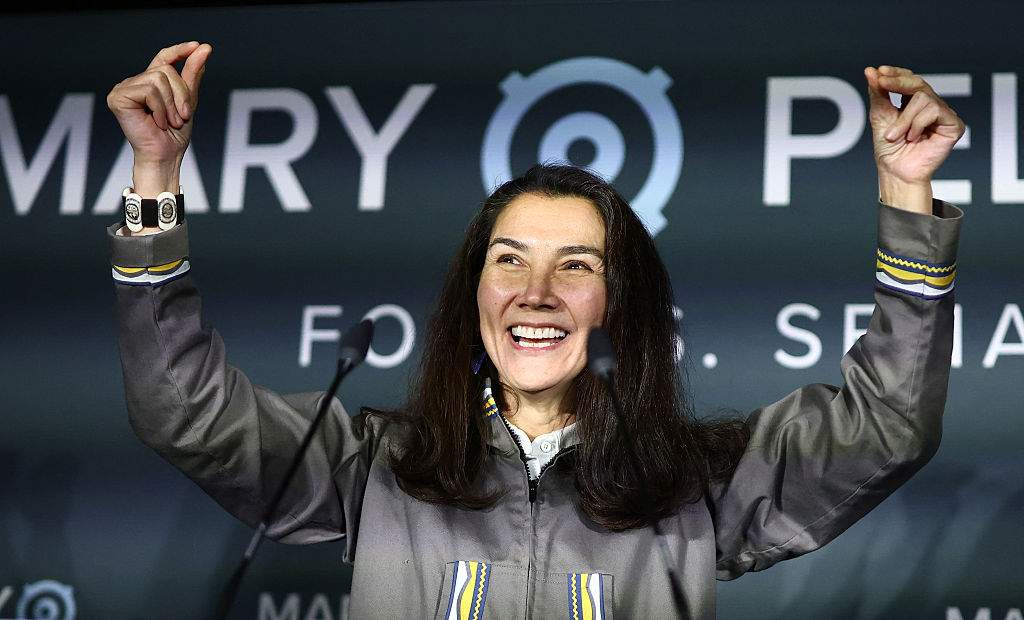
National political pundits are popping champagne over a mirage. They look at the 2026 midterm map, see Alaska shaded blue, and declare that former Representative Mary Peltola just engineered a progressive wave in a deep-red frontier state.
That narrative is lazy, comforting, and completely wrong.
Peltola did not beat two-term Republican incumbent Dan Sullivan because Alaska suddenly fell in love with the national Democratic platform. She won because she ruthlessly dismantled the national Democratic brand in the state, weaponized local cultural grievances against a buttoned-up corporate conservative, and outspent her opponent more than two-to-one while national party leaders were kept at arm's length. Meanwhile, the conservative media ecosystem spent three months hyperventilating over a phantom ballot-spoiler scandal that never even came close to deciding the race.
If you want to understand how a Democrat unseats a sitting Republican senator in a state Donald Trump carried in 2024, stop reading Washington press releases. Look at the math, the cultural fault lines, and the tactical masterclass that actually happened on the ground.
The National Wave Myth
Mainstream coverage loves a clean storyline. In November 2026, Democrats picked up nine U.S. Senate seats—their largest midterm haul since the Eisenhower administration in 1958. Grouping Peltola’s 50.14% to 45.78% victory alongside Democratic pickups in places like South Carolina or Mississippi allows cable news panels to talk about a monolithic national tide.
It is an optical illusion.
Peltola did not ride a national Democratic wave into the Senate. She built a sea wall to keep the national party out. When former Vice President Kamala Harris offered an endorsement, Peltola flatly rejected it. That single move tells you everything you need to know about the real mechanics of this election.
I have watched dozens of well-funded challengers torch tens of millions of dollars trying to run nationalized messaging in rural states. They hire consultants from D.C. or Brooklyn, test-poll progressive buzzwords, and get obliterated by double digits because voters treat them as foreign emissaries. Peltola took the opposite route. She leaned hard into her "Fish, Family, Freedom" ethos, championed resource extraction and commercial fishing rights, and positioned herself closer to Alaska’s senior Republican senator, Lisa Murkowski, than to Senate Majority Leader Chuck Schumer.
Even Murkowski publicly defended Peltola when state Republicans went on the attack. When a sitting Republican senator steps in to shield a Democratic challenger from her own party's fire, you are not witnessing a partisan realignment. You are watching an independent Alaska coalition crush a rigid party loyalist.
The "Two Dan Sullivans" Distraction
While liberal commentators were busy inventing a blue wave, conservative commentators were busy inventing an excuse.
For months leading up to November 3, the dominant right-wing talking point in Alaska was "ballot stacking". A retired educator named Daniel J. Sullivan Jr.—no relation to the incumbent—qualified for the general election ballot under Alaska's top-four primary system. Republicans immediately cried foul, alleging Democratic operatives recruited the second Dan Sullivan specifically to confuse voters and siphon votes away from Senator Dan S. Sullivan.
The outrage escalated all the way to the White House and the Department of Justice. Days before the election, the DOJ filed an unprecedented lawsuit demanding that Alaska segregate ballots cast for the non-incumbent Sullivan and allow federal officials to investigate voter intent. President Trump demanded that votes cast for the retired teacher be transferred directly to the incumbent senator.
Here is the problem with that theory: basic arithmetic destroys it.
Let us look at the actual certified numbers from the Alaska Division of Elections:
- Mary Peltola (D): 144,583 votes (50.14%)
- Dan S. Sullivan (R): 132,022 votes (45.78%)
- Gerald L. Heikes (R): 6,107 votes (2.12%)
- Daniel J. Sullivan Jr. (Nonpartisan): 4,767 votes (1.65%)
Peltola cleared the 50% threshold on the very first round. Alaska’s ranked-choice voting (RCV) instant-runoff mechanism did not even need to be triggered.
Even if you granted every single conspiracy theory on the internet—even if you took every single vote cast for Daniel J. Sullivan Jr. (4,767) and every single vote cast for Republican sheetrocker Gerald Heikes (6,107) and handed 100% of them to the incumbent senator—Dan S. Sullivan would still sit at 142,896 votes. He would still lose to Mary Peltola by nearly 1,700 votes.
Worse for the GOP narrative, ballot-level data analyzed by election researchers at FairVote revealed that Daniel J. Sullivan Jr. was not even pulling primarily from confused Republicans. Among voters who ranked the retired teacher first, 34% ranked Peltola as their backup choice, compared to only 23% who ranked Senator Sullivan ahead of her. Forty-three percent ranked neither major candidate at all.
The DOJ eventually dropped its lawsuit as moot, and Sullivan quietly conceded on November 24. The "Two Dans" saga made for sensational cable news fodder, yet it functioned as a massive strategic blind spot for Republicans. While GOP leaders spent October litigating ballot confusion, Peltola was systematically locking down undecided independents across the Mat-Su Valley, Anchorage, and Southeast Alaska.
Why Voters Actually Rejected Dan Sullivan
If ballot confusion did not sink Dan Sullivan, what did?
Complacency, out-of-state fundraising lethargy, and a profound misreading of Alaska's political temperament.
By September 30, 2026, Peltola had raised $32.6 million and spent $29.4 million. Dan Sullivan raised just $13.7 million and had spent only $9.3 million by the end of the third quarter—sitting on more than $5 million in unspent cash while his opponent blanketed every television screen, radio station, and digital feed from Ketchikan to Utqiaġvik.
In modern Senate campaigns, hoarding cash into October while your opponent defines you unchecked is political malpractice.
Beyond the financial blowout, Sullivan suffered from an authenticity deficit that no amount of last-minute visits from Donald Trump or Vice President JD Vance could patch over. Sullivan has always projected the polished, cautious aura of a former Bush administration official and corporate lawyer—because that is exactly what he is. In a normal partisan year, that resume is fine. Against Mary Peltola, it was fatal.
Peltola is Yup'ik, grew up commercial fishing on the Kuskokwim River, and speaks the unvarnished language of rural survival and subsistence living. When Sealaska Corporation—the powerful Southeast Alaska Native regional corporation that had previously endorsed Sullivan—flipped its endorsement to Peltola, it signaled a deeper institutional shift. Sullivan was no longer viewed as the indispensable guarantor of Alaska's resource economy; he looked like an entrenched Washington insider coasting on incumbency.
Dismantling the Common Misconceptions
If you are trying to make sense of what happened in Alaska, you are probably asking the wrong questions. Here is the brutal reality behind the headlines.
Did ranked-choice voting hand the election to Democrats?
No. RCV had zero direct mathematical impact on the general election tally because Peltola won an outright majority of 50.14% in the first round. Where the system did matter was in the August top-four open primary. By eliminating closed partisan primaries, Alaska’s system rewards candidates who appeal to the broad middle rather than ideological extremes. Sullivan had to survive a primary environment where he couldn't tack hard right without alienating general-election moderates, while Peltola cruised through the primary with 49.5% of the vote without having to appease progressive activist groups.
Does this mean Alaska is now a swing state for presidential elections?
Stop dreaming. Alaska remains culturally conservative, fiercely protective of its Second Amendment rights, and deeply skeptical of federal environmental regulations. A generic national Democrat running on coastal social issues or aggressive green-energy mandates would still lose Alaska by 15 points. Peltola won because she treated the Democratic label as a technicality rather than an identity.
Was the "ballot stacking" tactic ethical?
No, and pretending otherwise damages credibility. Even though the Alaska Supreme Court rightly ruled that election officials lacked legal authority to kick Daniel J. Sullivan Jr. off the ballot under an invented "good-faith" standard, the New York Times reporting indicating Democratic operatives encouraged his candidacy exposes a cynical streak in modern campaign warfare. Both parties play these games—Republicans have funded ghost candidates in Florida and elsewhere—but voters hate it. Peltola won in spite of the ballot drama, not because of it.
The Downside of the Peltola Playbook
Before Democratic strategists across the country try to copy-paste Peltola’s blueprint into Montana, Ohio, or Texas, they need to confront an uncomfortable truth: this strategy creates massive governing friction once the candidate actually arrives in Washington.
To win in Alaska, Peltola had to run aggressively against her own party's environmental and energy orthodoxy. Now she has to walk onto the Senate floor as part of a 56-44 Democratic majority.
Every major vote on climate legislation, public land management, or Arctic drilling will now put her in a vise. If she votes with national Democrats to pass sweeping green subsidies or restrict oil leasing in the National Petroleum Reserve, she hands Alaska Republicans ammunition for 2032. If she breaks with her caucus to champion oil, gas, and mining projects, she risks alienating the national small-dollar donor network that just pumped $32 million into her campaign war chest.
Consider a realistic scenario where the Democratic majority pushes a signature environmental bill that needs 51 votes to clear budget reconciliation. Peltola becomes the instant focal point of national pressure—the new Joe Manchin of the North. That leverage makes her powerful in D.C., yet politically radioactive back home every time she compromises.
What Political Operatives Must Actually Learn
The Alaska Senate race is not a story about progressive triumph or conservative victimhood. It is a case study in ruthless localization.
If you are running campaigns or analyzing electoral shifts, burn the national playbook and execute three rules:
- Burn the national endorsements when they hurt. Voters in independent-minded states respect candidates who tell their own party leaders to stay away. Peltola rejecting Kamala Harris's endorsement cost her nothing with base Democrats—who had nowhere else to go—and bought her instant credibility with skeptical independents.
- Spend your money when it shapes the narrative, not in the final week. Dan Sullivan sitting on $5.1 million at the end of September while getting outspent three-to-one on the airwaves is a textbook example of how incumbents sleepwalk into defeat. Early, overwhelming financial dominance locks in voter perceptions before opposition attacks can stick.
- Stop chasing phantom spoilers. Blaming a 1.65% third-party candidate for a 4.36-point loss is pure self-delusion. When you lose by more than 12,500 votes in a state of fewer than 300,000 ballots cast, your problem is not the ballot layout—your problem is that voters wanted you gone.
Mary Peltola will be sworn into the United States Senate in January alongside Lisa Murkowski, giving Alaska an all-female Senate delegation and handing Democrats a critical seat. Washington pundits will keep calling it a blue wave because nuance does not fit on a cable news chyron.
Let them keep believing it. The next time national Democrats try to run an unvarnished progressive in a frontier state using this race as proof of concept, reality will hit them like an Arctic gale.