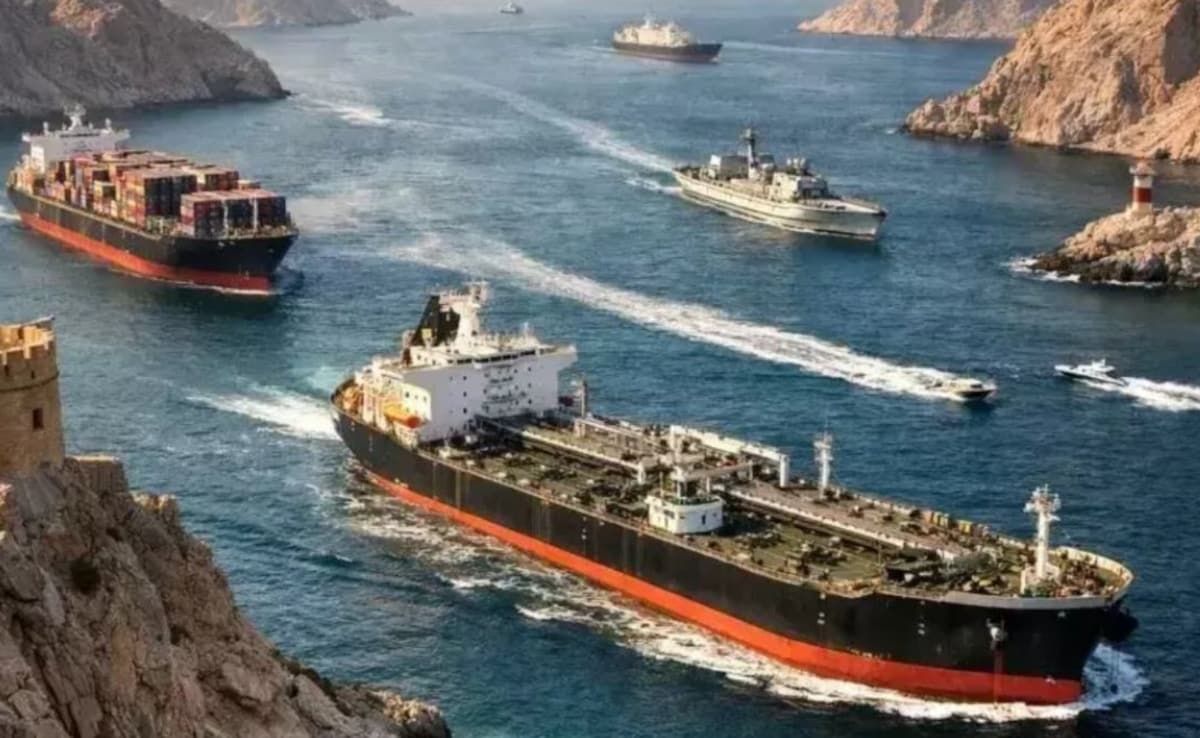
The interdiction of two oil tankers attempting to depart Iranian waters by a US Navy destroyer represents a tactical manifestation of a broader strategic friction: the enforcement of unilateral economic sanctions through kinetic maritime presence. While news reports focus on the immediate physical confrontation, the structural significance lies in the interaction between international maritime law, the physics of naval positioning, and the economic incentives of "dark fleet" operations. This event serves as a case study in the logistical and legal constraints that govern the global energy supply chain.
The Strategic Geometry of the Strait of Hormuz
The Strait of Hormuz functions as a global economic chokepoint, with approximately 21% of global petroleum liquids consumption passing through its 21-mile width daily. The tactical environment is defined by the Traffic Separation Scheme (TSS), which dictates specific inbound and outbound lanes. When a US destroyer interdicts a vessel, it is not merely a display of force; it is a calculated disruption of a maritime corridor governed by the United Nations Convention on the Law of the Sea (UNCLOS).
Naval operations in this corridor must navigate three distinct legal and operational zones:
- Territorial Waters: Extending 12 nautical miles from the baseline, where the coastal state (Iran or Oman) exercises sovereignty.
- Contiguous Zones: Areas where a state can exert limited control to prevent infringement of its customs, fiscal, or immigration laws.
- International Waters (High Seas): Where freedom of navigation is the baseline, and interdiction requires specific legal justification, such as the "right of visit" under Article 110 of UNCLOS or specific executive orders targeting sanctioned entities.
The Mechanics of Sanctions Enforcement at Sea
Interdiction is the final stage of a multi-layered intelligence and operational funnel. The process begins with Maritime Domain Awareness (MDA), utilizing a combination of Synthetic Aperture Radar (SAR) satellites, Radio Frequency (RF) signal tracking, and the Automatic Identification System (AIS).
The "dark fleet" typically employs three primary tactics to evade detection, which the US Navy must systematically neutralize:
- AIS Spoofing: Vessels transmit false coordinates to appear in a different location or manipulate their identity to mimic non-sanctioned ships.
- Ship-to-Ship (STS) Transfers: The transfer of crude oil between tankers in international waters to obfuscate the original source of the cargo.
- Flag Hopping: Frequent changes in a vessel’s registry (flag state) to take advantage of varying levels of oversight and regulatory rigor.
The interdiction by a destroyer implies that the "shadow" phase of tracking has transitioned into a "kinetic" phase. This occurs when the cost of allowing the cargo to reach its destination—likely a refinery willing to process sanctioned crude at a steep discount—outweighs the diplomatic and operational risk of a physical confrontation.
The Naval Force Multiplier: Arleigh Burke-class Capabilities
The deployment of a guided-missile destroyer for such a mission highlights the disproportionate force required to police commercial traffic. An Arleigh Burke-class destroyer provides a specific suite of capabilities that a standard coast guard cutter lacks, creating a deterrent effect through integrated sensors and overwhelming local superiority.
The vessel’s AN/SPY-1D Radar and Aegis Combat System allow it to track hundreds of surface and air targets simultaneously. This is critical in the Persian Gulf, where "swarm" tactics from fast attack craft are a standard counter-response. The destroyer acts as a mobile command-and-control hub, processing data from unmanned aerial vehicles (UAVs) to confirm vessel identities before the Visit, Board, Search, and Seizure (VBSS) teams are deployed.
Economic Impact and Risk Premiums
Every interdiction event injects immediate volatility into the maritime insurance market. The Joint War Committee (JWC) of the Lloyd’s Market Association frequently updates the list of areas where additional insurance premiums are required. An interdiction in the Strait of Hormuz triggers several financial cascading effects:
- War Risk Surcharges: Shipowners must pay higher premiums to transit the area, which are eventually passed down to the consumer in the form of higher landed costs of crude.
- Demurrage Costs: Delays caused by inspections or standoffs result in significant hourly charges for the vessel’s charterer, often exceeding $50,000 per day for a Suezmax tanker.
- Oil Price Volatility: While the removal of two tankers from the global supply is negligible in terms of volume, the "geopolitical risk premium" adds an invisible dollar value to every barrel of Brent crude traded globally.
The Legal Framework of Boarding Operations
The US Navy does not have the unilateral right to seize any vessel on the high seas. The legality of the interdiction rests on the Sanctions Regulatory Framework. Under US Executive Orders, the Treasury’s Office of Foreign Assets Control (OFAC) designates specific vessels as "Blocked Property." This designation provides the legal pretext for the military to act as an enforcement arm.
The confrontation typically follows a rigid escalation ladder:
- Querying: Contacting the vessel via VHF Channel 16 to determine its destination and cargo.
- Non-Consensual Boarding: If the vessel refuses to stop, the destroyer may use "disabling fire" (targeting engines, not personnel) or deploy helicopters to fast-rope VBSS teams onto the deck.
- Seizure and Diversion: If the cargo is confirmed to be in violation of sanctions, the vessel is diverted to a friendly port for legal adjudication.
The limitation of this strategy is the State of Registry problem. If a vessel is flagged in a country that does not recognize US sanctions, the interdiction can be framed as an act of piracy under international law, creating a diplomatic friction point between the US and the flag state.
Structural Bottlenecks in Enforcement
Despite the technical superiority of the US Navy, two primary bottlenecks prevent the total cessation of sanctioned oil exports.
The first is the Volume of Traffic. With thousands of vessels transiting the Strait monthly, it is mathematically impossible to inspect more than a fraction of the traffic without effectively blockading the waterway—a move that would be considered an act of war.
The second is the Refinery Paradox. Sanctioned oil is often sold at a "complexity discount." Smaller, independent refineries (often called "teapots") are configured to process specific grades of heavy sour crude. Their economic model depends on the availability of this cheaper, sanctioned feedstock. As long as there is a buyer willing to absorb the legal risk for a $20-per-barrel discount, the incentive for the "dark fleet" to operate will persist, regardless of the number of destroyers on station.
Strategic Projection of Maritime Power
The use of a destroyer to stop two tankers is an exercise in Signal Intelligence and Power Projection. It informs the "dark fleet" operators that their AIS spoofing and spoofing techniques are no longer sufficient to provide anonymity. However, the operational reality remains that for every vessel interdicted, several more likely pass through undetected or unmolested due to the high resource cost of a physical boarding.
Naval strategy must now pivot toward Unmanned Surface Vessels (USVs) and AI-driven behavioral analysis. By automating the tracking of "suspicious" maneuvering patterns—such as a tanker sitting low in the water without an active AIS signal—the Navy can expand its surveillance net without the massive overhead of a multi-billion dollar destroyer for every encounter.
The enforcement of maritime sanctions is transitioning from a game of physical hide-and-seek to a data-warfare competition. The destroyer is no longer just a platform for missiles; it is a physical node in a global digital net designed to make the cost of evading sanctions higher than the profit gained from the sale.
Shipowners and commodity traders must anticipate a tightening of the "compliance net." The integration of satellite imagery with blockchain-based bills of lading will soon make physical interdiction the exception rather than the rule. Future enforcement will likely focus on the financial infrastructure—denying insurance and port access—leaving the kinetic interdiction of tankers as a last-resort tool for high-profile signaling.


